• HOME
  • NEWS
  • EXPLORE
    • CAREER
      • Companies
      • Jobs
    • EVENTS
    • iGEM
      • News
      • Team
    • PHOTOS
    • VIDEO
    • WIKI
  • BLOG
  • COMMUNITY
    • FACEBOOK
    • INSTAGRAM
    • TWITTER
Sunday, July 5, 2026
BIOENGINEER.ORG
No Result
View All Result
  • Login
  • HOME
  • NEWS
  • EXPLORE
    • CAREER
      • Companies
      • Jobs
        • Lecturer
        • PhD Studentship
        • Postdoc
        • Research Assistant
    • EVENTS
    • iGEM
      • News
      • Team
    • PHOTOS
    • VIDEO
    • WIKI
  • BLOG
  • COMMUNITY
    • FACEBOOK
    • INSTAGRAM
    • TWITTER
  • HOME
  • NEWS
  • EXPLORE
    • CAREER
      • Companies
      • Jobs
        • Lecturer
        • PhD Studentship
        • Postdoc
        • Research Assistant
    • EVENTS
    • iGEM
      • News
      • Team
    • PHOTOS
    • VIDEO
    • WIKI
  • BLOG
  • COMMUNITY
    • FACEBOOK
    • INSTAGRAM
    • TWITTER
No Result
View All Result
Bioengineer.org
No Result
View All Result
Home NEWS Science News Chemistry

Rational transparent conductor design provides a boost to carbon nanotubes application

Bioengineer by Bioengineer
November 13, 2019
in Chemistry
Reading Time: 2 mins read
0
IMAGE
Share on FacebookShare on TwitterShare on LinkedinShare on RedditShare on Telegram

IMAGE

Credit: Skoltech


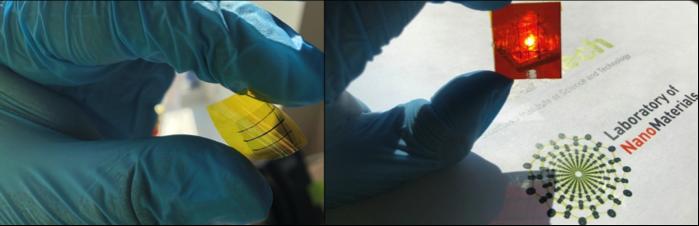
An international team of scientists led by researchers from the Laboratory of Nanomaterials at the Skoltech Center for Photonics and Quantum Materials (CPQM) have rationally designed a novel p-type flexible transparent conductor using single-walled carbon nanotubes. This opens new avenues for its applications in next generation opto-electronics and energy technologies. The results of the study were published in the prestigious international journal Nano Energy.

Most of the optical and electronic devices encountered daily are constituted of transparent conductors. However, all the presently available transparent conductors are n-type semiconductors, thus restricting technological advancement. The emergence of carbon nanotubes as p-type transparent conductors has been promising. Its further development will be tremendously instrumental for various opto-electronics and energy technologies.

Scientists at the Skolkovo Institute of Science and Technology (Skoltech) chose to address this by developing a novel rational design of unifying a multilayered combination of films with carbon nanotubes, conductive polymers, transition metal oxides and carbon nanotube fibers.

The Skoltech team together with its partners from Aalto University (Finland), DLR Institute of Networked Energy Systems (Germany) and Tallinn University of Technology (Estonia) utilized this newly developed p-type transparent conductor in solar cells. “We discovered the use of thin multicomponent layers and the introduction of carbon nanotube fibers in a dramatic improvement in the p-type transparent conductor development. Moreover, carbon nanotube fibers by themselves can be used as a replacement for traditional metal contacts. However, the most fascinating result was the solar cells fabricated at room temperature using the developed p-type transparent conductor and amorphous silicon, which are classified specially as hybrid devices and yield a record power conversion efficiency (conversion efficiency of sunlight to electricity) of 8.8%. This is an effective 16% increase over the traditional amorphous silicon solar cells, thus highlighting the efficacy of the developed p-type transparent conductor. We have progressed from the initial 1.6% and 3.4% reported previously in 2016 and 2018 respectively to 8.8% in 2019 using our newly developed p-type transparent conductor for such hybrid thin film solar cells,” says the first author of the study and PhD Student at Skoltech, Pramod M. Rajanna.

“We have developed a p-type transparent conductor with a state-of-the-art sheet resistance of 17 Ω/sq at a transmittance of 90% in the middle of the visible spectrum and a high degree of mechanical flexibility. The newly developed conductor is certainly revolutionary for various single-walled carbon nanotube applications. We anticipate that this will open new avenues for its application in widespread technologies such as optoelectronics, photonics and energy,” explains Albert Nasibulin, Professor of RAS and Head of Skoltech’s Laboratory of Nanomaterials.

###

Media Contact
Alina Chernova
[email protected]
890-556-53633

Original Source

https://www.skoltech.ru/en/2019/11/rational-transparent-conductor-design-provides-a-boost-to-carbon-nanotubes-application/

Related Journal Article

http://dx.doi.org/10.1016/j.nanoen.2019.104183

Tags: Chemistry/Physics/Materials SciencesNanotechnology/Micromachines
Share12Tweet8Share2ShareShareShare2

Related Posts

Intelligent Microgrid Management Promises Lower Household Energy Bills and Reduced Diesel Emissions — Chemistry

Intelligent Microgrid Management Promises Lower Household Energy Bills and Reduced Diesel Emissions

July 4, 2026
Graz University of Technology Deciphers the Structural Secrets of MOF Thin Films — Chemistry

Graz University of Technology Deciphers the Structural Secrets of MOF Thin Films

July 2, 2026

Breaking Thermodynamic Limits: Wavelength-Driven Catalysis Advances Ammonia Synthesis

July 2, 2026

From Quantum Mechanics to AI-Powered Materials Discovery: MARVEL Marks 12 Years of Transforming Computational Science

July 2, 2026
Please login to join discussion

POPULAR NEWS

  • Detection of EDCs in Breast Milk and Infant Urine Up to Six Months Highlights Early Exposure Risks

    77 shares
    Share 31 Tweet 19
  • Saying Goodbye to PGY-6: Pediatric Fellowship Realities

    103 shares
    Share 41 Tweet 26
  • New Drug Candidate Developed at McMaster Shows Potential for Treating Brain Cancer

    58 shares
    Share 23 Tweet 15
  • KTU Researchers Explore Ultrasound’s Role in Enhancing Blood Flow Beyond Diagnostics

    53 shares
    Share 21 Tweet 13

About

We bring you the latest biotechnology news from best research centers and universities around the world. Check our website.

Follow us

Recent News

Quasi-Bound States Boost Quantum Well Photoresponse

Lysine Pyruvylation Links Glycolysis to Epigenetics

Multiphysics Coupling: Single vs. Multiple DeepONet Branches

Subscribe to Blog via Email

Success! An email was just sent to confirm your subscription. Please find the email now and click 'Confirm' to start subscribing.

Join 83 other subscribers
  • Contact Us

Bioengineer.org © Copyright 2023 All Rights Reserved.

Welcome Back!

Login to your account below

Forgotten Password?

Retrieve your password

Please enter your username or email address to reset your password.

Log In
No Result
View All Result
  • Homepages
    • Home Page 1
    • Home Page 2
  • News
  • National
  • Business
  • Health
  • Lifestyle
  • Science

Bioengineer.org © Copyright 2023 All Rights Reserved.