• HOME
  • NEWS
  • EXPLORE
    • CAREER
      • Companies
      • Jobs
    • EVENTS
    • iGEM
      • News
      • Team
    • PHOTOS
    • VIDEO
    • WIKI
  • BLOG
  • COMMUNITY
    • FACEBOOK
    • INSTAGRAM
    • TWITTER
Wednesday, December 31, 2025
BIOENGINEER.ORG
No Result
View All Result
  • Login
  • HOME
  • NEWS
  • EXPLORE
    • CAREER
      • Companies
      • Jobs
        • Lecturer
        • PhD Studentship
        • Postdoc
        • Research Assistant
    • EVENTS
    • iGEM
      • News
      • Team
    • PHOTOS
    • VIDEO
    • WIKI
  • BLOG
  • COMMUNITY
    • FACEBOOK
    • INSTAGRAM
    • TWITTER
  • HOME
  • NEWS
  • EXPLORE
    • CAREER
      • Companies
      • Jobs
        • Lecturer
        • PhD Studentship
        • Postdoc
        • Research Assistant
    • EVENTS
    • iGEM
      • News
      • Team
    • PHOTOS
    • VIDEO
    • WIKI
  • BLOG
  • COMMUNITY
    • FACEBOOK
    • INSTAGRAM
    • TWITTER
No Result
View All Result
Bioengineer.org
No Result
View All Result
Home NEWS Science News Biology

Researchers highlight progress and challenges of phloem research

Bioengineer by Bioengineer
November 12, 2019
in Biology
Reading Time: 2 mins read
0
IMAGE
Share on FacebookShare on TwitterShare on LinkedinShare on RedditShare on Telegram

IMAGE

Credit: JIANG Yanjuan


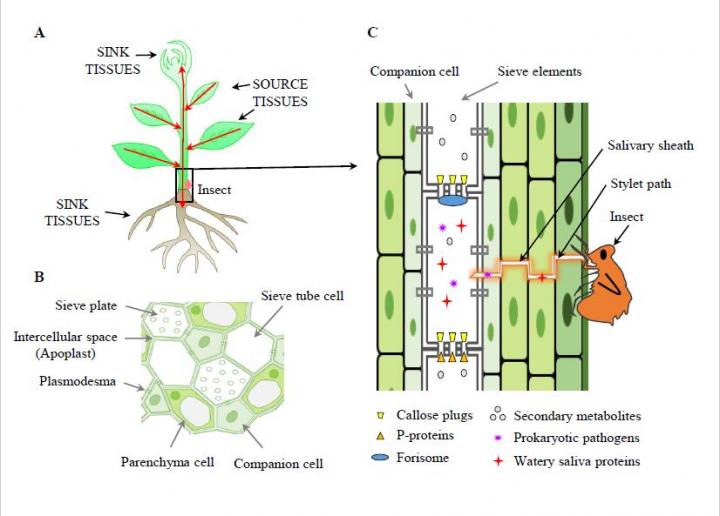
Numerous insects and pathogens extract nutrients from phloem tissue buried deep inside plants. These phloem-feeding insects and pathogens cause tremendous economic losses worldwide and represent some of the most difficult pests to understand due to their specialized feeding strategies. The resulting infestations and diseases are also among the most costly and difficult to manage. However, for historic and technical reasons, our knowledge of phloem-insect/pathogen interactions has been fragmentary.

Now, a new study by researchers from the Xishuangbanna Tropical Botanical Garden (XTBG) and their collaborators brings this knowledge together. In a survey of the relevant scientific literature, the scientists highlight significant advances in the understanding of phloem interactions with insects and prokaryotic pathogens as well as make recommendations for future research. The report was published in the latest issue of PNAS on November 12.

The researchers point out that several studies have focused on identifying the secretomes of phloem-limited insects and pathogens over the past decade. Progress has been made in understanding how some effector proteins of phloem-associated insects facilitate the feeding behavior and performance of insects in plants. However, research to understand how they influence plant and insect physiology is still at an early stage.

The researchers propose that interactions with phloem-feeding insects and pathogens should be considered when studying phloem, since it contains a fascinating collection of unique and interactive cell types.

Unlike phloem-feeding insects, prokaryotes cannot actively enter the phloem; therefore, all known phloem-associated prokaryotes are passively delivered into the phloem by phloem-feeding insects.

Innovative culturing approaches are also required for future research, in order to remove one of the most formidable barriers to the study of phloem-pathogen interactions.

“Most importantly, identifying host genes that underlie plant interactions with phloem-feeding insects and pathogens would be an attractive target for improving host resistance via introgression of naturally occurring variants or genome editing,” said Dr. JIANG Yanjuan, first author of the study.

###

According to the researchers, phloem-insect/pathogen interactions represent an exciting frontier in plant science. “We consider that an influx of new scientific expertise and funding is crucial to achieving faster progress in this important area of research, which is integral to global food security,” said Dr. JIANG.

Media Contact
JIANG Yanjuan
[email protected]

Original Source

http://english.cas.cn/newsroom/research_news/life/201911/t20191112_223097.shtml

Related Journal Article

http://dx.doi.org/10.1073/pnas.1915396116

Tags: BiodiversityBiologyForestryPlant Sciences
Share12Tweet8Share2ShareShareShare2

Related Posts

Rethinking Gender Inference from Health Record Algorithms

Rethinking Gender Inference from Health Record Algorithms

December 31, 2025
blank

Mapping RNA Editome Development in Ningxiang Pig Fat

December 31, 2025

Revealing Chloroplast Genomes: Insights on Plant Evolution

December 31, 2025

Genomic Insights into Staphylococcus epidermidis Se252 from Plants

December 31, 2025
Please login to join discussion

POPULAR NEWS

  • blank

    PTSD, Depression, Anxiety in Childhood Cancer Survivors, Parents

    105 shares
    Share 42 Tweet 26
  • NSF funds machine-learning research at UNO and UNL to study energy requirements of walking in older adults

    71 shares
    Share 28 Tweet 18
  • Exploring Audiology Accessibility in Johannesburg, South Africa

    52 shares
    Share 21 Tweet 13
  • Nurses’ Views on Online Learning: Effects on Performance

    71 shares
    Share 28 Tweet 18

About

We bring you the latest biotechnology news from best research centers and universities around the world. Check our website.

Follow us

Recent News

4R-Tau Seeding Uncovers Progressive Supranuclear Palsy Subtypes

Fluid Dynamics Reveal Hemifacial Spasm Vessel Insights

Methionine Restriction Reverses Kidney Fibrosis Epigenetically

Subscribe to Blog via Email

Enter your email address to subscribe to this blog and receive notifications of new posts by email.

Join 71 other subscribers
  • Contact Us

Bioengineer.org © Copyright 2023 All Rights Reserved.

Welcome Back!

Login to your account below

Forgotten Password?

Retrieve your password

Please enter your username or email address to reset your password.

Log In
No Result
View All Result
  • Homepages
    • Home Page 1
    • Home Page 2
  • News
  • National
  • Business
  • Health
  • Lifestyle
  • Science

Bioengineer.org © Copyright 2023 All Rights Reserved.