• HOME
  • NEWS
  • EXPLORE
    • CAREER
      • Companies
      • Jobs
    • EVENTS
    • iGEM
      • News
      • Team
    • PHOTOS
    • VIDEO
    • WIKI
  • BLOG
  • COMMUNITY
    • FACEBOOK
    • INSTAGRAM
    • TWITTER
Saturday, February 7, 2026
BIOENGINEER.ORG
No Result
View All Result
  • Login
  • HOME
  • NEWS
  • EXPLORE
    • CAREER
      • Companies
      • Jobs
        • Lecturer
        • PhD Studentship
        • Postdoc
        • Research Assistant
    • EVENTS
    • iGEM
      • News
      • Team
    • PHOTOS
    • VIDEO
    • WIKI
  • BLOG
  • COMMUNITY
    • FACEBOOK
    • INSTAGRAM
    • TWITTER
  • HOME
  • NEWS
  • EXPLORE
    • CAREER
      • Companies
      • Jobs
        • Lecturer
        • PhD Studentship
        • Postdoc
        • Research Assistant
    • EVENTS
    • iGEM
      • News
      • Team
    • PHOTOS
    • VIDEO
    • WIKI
  • BLOG
  • COMMUNITY
    • FACEBOOK
    • INSTAGRAM
    • TWITTER
No Result
View All Result
Bioengineer.org
No Result
View All Result
Home NEWS Science News Biology

New sphenisciform fossil further resolves bauplan of extinct giant penguins

Bioengineer by Bioengineer
November 8, 2019
in Biology
Reading Time: 2 mins read
0
IMAGE
Share on FacebookShare on TwitterShare on LinkedinShare on RedditShare on Telegram

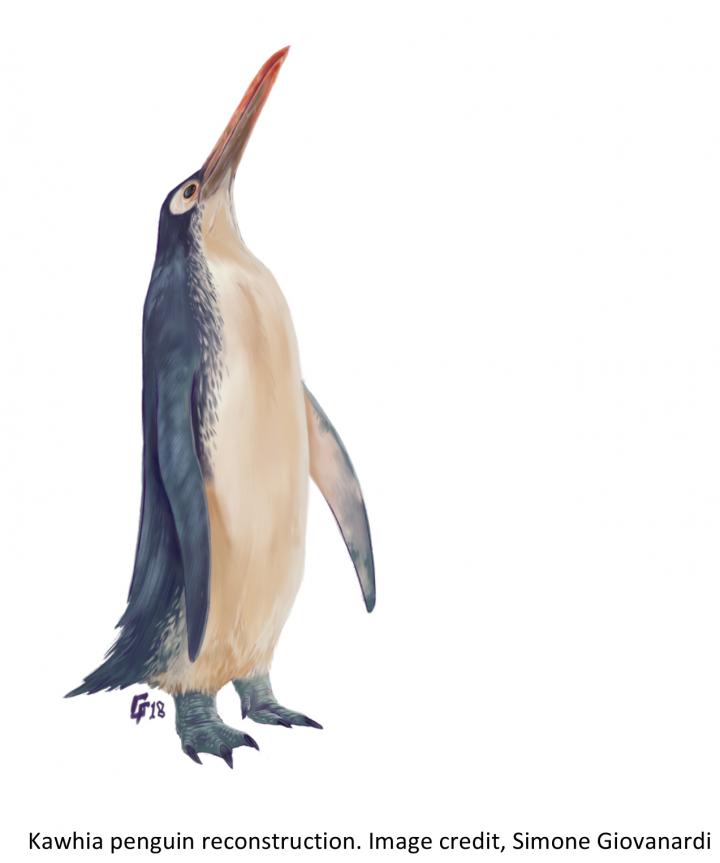
A new sphenisciform fossil from the north island of New Zealand further resolves the bauplan of extinct giant penguins
IMAGE

Credit: Simone Giovanardi


Penguins are descendants of seabirds that lost the ability to fly more than 60 million years ago in exchange for chasing the abundant food available in the ocean. New Zealand is a key area for understanding the diversity of the extinct penguins and has even revealed the existence of ‘giant’ penguin species (larger than living penguins). A new study describing a remarkably complete giant penguin skeleton from the Oligocene, Kawhia Harbour in the North Island of New Zealand was presented by Simone Giovanardi, Massey University Albany, Auckland, New Zealand, at this year’s annual meeting of the Society of Vertebrate Paleontology held this year in Brisbane, Australia.

These giant penguins differed from their living descendants in the length of their front limbs and elongated beaks, perhaps suggesting differences in ecological roles when compared with living penguins. The preserved hindlimbs of the new North Island fossil are also significantly longer than all previously described specimens.

Giovanardi adds, “The Kawhia giant penguin is mostly complete and largely articulated in life position, which helps a great deal with reconstructing the relatively long and slender body.” This specimen suggests a mixture of characteristics of an older body plan found in other Eocene-Oligocene giant penguins and the one found in the more derived giant penguin, Kairuku.

To date, most of the giant penguins found in New Zealand have been discovered in the South Island. This fossil was found in an Oligocene silty mudstone from the North Island of New Zealand and currently represents the most complete pre-Pleistocene vertebrate reported from this region. Giovanardi concludes by stating, “The North Island of New Zealand has its own paleontological tale to tell.”

###

About the Society of Vertebrate Paleontology

Founded in 1940 by thirty-four paleontologists, the Society now has more than 2,300 members representing professionals, students, artists, preparators, and others interested in VP. It is organized exclusively for educational and scientific purposes, with the object of advancing the science of vertebrate paleontology.
Journal Web site: Society of Vertebrate Paleontology: http://www.vertpaleo.org

Media Contact
Serena Weisman
[email protected]
301-634-7036

Tags: Biology
Share12Tweet8Share2ShareShareShare2

Related Posts

Florida Cane Toad: Complex Spread and Selective Evolution

Florida Cane Toad: Complex Spread and Selective Evolution

February 7, 2026
New Study Uncovers Mechanism Behind Burn Pit Particulate Matter–Induced Lung Inflammation

New Study Uncovers Mechanism Behind Burn Pit Particulate Matter–Induced Lung Inflammation

February 6, 2026

DeepBlastoid: Advancing Automated and Efficient Evaluation of Human Blastoids with Deep Learning

February 6, 2026

Navigating the Gut: The Role of Formic Acid in the Microbiome

February 6, 2026
Please login to join discussion

POPULAR NEWS

  • Robotic Ureteral Reconstruction: A Novel Approach

    Robotic Ureteral Reconstruction: A Novel Approach

    82 shares
    Share 33 Tweet 21
  • Digital Privacy: Health Data Control in Incarceration

    63 shares
    Share 25 Tweet 16
  • Study Reveals Lipid Accumulation in ME/CFS Cells

    57 shares
    Share 23 Tweet 14
  • Breakthrough in RNA Research Accelerates Medical Innovations Timeline

    53 shares
    Share 21 Tweet 13

About

We bring you the latest biotechnology news from best research centers and universities around the world. Check our website.

Follow us

Recent News

Evaluating Pediatric Emergency Care Quality in Ethiopia

TPMT Expression Predictions Linked to Azathioprine Side Effects

Improving Dementia Care with Enhanced Activity Kits

Subscribe to Blog via Email

Success! An email was just sent to confirm your subscription. Please find the email now and click 'Confirm' to start subscribing.

Join 73 other subscribers
  • Contact Us

Bioengineer.org © Copyright 2023 All Rights Reserved.

Welcome Back!

Login to your account below

Forgotten Password?

Retrieve your password

Please enter your username or email address to reset your password.

Log In
No Result
View All Result
  • Homepages
    • Home Page 1
    • Home Page 2
  • News
  • National
  • Business
  • Health
  • Lifestyle
  • Science

Bioengineer.org © Copyright 2023 All Rights Reserved.