Synthetic DMAbs allow for in vivo production of broadly neutralizing antibodies in preclinical studies
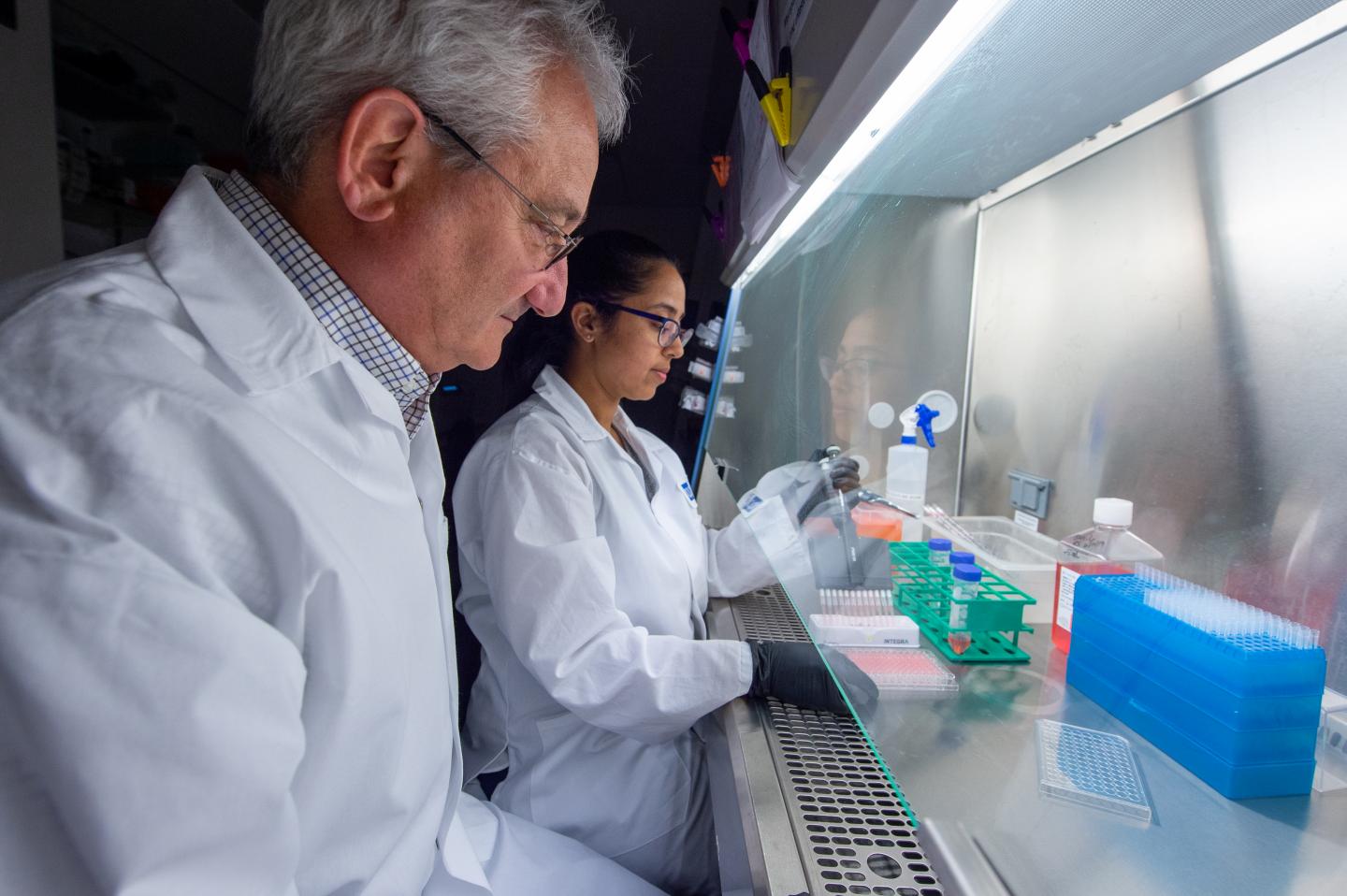
Credit: The Wistar Institute
PHILADELPHIA — (Nov. 8, 2019) — Scientists at The Wistar Institute applied synthetic DNA-based technology to drive in vivo production of broadly neutralizing anti-HIV antibodies in small and large-animal models, providing proof of concept for a simple and effective next generation approach to HIV prevention and therapy. These results were published online in the Journal of Clinical Investigation.
Despite exceptional advances in antiretroviral therapies, there remains a need for new preventive and therapeutic modalities to eliminate HIV infection. Researchers have isolated a number of very potent monoclonal antibodies from infected individuals that can neutralize a diverse array of HIV strains. Such monoclonal antibodies can be manufactured and administered as passive immunotherapy and represent a promising approach currently in early clinical studies.
Widespread use of recombinant monoclonal antibodies, though, remains limited by several factors related to their half-life of expression, production costs supporting high doses needed, temperature stability, formulation issues, and limitations in production of antibody combinations, among others.
“We developed the DMAb platform to allow for direct in vivo production of antibodies through synthetic DNA engineered to provide instructions to the body to make the desired antibodies,” said lead researcher David B. Weiner, Ph.D., executive vice president, director of the Vaccine & Immunotherapy Center and W.W. Smith Charitable Trust Professor in Cancer Research at Wistar. “Based on our early data, we suggest that this platform is worth further investigation as a new strategy for HIV antibody delivery.”
Weiner and collaborators engineered a panel of 16 DMAbs rederiving previously characterized broadly neutralizing antibodies into the DMAb format. These were studied in mice via injection using Cellectra adaptive electroporation to enhance the DNA uptake. Researchers observed rapid DMAb expression and sustained blood levels for several months. Furthermore, the in vivo-produced DMAbs displayed strong neutralization ability, comparable to the corresponding recombinant antibodies.
Since the HIV virus is capable of mutating to escape single antibody immunity, combinations of up to four different DMAbs were tested as a strategy to overcome resistance. Total in vivo levels of antibodies produced in combination were comparable to the sum of the levels of the same antibodies administered individually, showing that this platform is flexible and suited for combination therapies with multiple antibodies. Importantly, the data supported that the combination could block more HIV viruses than the single antibodies.
Researchers next explored HIV-1 DMAb delivery in a pilot non-human primate study that is more relevant for translation to humans. Expression was detected as early as three days post-administration of one or two combined DMAbs, which displayed peak activity by 14 days. Importantly, the serum from treated animals had high antiviral activity.
“Although still in early stage of development, DMAbs have significant potential as a tool for treatment of HIV and other diseases and, if successfully translated to the clinic, will provide multiple new avenues for immunotherapy,” said Weiner. “Translational animal studies and clinical development are likely to be a very active area of research providing important information over the next few years.”
###
Co-authors: Megan C. Wise from Inovio Pharmaceuticals and Ziyang Xu from The Wistar Institute are co-first authors. Other co-authors include: Edgar Tello-Ruiz, Aspen Trautz, Ami Patel, Sarah T.C. Elliott, Neethu Chokkalingam, Sophie Kim, Kar Muthumani, and Daniel W. Kulp from Wistar; Jingjing Jiang, Paul Fisher, Stephany J. Ramos, Trevor R.F. Smith, Janess Mendoza, Kate E. Broderick, and Laurent Humeau from Inovio; Charles Beck, Melissa G. Kerkau, Guido Ferrari, and David C. Montefiori from Duke University.
Work supported by: National Institutes of Health grant U19 Al109646-04 (Integrated Preclinical/Clinical AIDS Vaccine Development Program), The W.W. Smith Charitable Trust and grant 2528109374 from the Martin Delaney Collaboratory: Towards an HIV Cure.
Publication information: In vivo delivery of synthetic DNA-encoded antibodies induces broad HIV-1-neutralizing activity, Journal of Clinical Investigation (2019). Advanced online publication.
The Wistar Institute is an international leader in biomedical research with special expertise in cancer research and vaccine development. Founded in 1892 as the first independent nonprofit biomedical research institute in the United States, Wistar has held the prestigious Cancer Center designation from the National Cancer Institute since 1972. The Institute works actively to ensure that research advances move from the laboratory to the clinic as quickly as possible. wistar.org.
Media Contact
Darien Sutton
[email protected]
215-898-3988
Original Source
https:/
Related Journal Article
http://dx.