• HOME
  • NEWS
  • EXPLORE
    • CAREER
      • Companies
      • Jobs
    • EVENTS
    • iGEM
      • News
      • Team
    • PHOTOS
    • VIDEO
    • WIKI
  • BLOG
  • COMMUNITY
    • FACEBOOK
    • INSTAGRAM
    • TWITTER
Saturday, February 7, 2026
BIOENGINEER.ORG
No Result
View All Result
  • Login
  • HOME
  • NEWS
  • EXPLORE
    • CAREER
      • Companies
      • Jobs
        • Lecturer
        • PhD Studentship
        • Postdoc
        • Research Assistant
    • EVENTS
    • iGEM
      • News
      • Team
    • PHOTOS
    • VIDEO
    • WIKI
  • BLOG
  • COMMUNITY
    • FACEBOOK
    • INSTAGRAM
    • TWITTER
  • HOME
  • NEWS
  • EXPLORE
    • CAREER
      • Companies
      • Jobs
        • Lecturer
        • PhD Studentship
        • Postdoc
        • Research Assistant
    • EVENTS
    • iGEM
      • News
      • Team
    • PHOTOS
    • VIDEO
    • WIKI
  • BLOG
  • COMMUNITY
    • FACEBOOK
    • INSTAGRAM
    • TWITTER
No Result
View All Result
Bioengineer.org
No Result
View All Result
Home NEWS Science News Biology

Straight from the source

Bioengineer by Bioengineer
November 5, 2019
in Biology
Reading Time: 2 mins read
0
IMAGE
Share on FacebookShare on TwitterShare on LinkedinShare on RedditShare on Telegram

Arts & Sciences researchers discover novel process microbes use to harvest electrons
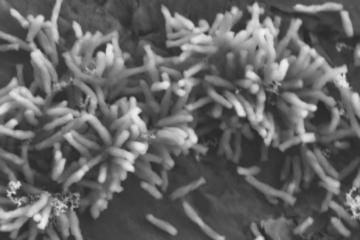
IMAGE

Credit: Image courtesy Bose laboratory, Washington University in St. Louis


Ever since scientists discovered that certain microbes can get their energy from electrical charges, researchers have wondered how they do it.

Bacteria don’t have mouths, so they need another way to bring their fuel into their bodies. New research from Washington University in St. Louis reveals how one such bacteria pulls in electrons straight from an electrode source. The work from the laboratory of Arpita Bose, assistant professor of biology in Arts & Sciences, was published Nov. 5 in the scientific journal mBio.

“The molecular underpinning of this process has been difficult to unravel until our work,” Bose said. “This is mostly due to the complex nature of the proteins involved in this process. But now, for the first time, we understand how phototrophic microbes can accept electrons from solid and soluble substances.”

Dinesh Gupta, a PhD candidate in the Bose laboratory, is the first author on this new study. “I was excited when we found that these phototrophic bacteria use a novel processing step to regulate the production of key electron transfer protein involved in this process,” Gupta said. “This study will aid in designing a bacterial platform where bacteria can feed on electricity and carbon dioxide to produce value-added compounds such as biofuels.”

Getting the electricity across the outer layer of the bacteria is the key challenge. This barrier is both nonconductive and impermeable to insoluble iron minerals and/or electrodes.

Bose and her collaborators, including Robert Kranz, professor of biology, showed that the naturally occurring strain of Rhodopseudomonas palustris TIE-1 builds a conduit to accept electrons across its outer membrane. The bacteria relies on an iron-containing helper molecule called a deca-heme cytochrome c. By processing this protein, TIE-1 can form an essential bridge to its electron source.

Extracellular electron uptake, or EEU, can help microbes to survive under nutrient-scarce conditions.

Now that Bose has documented these mechanisms behind EEU, she hopes to use it as a biological marker to identify other electricity-eating bacteria in the wild. The findings will help researchers to understand the importance of this functionality in metabolic evolution and microbial ecology.

###

VIDEO on Bose’s research with electricity-eating bacteria: lhttps://www.youtube.com/watch?v=z5cyX0MUAiU

Media Contact
Talia S Ogliore
[email protected]
626-390-8628

Original Source

https://source.wustl.edu/2019/11/straight-from-the-source/

Related Journal Article

http://dx.doi.org/10.1128/mBio.02668-19

Tags: BacteriologyBiologyCell Biology
Share12Tweet8Share2ShareShareShare2

Related Posts

Florida Cane Toad: Complex Spread and Selective Evolution

Florida Cane Toad: Complex Spread and Selective Evolution

February 7, 2026
New Study Uncovers Mechanism Behind Burn Pit Particulate Matter–Induced Lung Inflammation

New Study Uncovers Mechanism Behind Burn Pit Particulate Matter–Induced Lung Inflammation

February 6, 2026

DeepBlastoid: Advancing Automated and Efficient Evaluation of Human Blastoids with Deep Learning

February 6, 2026

Navigating the Gut: The Role of Formic Acid in the Microbiome

February 6, 2026
Please login to join discussion

POPULAR NEWS

  • Robotic Ureteral Reconstruction: A Novel Approach

    Robotic Ureteral Reconstruction: A Novel Approach

    82 shares
    Share 33 Tweet 21
  • Digital Privacy: Health Data Control in Incarceration

    63 shares
    Share 25 Tweet 16
  • Study Reveals Lipid Accumulation in ME/CFS Cells

    57 shares
    Share 23 Tweet 14
  • Breakthrough in RNA Research Accelerates Medical Innovations Timeline

    53 shares
    Share 21 Tweet 13

About

We bring you the latest biotechnology news from best research centers and universities around the world. Check our website.

Follow us

Recent News

TPMT Expression Predictions Linked to Azathioprine Side Effects

Improving Dementia Care with Enhanced Activity Kits

Decoding Prostate Cancer Origins via snFLARE-seq, mxFRIZNGRND

Subscribe to Blog via Email

Enter your email address to subscribe to this blog and receive notifications of new posts by email.

Join 73 other subscribers
  • Contact Us

Bioengineer.org © Copyright 2023 All Rights Reserved.

Welcome Back!

Login to your account below

Forgotten Password?

Retrieve your password

Please enter your username or email address to reset your password.

Log In
No Result
View All Result
  • Homepages
    • Home Page 1
    • Home Page 2
  • News
  • National
  • Business
  • Health
  • Lifestyle
  • Science

Bioengineer.org © Copyright 2023 All Rights Reserved.