Credit: Photo Courtesy of UTSA
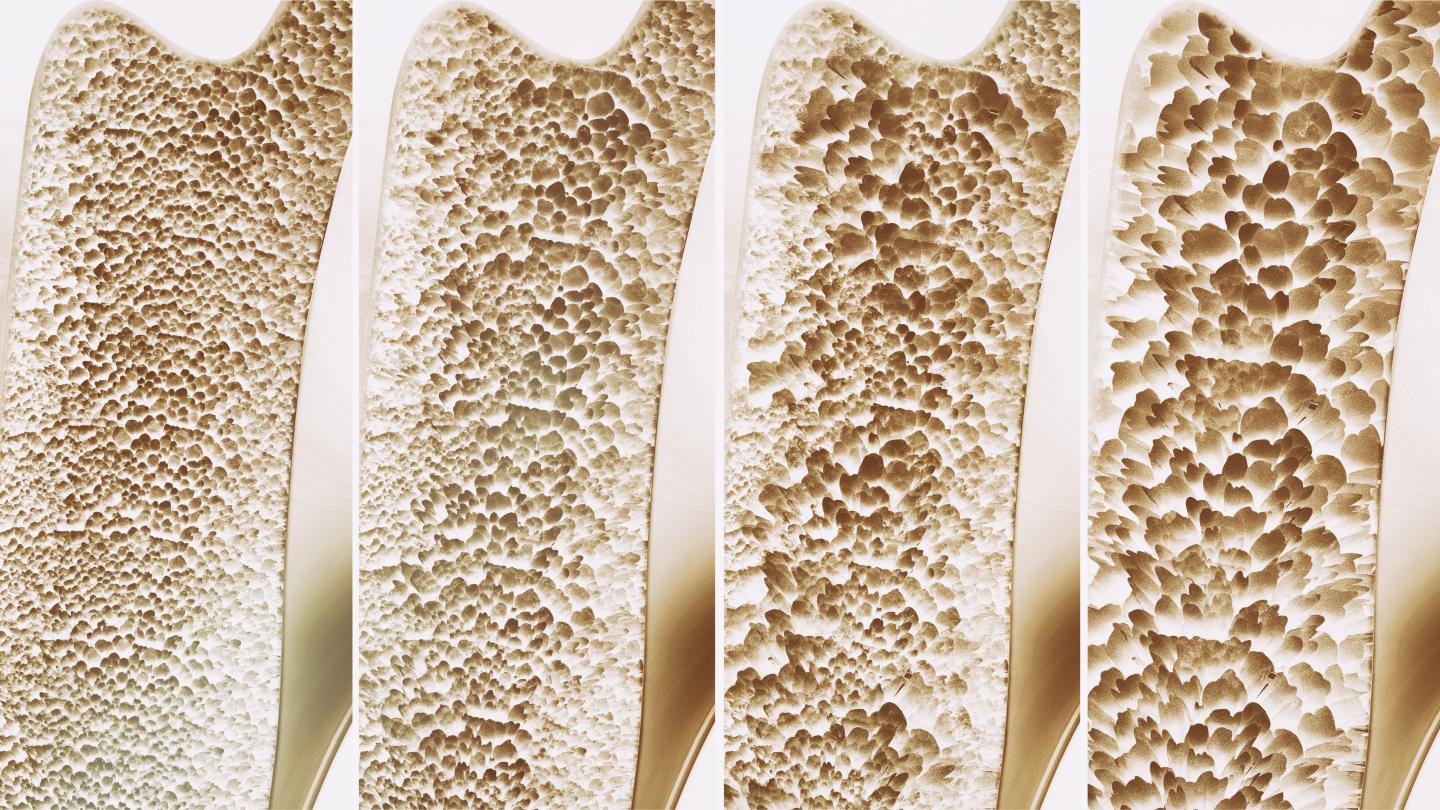
About half of all women in the U.S. will suffer a bone fracture due to osteoporosis. For women, the incidence of this condition is greater than that of heart attack, stroke and breast cancer combined. Now, researchers at UTSA have received multimillion-dollar funding to reexamine bone mineral density, a measure of bone fracture risks, and another critical component in bone known as proteoglycans.
UTSA scientists believe that proteoglycans, which occur naturally in bones’ extrafibrillar matrix in a small amount (less than 1.0% in volume), interact with water to sustain bones’ ductility, or their ability to absorb energy and resist fracture.
“If there are proteoglycans in your bones, we think you are better equipped to resist a fracture during a fall,” said Xiaodu Wang, a professor in UTSA’s Department of Mechanical Engineering and the principal investigator on the project, who will examine if this group of proteins indeed make bones tougher by absorbing water into the bone structure.
Data show that BMD captures only about 50% to 60% of actual bone fragility fractures. According to Wang, when bones lose proteoglycans they appear to lose their capability to resist fractures irrespective of BMD. Wang’s laboratory seeks to understand the underlying mechanism and thus prevent or deter the loss of the proteins before bone brittleness develops.
As part of the study, UTSA researchers will inject the proteins into animal models and then examine what is the appropriate strategy to best maintain the proteins in the bone matrix. They will also examine whether reversing the process of proteoglycan deficiency is possible for different gender and age groups.
Wang had a eureka moment when he thought about articulate cartilage–the firm, whitish, flexible connective tissue found in joints. It has been well known that damage to the cartilage will result in osteoarthritis.
“Supplements like chondroitin (a type of sugar protein in proteoglycans) are taken to help with osteoarthritis,” said Wang. “I then thought the same could be examined with these water-absorbing proteins [proteoglycans] in bone.”
This UTSA research will ultimately seek to answer why water loss associated with proteoglycan deficiency leads to potential bone brittleness. It will also explore what happens to the bone’s microstructure when it has a fracture.
Collaborating with UT Health San Antonio researcher Jean Jiang, Wang is one of very few scientists in the country studying the effect of these proteins on bone quality. He has close to a decade of experience on this particular subject. Recently the National Institutes of Health granted his laboratory $2.3 million to embark on this field of work. It’s anticipated that he will have results in five years.
Bone fragility fractures affect not only women but also all elderly as well as people with diabetes. The disease is responsible for an estimated 2 million broken bones per year, yet nearly 80% of older Americans who suffer bone breaks are not diagnosed or treated for osteoporosis.
“It’s about building and testing a model that includes all factors, not just bone mineral density, that cause bone fragility fractures,” said Wang. “My mother-in-law broke her hip. This is also personal for me.”
Osteoporosis is serious, even deadly. About one in four patients over the age of 70 that suffers a hip fracture will die the following year.
This project is an example of UTSA’s commitment to solving society’s most pressing global health challenges.
###
Media Contact
MIlady Nazir
[email protected]
210-458-2087
Original Source
https:/