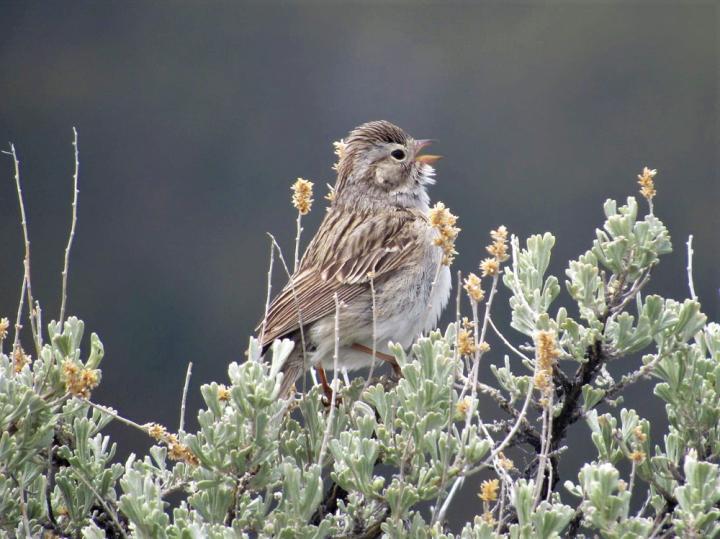
Credit: Kaitlyn Strickfaden, University of Montana research associate
MISSOULA – Research led by a University of Montana undergraduate student to identify less error-prone methods for performing wildlife surveys was published Oct. 20 in Ecological Applications.
Biologists around the world use a variety of boots-on-the-ground field methods to survey animal populations. When extrapolated, these data provide population counts and other scientific information used to study and manage species. But counting wildlife is rarely straightforward. Birds, for instance, are small or sometimes hard to see, and many species look and sound similar.
“Many biologists assume that false positives – either misidentifications or double-counts of animals – don’t happen in their surveys. But research has shown that false positives happen quite a lot, and those false positives can have huge impacts on the reliability of population estimates that we calculate from those data,” said first author Kaitlyn Strickfaden, a researcher with UM’s Avian Science Center. “So we made bird call simulations in which we knew the true identity of every calling bird to test differences in false positive rates in a few survey scenarios.”
Strickfaden and her co-authors tested different experience levels (expert and naive) and two survey methods. The first survey method used a single observer while the second used two collaborating observers.
Strickfaden and her team created call simulations featuring mashups of songs from 10 different bird species. The researchers knew when particular species were calling throughout each of the simulations. Their volunteer observers – six experts and six beginners – did not. These observers listened to the call simulations, either alone or with another observer, and recorded the birds they thought they heard.
The double-observer method reported significantly lower false-positive rates regardless of the observers’ experience level.
Observer experience was also an important factor, reaffirming that proper training is crucial to minimizing misidentifications during data collection.
The researchers found that error rates varied widely by species. Species with more unique songs were not misidentified as often as other species in the study. There also was an uneven trade-off in misidentifications within similar-sounding pairs. For example, McCown’s longspurs were often misidentified as horned larks, so horned larks were greatly overcounted in the study compared to how many truly occurred, while McCown’s longspurs were greatly undercounted.
“We don’t make any claims about what survey method researchers should use, since every researcher’s situation is different, but our data do show that the double-observer method was less prone to errors than the single-observer method,” Strickfaden said. “Collecting more accurate data gives us the ability to more accurately estimate population sizes. When we ignore false-positive errors, we may not know when populations are doing poorly and need conservation actions. Our research is a step forward in addressing this problem.”
Strickfaden, who graduated from UM in 2018 with a wildlife biology degree, has worked in the Avian Science Center since 2017. She conducted this research as her undergraduate senior thesis project.
“Kaitlyn’s persistence and tenacity is admirable. Publishing her undergraduate senior research in Ecological Applications is an outstanding accomplishment and demonstrates her abilities,” said Vicky Dreitz, director of the Avian Science Center and paper co-author. “Kaitlyn had the foresight to develop a project that provides information to avian ecologists, and wildlife biologists and managers, about the level of false positives, a well-known nuance in count-based survey data. We are proud and excited to be part of her accomplishment.”
###
Other co-authors include Danielle Fagre, Alan Harrington, Jessie Golding, Kaitlyn Reintsma and Jason Tack, all former or current UM students and part of the Avian Science Center.
The article “Dependent double-observer method reduces false positive errors in auditory avian survey data” is online at https:/
By Kasey Rahn, UM News Service
Media Contact
Kaitlyn Strickfaden
[email protected]
815-900-6086
Original Source
http://news.
Related Journal Article
http://dx.