New simulations of interstellar magnetic fields open new chapter in understanding star formation
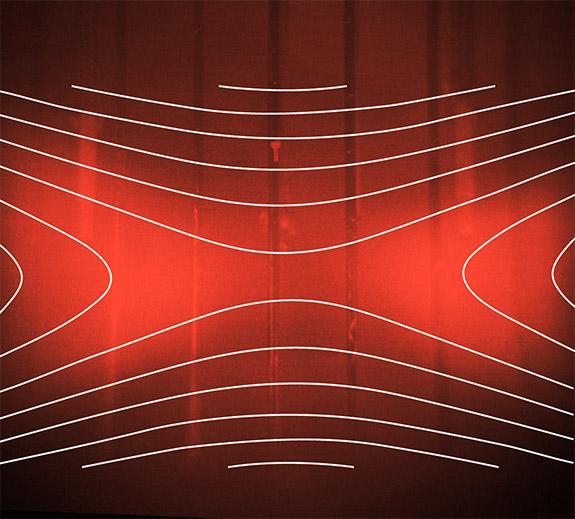
Credit: Jongsoo Yoo
Fort Lauderdale, Fla.–Many of the most dramatic events in the solar system–the spectacle of the Northern Lights, the explosiveness of solar flares, and the destructive impact of geomagnetic storms that can disrupt communication and electrical grids on Earth–are driven in part by a common phenomenon: fast magnetic reconnection. In this process the magnetic field lines in plasma–the gas-like state of matter consisting of free electrons and atomic nuclei, or ions–tear, come back together and release large amounts of energy (Figure 1).
Astrophysicists have long puzzled over whether this mechanism can occur in the cold, relatively dense regions of interstellar space outside the solar system where stars are born. Such regions are filled with partially ionized plasma, a mix of free charged electrons and ions and the more familiar neutral, or whole, atoms of gas. If magnetic reconnection does occur in these regions it might dissipate magnetic fields and stimulate star formation.
Researchers at the U.S. Department of Energy’s Princeton Plasma Physics Laboratory (PPPL) have developed a model and simulation that show the potential for reconnection to occur in interstellar space.
“Our models show that fast reconnection can indeed occur in partially ionized systems,” says Dr. Jonathan Jara-Almonte, a physicist at PPPL.
Dr. Jara-Almonte developed a mathematical model that adds the behavior of neutral particles to previous simulations of fully ionized plasma. Powerful Princeton University computers then solved the equations, which determine the motion of billions of plasma particles
These findings can help guide the understanding of how reconnection may differ between fully ionized and partially ionized plasma, and how it might affect the formation of stars. Researchers will next compare these simulations with magnetic reconnection in small-scale laboratory experiments at PPPL to validate the approximations used in the model.
###
This work was funded by the Basic Plasma Science Program from the DOE Office of Fusion Energy Sciences under contract number DE-AC02-09CH11466 and from NASA under grant number NNH15AB29
Contact: Jonathan Jara-Almonte, PPPL, [email protected]
Abstract:
Higher Off-Axis Electron Cyclotron Current Drive Via ‘Top Launch’ Approach
9:30 AM – 12:30 PM, Friday, October 25, 2019
Room: Floridian Ballroom CD
http://meetings.
About APS/DPP:
The 61st Annual Meeting of the American Physical Society’s Division of Plasma Physics will take place from October 21-25, 2019 in Fort Lauderdale, Florida. All technical sessions will be located at the Fort Lauderdale/Broward County Convention Center, where over 1,900 papers will be presented by scientists from over 20 countries around the world.
The American Physical Society (APS) is a nonprofit membership organization working to advance and diffuse the knowledge of physics through its outstanding research journals, scientific meetings, and education, outreach, advocacy, and international activities. APS represents over 55,000 members, including physicists in academia, national laboratories, and industry in the United States and throughout the world.
Media Contact
Saralyn Stewart
[email protected]
512-694-2320