New microwave injection system at the DIII-D National Fusion Facility doubles current-drive efficiency and demonstrates for the first time efficient off-axis current drive in a tokamak
Credit: Xi Chen, DIII-D National Fusion Facility
Fort Lauderdale, Fla.–Researchers at the DIII-D National Fusion Facility in San Diego have demonstrated a new approach for injecting microwaves into a fusion plasma that doubles the efficiency of a critical technique that could have major implications for future fusion reactors. The results show that launching the microwaves into the plasma via a novel geometry delivers substantial improvements in the plasma current drive.
Dr. Xi Chen will present the team’s findings at this week’s APS Division of Plasma Physics annual meeting.
Building economical fusion reactors in the future will require driving electric current efficiently in specific regions of the plasma–a technique known as off-axis current drive. Electric current enhances the stability of the magnetically contained plasma in doughnut-shaped fusion reactors known as tokamaks. The current allows the plasma to remain cohesive as it is heated to more than 150 million degrees, where atoms of hydrogen start to fuse and release large amounts of energy. One of the techniques to drive current, known as Electron-Cyclotron Current Drive (ECCD), uses extremely powerful microwaves to heat electrons in the plasma. The more efficiently the microwaves interact with the energetic electrons, the greater the current drive in the plasma.
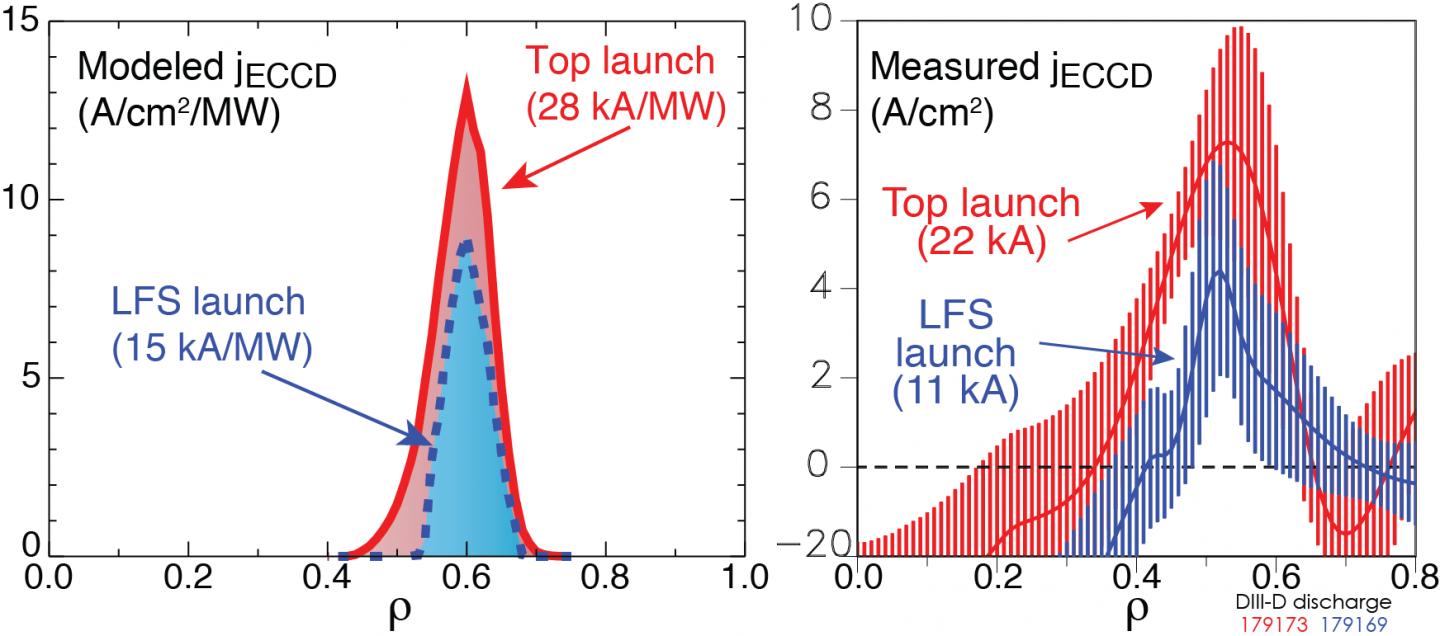
The ECCD microwaves were traditionally injected from the outer curve of the tokamak toward the heart of the plasma. Recent computer modeling at DIII-D, however, predicted efficiency could be substantially improved by moving the injection point toward the top of the tokamak and carefully directing it to precise points away from the center (Figure 1). Based on that modeling, Dr. Chen led a team that designed and installed a new system that allows the microwaves to be injected from the top. This new top-launch configuration aligns the microwave trajectory with the magnetic field and energy distribution of the plasma, so that the microwaves selectively interact with only the most energetic electrons, doubling drive current efficiency.
The experimental results were startling in how closely they aligned to the gains predicted by the computer models (Figure 2).
“I had high expectations that we were going to see improvements based on the modelling, but were surprised at how clearly and quickly we doubled the efficiency in the real measurements,” said Dr. Chen. “We are very excited to see these results and we think this could prove to be very significant.” These results provide experimental validation of the top-launch ECCD approach and could be a major consideration in planning for future tokamaks.
###
This work was supported in part by the U.S. Department of Energy under ADE-FC02-04ER54698.
Contact: Xi Chen, General Atomics, [email protected]
Abstract:
Higher Off-Axis Electron Cyclotron Current Drive Via ‘Top Launch’
9:30 AM – 12:30 PM, Friday, October 25, 2019
Room: Floridian Ballroom CD
http://meetings.
About APS/DPP:
The 61st Annual Meeting of the American Physical Society’s Division of Plasma Physics will take place from October 21-25, 2019 in Fort Lauderdale, Florida. All technical sessions will be located at the Fort Lauderdale/Broward County Convention Center, where over 1,900 papers will be presented by scientists from over 20 countries around the world.
The American Physical Society (APS) is a nonprofit membership organization working to advance and diffuse the knowledge of physics through its outstanding research journals, scientific meetings, and education, outreach, advocacy, and international activities. APS represents over 55,000 members, including physicists in academia, national laboratories, and industry in the United States and throughout the world.
Media Contact
Saralyn Stewart
[email protected]
512-694-2320