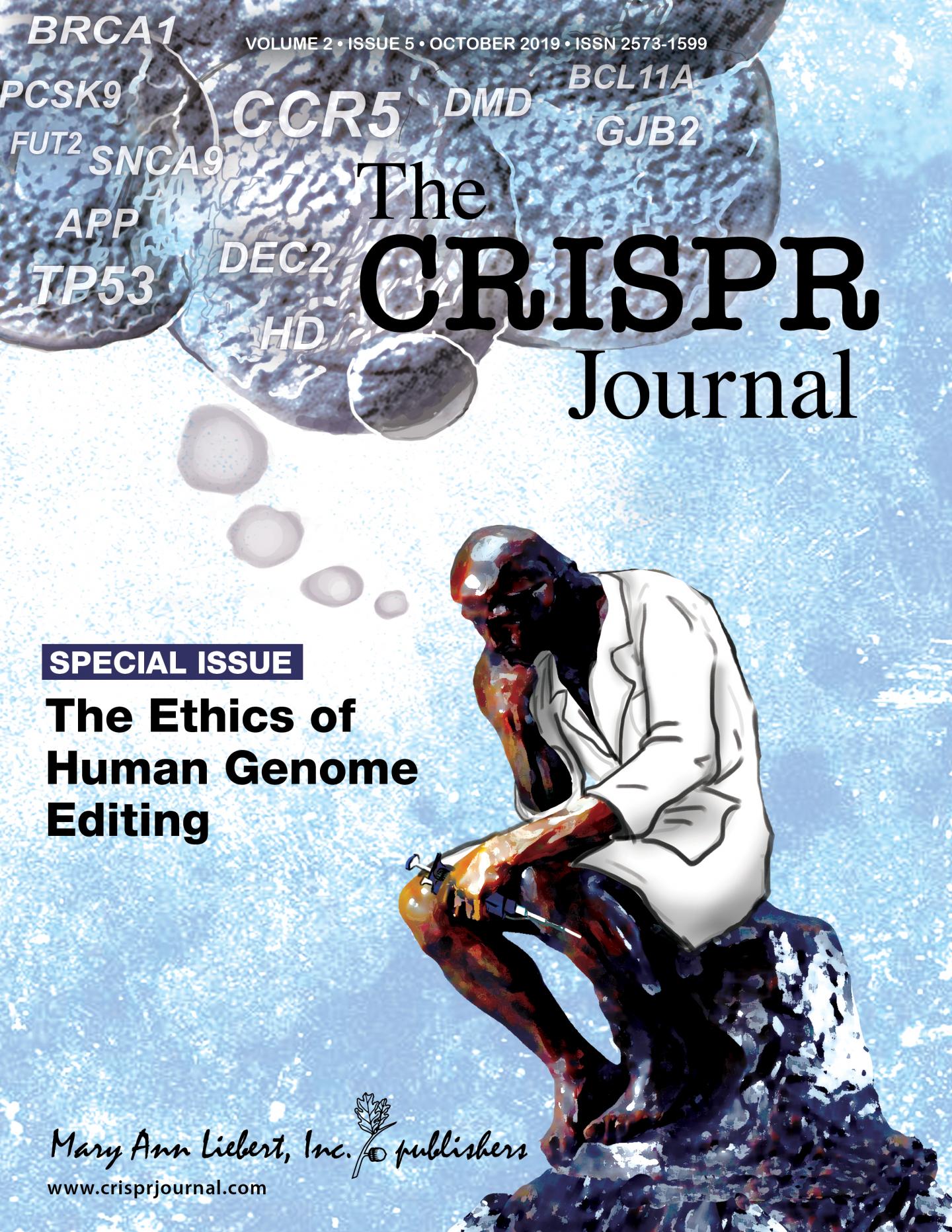
Credit: Mary Ann Liebert, Inc., publishers
New Rochelle, NY, October 15, 2019–The Ethics of Human Genome Editing is the subject of intensive discussion and debate in a special issue of The CRISPR Journal, a new peer-reviewed journal from Mary Ann Liebert, Inc., publishers. Click here) to read the full-text issue free on The CRISPR Journal.
The issue contains 11 articles: nine Perspectives and two research articles on issues including human rights for the unborn, the economics of gene editing therapies, the pros and cons of a moratorium on genome editing, the real-world cases where germline editing could provide medical utility, and (on a lighter note) the use and misuse of “Brave New World.”
Leading off the special issue is an article by Henry Greely, Stanford University Center for Law and Biosciences (CA) entitled “Human Germline Genome Editing: An Assessment.” Greely contends that germline editing is not inherently bad or immoral. The technology, however, is not likely to be particularly useful, at least in the near future, Greely argues, except perhaps in cases where both reproductive partners have the same recessive disorder, or one is homozygous for a dominant disease. The biggest problem with germline genome editing for non-Mendelian conditions is that we do not know nearly enough about the conditions, says Greely.
Another article concerns the two international commissions organized by the World Health Organization, the U.S. National Academies, and the Royal Society, to provide recommendations for the governance of human germline editing. In a Perspective article, Sheila Jasanoff, Harvard University (Cambridge, MA), J. Benjamin Hurlbut, Arizona State University (Tempe, AZ), and Krishanu Saha, University of Wisconsin-Madison call this approach “premature and problematic.” In the article entitled “Democratic Governance of Human Germline Genome Editing” they discuss the “CRISPR babies” case and state that global democratic governance “demands a new mechanism for active, sustained reflection by scientists” in partnership with scholars from other disciplines and the public. They provide six recommendations to promote democratic governance.
In her perspective piece, “Heritable Genome Editing and the Downsides of a Global Moratorium,” Kerry Macintosh, Santa Clara University School of Law (CA), gives three reasons that she opposes a moratorium on heritable genome editing. These include the danger of a temporary ban becoming permanent, a disincentive to support appropriate research to make the technology safer and more effective, and the potential stigmatization of children born with edited genomes. She contends that nations should regulate germline editing for safety and efficacy only, without differentiating between therapeutic applications and enhancement.
“This is a critical time for the field, and we need to take into account the many voices and opinions of those concerned with genome editing and corresponding societal implications,” states Rodolphe Barrangou, PhD, Editor-in-Chief of The CRISPR Journal. “This issue captures many voices and covers various topics, illustrating how timely and critical it is to ponder the ethics of genome editing.”
###
About the Journal
The CRISPR Journal is a groundbreaking peer-reviewed journal dedicated to outstanding research and commentary on all aspects of CRISPR and gene editing research. Published bimonthly in print and online and led by Editor-in-Chief Rodolphe Barrangou, PhD, North Carolina State University, the Journal covers CRISPR biology, technology and genome editing, and commentary and debate of key policy, regulatory, and ethical issues affecting the field. For complete information and a sample issue, please visit The CRISPR Journal website.
About the Publisher
Mary Ann Liebert, Inc., publishers is a privately held, fully integrated media company known for establishing authoritative peer-reviewed journals in many promising areas of science and biomedical research, including Human Gene Therapy, ASSAY and Drug Development Technologies, Nucleic Acid Therapeutics, Stem Cells and Development, and Biopreservation and Biobanking. Its biotechnology trade magazine, GEN (Genetic Engineering & Biotechnology News), was the first in its field and is today the industry’s most widely read publication worldwide. A complete list of the firm’s 80 journals, books, and newsmagazines is available on the Mary Ann Liebert, Inc., publishers website.
Media Contact
Kathryn Ryan
[email protected]
914-740-2250
Original Source
https:/