• HOME
  • NEWS
  • EXPLORE
    • CAREER
      • Companies
      • Jobs
    • EVENTS
    • iGEM
      • News
      • Team
    • PHOTOS
    • VIDEO
    • WIKI
  • BLOG
  • COMMUNITY
    • FACEBOOK
    • INSTAGRAM
    • TWITTER
Friday, January 16, 2026
BIOENGINEER.ORG
No Result
View All Result
  • Login
  • HOME
  • NEWS
  • EXPLORE
    • CAREER
      • Companies
      • Jobs
        • Lecturer
        • PhD Studentship
        • Postdoc
        • Research Assistant
    • EVENTS
    • iGEM
      • News
      • Team
    • PHOTOS
    • VIDEO
    • WIKI
  • BLOG
  • COMMUNITY
    • FACEBOOK
    • INSTAGRAM
    • TWITTER
  • HOME
  • NEWS
  • EXPLORE
    • CAREER
      • Companies
      • Jobs
        • Lecturer
        • PhD Studentship
        • Postdoc
        • Research Assistant
    • EVENTS
    • iGEM
      • News
      • Team
    • PHOTOS
    • VIDEO
    • WIKI
  • BLOG
  • COMMUNITY
    • FACEBOOK
    • INSTAGRAM
    • TWITTER
No Result
View All Result
Bioengineer.org
No Result
View All Result
Home NEWS Science News Chemistry

Livestream available: metal to metal oxide progression

Bioengineer by Bioengineer
October 16, 2019
in Chemistry
Reading Time: 2 mins read
0
IMAGE
Share on FacebookShare on TwitterShare on LinkedinShare on RedditShare on Telegram

IMAGE

Credit: OIST

A catalyst’s utility is influenced by its surface charge and how that charge is transferred. Until recently, studying charge transfer has relied on complex imaging techniques that are both expensive and time-consuming. Scientists at the Okinawa Institute of Science and Technology Graduate University (OIST) report an approach for studying charge transfer that does not rely on complicated equipment — simplifying the real-time observation of catalysis.

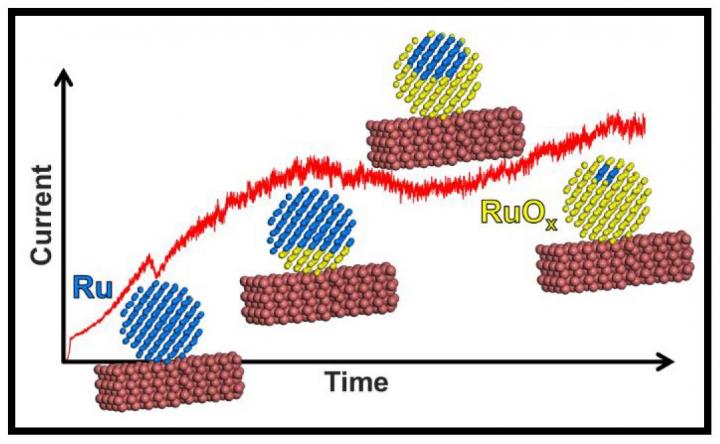
The team describes an experimental setup using a tiny ruthenium catalyst, a nanocluster, that reacts with oxygen in the air when heated to high temperatures. This oxidation reaction is detected by a support structure attached to the catalyst that provides a live readout to a computer. Ruthenium can be used to detect breath acetone, which is a biomarker for various disease states, but this setup also has wider value in demonstrating exactly how catalysts facilitate a reaction.

“Essentially, the attached support structure detects a change in current, corresponding to a change in the catalyst nanocluster,” explains Dr. Alexander Porkovich, first author of the study, published in ACS Nano. “In this case, that change is a shift in oxidation state as the ruthenium reacts with oxygen.”

“When studying charge transfer phenomena, we are interested in the interface between the catalyst and the support — and this experimental setup is ideal. With such a clean interface, we can be confident that our data accurately captures the unfolding oxidation reaction.”

This paper adds to the growing body of literature bringing hidden catalytic activity to light, taking observations in situ — allowing the reaction to take place unperturbed. These readings, dubbed chrono-conductometric measurements, are a useful evolution in methodology, and they are supplemented with other approaches to validate the ruthenium’s shift in structure, chemical ordering, and surface charge. Combined, these techniques provide a complete and reliable picture of the reaction mechanics.

The study also highlights the importance of the ruthenium nanocluster’s structure. Ruthenium was bound to the support in two distinct configurations, each exhibiting different mechanics when reacting with oxygen. One structure more fully reacts with oxygen, whereas the other retains an inert core. This raises further questions about how the structure of the nanocluster impacts on catalysis, and which conformation of ruthenium may be better suited to industrial applications.

Understanding charge transfer phenomena also has utility beyond catalysis, including the study of surface plasmons employed in electron microscopy, and materials required in solar energy devices. Exploring these systems with similar in situ, chrono-conductometric measurements could shed further light on important industrial processes.

###

Media Contact
Tomomi Okubo
[email protected]
809-898-23447

Original Source

https://www.oist.jp/news-center/news/2019/10/16/livestream-available-metal-metal-oxide-progression

Related Journal Article

http://dx.doi.org/10.1021/acsnano.9b06224

Tags: Chemistry/Physics/Materials SciencesNanotechnology/MicromachinesTechnology/Engineering/Computer Science
Share12Tweet8Share2ShareShareShare2

Related Posts

Selective GlcNAc to GalNAc Epimerization via Kinetic Control

Selective GlcNAc to GalNAc Epimerization via Kinetic Control

January 15, 2026
blank

Thermal [2+2] Cycloaddition Builds Gem-Difluoro Bicycloalkanes

January 13, 2026

Cobalt-Catalyzed Thioester Coupling via Siloxycarbene

January 12, 2026

Advancing Alkene Chemistry: Homologative Difunctionalization Breakthrough

January 8, 2026
Please login to join discussion

POPULAR NEWS

  • Enhancing Spiritual Care Education in Nursing Programs

    155 shares
    Share 62 Tweet 39
  • PTSD, Depression, Anxiety in Childhood Cancer Survivors, Parents

    147 shares
    Share 59 Tweet 37
  • Robotic Ureteral Reconstruction: A Novel Approach

    76 shares
    Share 30 Tweet 19
  • Study Reveals Lipid Accumulation in ME/CFS Cells

    53 shares
    Share 21 Tweet 13

About

We bring you the latest biotechnology news from best research centers and universities around the world. Check our website.

Follow us

Recent News

Carbon Fiber Boosts Zirconium Diboride in 3D Printing

Revolutionary Support Program for Families of Cancer Patients

Spatial Multiomics Uncovers Immune Dysfunction in Parkinson’s, IBD

Subscribe to Blog via Email

Success! An email was just sent to confirm your subscription. Please find the email now and click 'Confirm' to start subscribing.

Join 71 other subscribers
  • Contact Us

Bioengineer.org © Copyright 2023 All Rights Reserved.

Welcome Back!

Login to your account below

Forgotten Password?

Retrieve your password

Please enter your username or email address to reset your password.

Log In
No Result
View All Result
  • Homepages
    • Home Page 1
    • Home Page 2
  • News
  • National
  • Business
  • Health
  • Lifestyle
  • Science

Bioengineer.org © Copyright 2023 All Rights Reserved.