New major project aims to improve global date palm production and protection
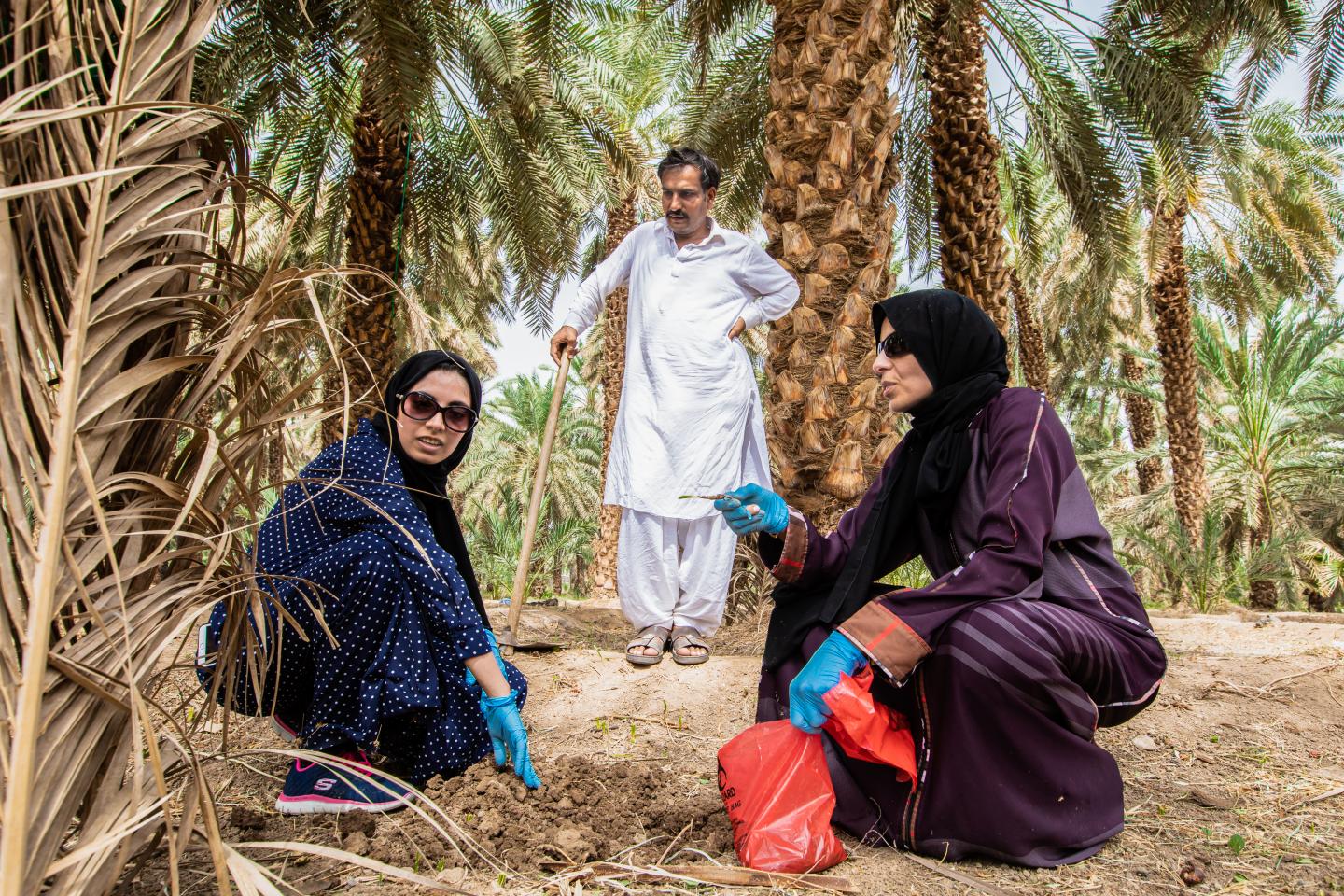
Credit: King Abdullah University for Science and Technology (KAUST)
Today on World Food Day, a team of Plant Scientists from King Abdullah University for Science and Technology (KAUST) has begun a major project to improve global date palm production and protection.
This project is the first time that the date palm genome has been studied so comprehensively. Dr. Ikram Blilou, Professor of Plant Science at King Abdullah University for Science and Technology (KAUST) and her research team in Saudi Arabia have collected samples from date palms by the Quba mosque in Madinah, some of the most ancient date palms in the world.
“The date palm is one of the few fruit trees that, remarkably, can grow in the desert, a habitat with an arid climate where extreme temperature changes and drought conditions limit plant growth.
“Within KAUST’s Center for Desert Agriculture Research we are studying date palms using advanced genome sequencing techniques and have begun to develop new breeding strategies to help palms grow faster and healthier as well as making them more resistant to pathogens and pests like the red palm weevil,” says Dr. Blilou.
Earlier this year, Dr. Ikram published in the scientific journal Plant Cell, findings that provide insights into how desert plants are able to thrive in hostile habitats.
The research teams within KAUST’s Center for Desert Agriculture are creating molecular and biotechnological tools to improve date palm agriculture by sequencing the genome of the ajwa date palm.
“This will help us to develop methods for rapid sex determination in palms, and we will use the genetic information obtained from the high quality and well annotated genome to isolate candidate genes that will be used for date palm gene editing,” continued Dr. Blilou.
Dates are famous for their high nutritional value, being high in both potassium and magnesium, making them an important part of many peoples’ diets around the world. Date palm fruits are important for many cultures and can grow to 21-23 meters tall, with a lifespan of more than 100 years.
According to the National Palms and Dates Centre (NCPD) Saudi Arabia produces an estimated 1.1 million tons of dates per year, 15% of the world’s date production. In addition, export of dates from Saudi Arabia grew by 11.7% in 2018 compared to 2017.
“Despite this economic importance, basic research into the date palm, including understanding mechanisms of growth and adaptation to the desert environment, is still at its early stages mainly because of the lack of molecular tools and the challenging nature of the plant.”
“It requires a long generation time for flowering which can be 4- 5 years and setting fruits that take 10-15 years,” says Dr. Rod Wing, Professor of Plant Science and Director of the KAUST Center for Desert Agriculture.
The next step for researchers in the KAUST Center for Desert Agriculture is to work on generating high quality genomes for a large number of other varieties of date palms, bringing further potential benefits for date palm agriculture around the world.
###
Notes to Editors:
DOI: https:/
Images: https:/
Caption: Dr. Ikram Blilou, Professor of Plant Science at King Abdullah University for Science and Technology (KAUST) with members of her research team collect date palm samples from the historical farm Al Dabeta by the Quba mosque in Madinah, the oldest mosque in the world.
About KAUST
Established in 2009, King Abdullah University of Science and Technology (KAUST) is a graduate research university devoted to finding solutions for some of the world’s most pressing scientific and technological challenges in the areas of food, water, energy and the environment. With 19 research areas related to these themes and state-of-the art labs, KAUST has created a collaborative and interdisciplinary problem- solving environment, which has resulted in over 11,000 published papers to date.
With over 100 different nationalities living, working and studying on campus, KAUST has brought together the best minds and ideas from around the world with the goal of advancing science and technology through distinctive and collaborative research. KAUST is a catalyst for innovation, economic development and social prosperity in Saudi Arabia and the world.
For additional information, visit: http://www.
Media Contact
Alexander Buxton
[email protected]
966-544-701-577
Related Journal Article
http://dx.