• HOME
  • NEWS
  • EXPLORE
    • CAREER
      • Companies
      • Jobs
    • EVENTS
    • iGEM
      • News
      • Team
    • PHOTOS
    • VIDEO
    • WIKI
  • BLOG
  • COMMUNITY
    • FACEBOOK
    • INSTAGRAM
    • TWITTER
Saturday, February 7, 2026
BIOENGINEER.ORG
No Result
View All Result
  • Login
  • HOME
  • NEWS
  • EXPLORE
    • CAREER
      • Companies
      • Jobs
        • Lecturer
        • PhD Studentship
        • Postdoc
        • Research Assistant
    • EVENTS
    • iGEM
      • News
      • Team
    • PHOTOS
    • VIDEO
    • WIKI
  • BLOG
  • COMMUNITY
    • FACEBOOK
    • INSTAGRAM
    • TWITTER
  • HOME
  • NEWS
  • EXPLORE
    • CAREER
      • Companies
      • Jobs
        • Lecturer
        • PhD Studentship
        • Postdoc
        • Research Assistant
    • EVENTS
    • iGEM
      • News
      • Team
    • PHOTOS
    • VIDEO
    • WIKI
  • BLOG
  • COMMUNITY
    • FACEBOOK
    • INSTAGRAM
    • TWITTER
No Result
View All Result
Bioengineer.org
No Result
View All Result
Home NEWS Science News Chemistry

Opening up the black box of heterogeneous catalysis

Bioengineer by Bioengineer
October 15, 2019
in Chemistry
Reading Time: 2 mins read
0
IMAGE
Share on FacebookShare on TwitterShare on LinkedinShare on RedditShare on Telegram

IMAGE

Credit: Rodrigo García ICIQ


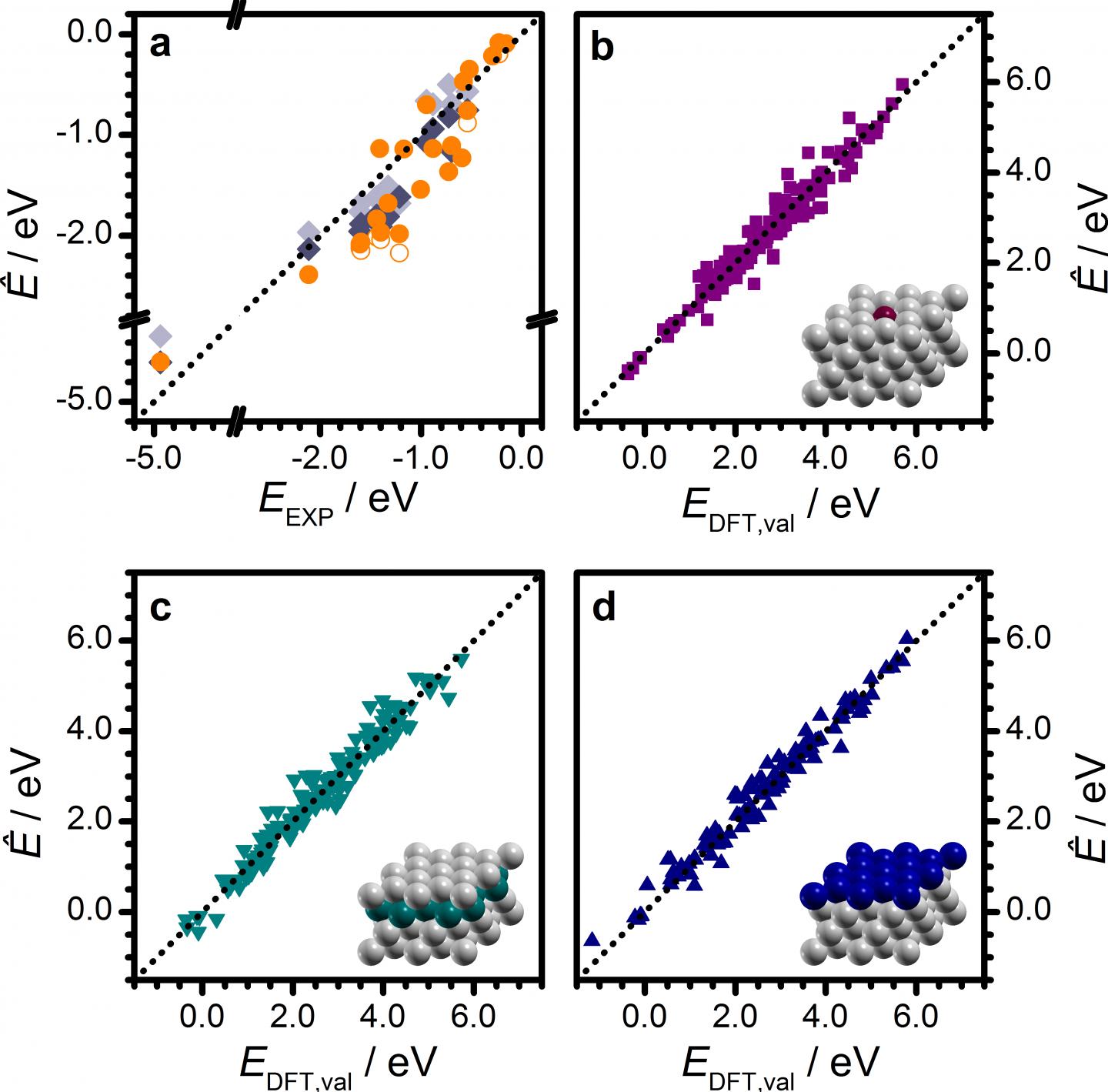
The team’s new method, published in Nature Communications, will facilitate the discovery of heterogeneous catalysts able to transform the non-edible fraction of biomass into valuable chemical products. The procedure reduces the number of calculations by a factor of 20 while retaining error bars comparable to Density Functional Theory (DFT).

As simple as possible, but not simpler

Biomass molecules are big. With complex molecular structures, there are many reaction sites to be considered when biomass interacts with a catalyst. A relatively small molecule, such as a C6, could present a reaction network of about 500 000 reactions – making it too time and resource-demanding to study using current models. In contrast, by studying C1 and C2 species the scientists now can extrapolate the behavior to bigger molecules commonly found in biomass.

The researchers from the López group applied PCA, a simple and unsupervised Machine Learning technique, to reduce the dimensionality of the problem. After analysing the formation energies of 71 adsorbates on 12 close-packed metal surfaces, the researchers obtained a two-term linear expression that allows for the rapid and accurate survey of whole reaction networks on metallic surfaces while drastically slashing the number of DFT calculations needed.

The simplicity of the resulting model has allowed the ICIQ researchers to go one step beyond the state of the art and interpret the results – a first in heterogeneous catalysis.

From black to green

Interpreting the results of machine learning tools yield can be a challenge. Luckily, the ICIQ scientists have been able to open the box and interpret in physical terms the parameters of the equation. “If you know what each of the terms in the equation means, you can go further and expand your model” explains Rodrigo García-Muelas, first author of the paper, “the equation’s first term describes bond covalency while the second one is related to the bond’s ionicity.” The mathematical sequence used to find the models is publicly available to other researchers to reproduce the results.

The new model applies to a wide range of scenarios and allows the prediction of how a system will react and what it will yield by just knowing the characteristics of the bonds. Machine Learning approaches applied to catalysis are expanding our understanding of the inner workings of molecules bringing closer the transformation of biomass into biofuels, thus providing a greener alternative to fossil fuels.

###

Media Contact
Berta Carreño
[email protected]
34-650-020-340

Original Source

http://www.iciq.org/opening-up-the-b…eneous-catalysis/

Tags: Chemistry/Physics/Materials Sciences
Share12Tweet8Share2ShareShareShare2

Related Posts

blank

Breakthrough in Environmental Cleanup: Scientists Develop Solar-Activated Biochar for Faster Remediation

February 7, 2026
blank

Cutting Costs: Making Hydrogen Fuel Cells More Affordable

February 6, 2026

Scientists Develop Hand-Held “Levitating” Time Crystals

February 6, 2026

Observing a Key Green-Energy Catalyst Dissolve Atom by Atom

February 6, 2026
Please login to join discussion

POPULAR NEWS

  • Robotic Ureteral Reconstruction: A Novel Approach

    Robotic Ureteral Reconstruction: A Novel Approach

    82 shares
    Share 33 Tweet 21
  • Digital Privacy: Health Data Control in Incarceration

    63 shares
    Share 25 Tweet 16
  • Study Reveals Lipid Accumulation in ME/CFS Cells

    57 shares
    Share 23 Tweet 14
  • Breakthrough in RNA Research Accelerates Medical Innovations Timeline

    53 shares
    Share 21 Tweet 13

About

We bring you the latest biotechnology news from best research centers and universities around the world. Check our website.

Follow us

Recent News

Decoding Prostate Cancer Origins via snFLARE-seq, mxFRIZNGRND

Digital Health Perspectives from Baltic Sea Experts

Florida Cane Toad: Complex Spread and Selective Evolution

Subscribe to Blog via Email

Enter your email address to subscribe to this blog and receive notifications of new posts by email.

Join 73 other subscribers
  • Contact Us

Bioengineer.org © Copyright 2023 All Rights Reserved.

Welcome Back!

Login to your account below

Forgotten Password?

Retrieve your password

Please enter your username or email address to reset your password.

Log In
No Result
View All Result
  • Homepages
    • Home Page 1
    • Home Page 2
  • News
  • National
  • Business
  • Health
  • Lifestyle
  • Science

Bioengineer.org © Copyright 2023 All Rights Reserved.