The battle against ‘fake news’
Credit: UT Arlington
As claims of “fake news” proliferate, checking the truthfulness of information becomes more important and more difficult.
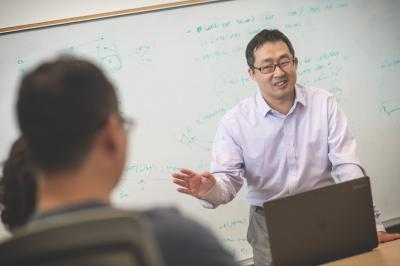
That’s the challenge taken on by Chengkai Li, a professor of computer science and engineering at The University of Texas at Arlington, who has been developing an electronic fact-checking system called ClaimBuster for several years.
Now, he is leading a multi-institution, multi-disciplinary team in the first phase of a $998,870 National Science Foundation Convergence Accelerator Pilot program to deliver verifiably credible, open-knowledge networks.
A knowledge network is a collection of records, facts and properties of information that is gathered and updated by various entities and shared with stakeholders. However, to be useful it must be accurate.
“We will develop a resource for debunking misinformation, which is important to decision-making by individuals, organizations, communities and policy-makers,” Li said. “Our goal is to ensure credibility, integrity, completeness and truthfulness so that people accessing the knowledge network can be confident that the information provided is correct.”
Li’s team includes researchers in computer science, psychology, political science, health care, economics, journalism and communication who will work to understand what factors make factual statements persuasive and to vet statements using knowledge graphs, then make those knowledge graphs more robust and credible. In addition to university faculty, participants also come from government agencies and industry.
The team will focus initially on misinformation about software security threats and health-related topics.
“The public’s trust in online information has eroded in recent years partly due to the sheer volume of content and the questionable agendas of those posting messages,” said Mark Tremayne, assistant professor of broadcast communications at UTA and a long-time collaborator with Li. “The scale of the misinformation problem is so large that automated tools to identify false or questionable information are needed. Computational means are needed and, coupled with social science research on human perceptions of credibility, can provide powerful means of restoring trust in online information.”
Co-principal investigators on the project are Sibel Adali of Rochester Polytechnic Institute, Xiaojing Liao of Indiana University, Yinghui Wu of Case Western Reserve University and Jun Yang of Duke University. Sub-awardees include New York University, the University of California-Santa Barbara and the University of Maryland. Other collaborators and partners are UT Dallas, Army Research Lab, Pacific Northwest National Lab, Qatar Computing Research Institute, IBM, Amazon, Lehigh University, Cardiff University and Idaho National Lab.
Senior personnel at UTA who are contributing to the project include Gautam Das and Shirin Nilizadeh in the Department of Computer Science and Engineering, Yan Xiao in the College of Nursing and Health Innovation and Jennifer Jie Zhang in the Department of Information Systems and Operations Management.
In June 2020, all 43 teams that received funding in the first phase of the Convergence Accelerator program will make presentations to the National Science Foundation in hopes of being one of eight to receive $5 million awards for further development in phase two.
“The Convergence Accelerator initiative is an exciting new approach to discovery by the National Science Foundation, and Dr. Li and his collaborators at UTA and across the country have a unique opportunity to provide an impactful service to the public,” said Peter Crouch, dean of the College of Engineering. “By bringing perspectives from health care, psychology and communication to an engineering problem, they are challenging the traditional approach to research.”
###
–Written by Jeremy Agor
Media Contact
Herb Booth
[email protected]
817-272-7075
Original Source
https:/