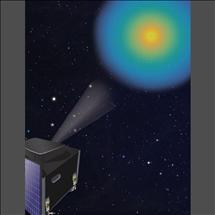
Credit: University of Illinois Department of Electrical and Computer Engineering
Lara Waldrop, assistant professor electrical and computer engineering at the University of Illinois at Urbana-Champaign has been selected by NASA to lead a multi-institution team to conduct a concept study for a satellite mission. Her mission, titled “Global Lyman-alpha Imagers of the Dynamic Exosphere”, or “GLIDE” for short, is one of two finalists chosen for consideration after a competitive selection process. One mission will be selected for launch as a NASA Heliophysics Science Mission of Opportunity, with the total mission cost capped at $75 million.
The GLIDE spacecraft’s observations of the vast cloud of hydrogen atoms surrounding Earth will reveal the structure and dynamic behavior of this region in response to influences from the sun above or the atmosphere below.
The GLIDE spacecraft’s observations of the vast cloud of hydrogen atoms surrounding Earth will reveal the structure and dynamic behavior of this region in response to influences from the sun above or the atmosphere below.
The GLIDE mission would make unprecedented measurements of the far ultraviolet light emitted by hydrogen atoms in the Earth’s outermost atmospheric layer, known as the exosphere, which extends almost halfway to the moon. This bright emission serves as a tracer of exospheric density and spatial structure, knowledge of which is needed to advance understanding of upper atmospheric physics, particularly regarding Earth’s recovery from solar-driven disturbances known as space weather.
“The exosphere is a critical component of Earth’s protection against solar storms” explained Prof. Waldrop. “GLIDE will reveal the nature and origins of the exosphere’s global structure and temporal variability, which will provide us with better ways to forecast and, ultimately, mitigate the ways in which space weather can disrupt modern technology, such as satellite electronics, radio communication, electric power distribution, and even air travel.”
GLIDE data will also help explain how exospheric hydrogen atoms are able to overcome Earth’s gravity and escape into space, a process that leads to the slow evaporation of a planet’s water reservoirs. “Atmospheric escape of light gases is a fundamental process throughout our solar system and beyond,” explained Dolon Bhattacharyya, an ECE ILLINOIS Research Scientist who is serving as Project Scientist for the GLIDE mission. “By seeing how Earth is losing its hydrogen today, we can better understand how other planets like Mars lost their hydrogen and thus their surface water a long time ago”.
Only a handful of images of exospheric emission have previously been made at large enough distances to capture its structure on global scales. GLIDE would fill this long-standing measurement gap by gathering observations at a high rate from its vantage at a distance of 1.5 million km from Earth, about four times farther than the moon’s orbit, ensuring a truly global view of the entire exosphere. Such a deployment would be achieved by GLIDE’s launch in October, 2024, as a secondary payload with NASA’S Interstellar Mapping and Acceleration Probe (IMAP) to the L1 Lagrange point located between the Earth and Sun.
“A ride share with IMAP offers the rare opportunity for satellite deployment to the ideal vantage for global and routine exospheric remote sensing”, explained Prof. Waldrop. “From its orbit around the L1 point, GLIDE will acquire wide-field images of ultraviolet emission with unprecedented cadence, revealing temporal variability in exospheric structure for the first time.”
GLIDE is one of two new science proposals chosen by NASA for a concept study to advance its understanding of the fundamental nature of space and how it changes over time. GLIDE and the competing proposal, “Spatial/Spectral Imaging of Heliospheric Lyman Alpha” (SIHLA), will each receive $400,000 to conduct the nine-month mission concept study. “The proposals will advance NASA’s Heliophysics program and could lead to better protection for both technology and humans as we travel farther from home,” NASA stated in its recent press release. According to NASA, the proposals were selected based on potential science value and feasibility of development plans.
###
Media Contact
Lara Waldrop
[email protected]
Original Source
https:/