• HOME
  • NEWS
  • EXPLORE
    • CAREER
      • Companies
      • Jobs
    • EVENTS
    • iGEM
      • News
      • Team
    • PHOTOS
    • VIDEO
    • WIKI
  • BLOG
  • COMMUNITY
    • FACEBOOK
    • INSTAGRAM
    • TWITTER
Saturday, February 7, 2026
BIOENGINEER.ORG
No Result
View All Result
  • Login
  • HOME
  • NEWS
  • EXPLORE
    • CAREER
      • Companies
      • Jobs
        • Lecturer
        • PhD Studentship
        • Postdoc
        • Research Assistant
    • EVENTS
    • iGEM
      • News
      • Team
    • PHOTOS
    • VIDEO
    • WIKI
  • BLOG
  • COMMUNITY
    • FACEBOOK
    • INSTAGRAM
    • TWITTER
  • HOME
  • NEWS
  • EXPLORE
    • CAREER
      • Companies
      • Jobs
        • Lecturer
        • PhD Studentship
        • Postdoc
        • Research Assistant
    • EVENTS
    • iGEM
      • News
      • Team
    • PHOTOS
    • VIDEO
    • WIKI
  • BLOG
  • COMMUNITY
    • FACEBOOK
    • INSTAGRAM
    • TWITTER
No Result
View All Result
Bioengineer.org
No Result
View All Result
Home NEWS Science News Chemistry

Researcher develops method to change fundamental architecture of polymers

Bioengineer by Bioengineer
October 2, 2019
in Chemistry
Reading Time: 2 mins read
0
IMAGE
Share on FacebookShare on TwitterShare on LinkedinShare on RedditShare on Telegram

IMAGE

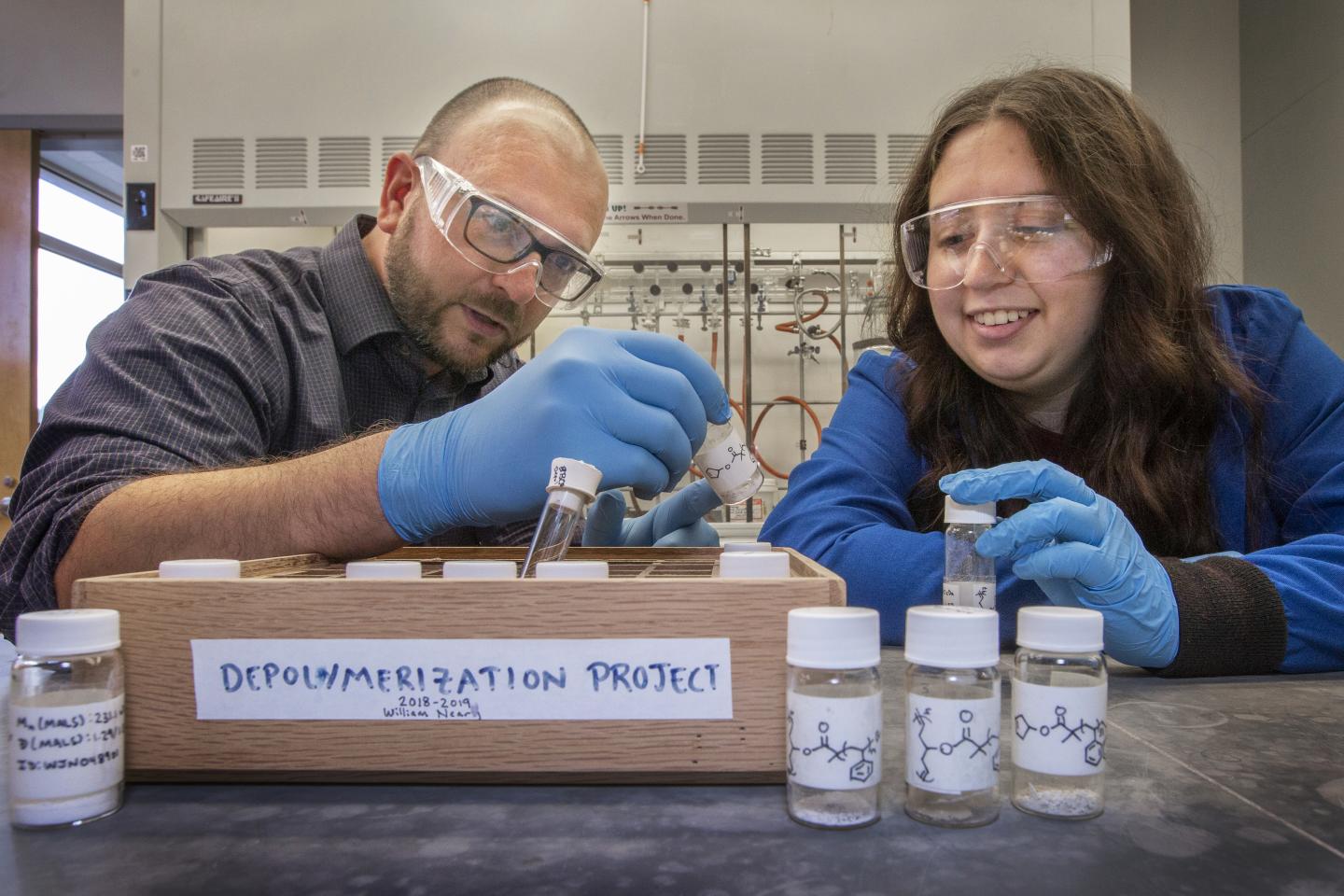
Credit: Bruce Palmer/FSU Photography Services

TALLAHASSEE, Fla. — A Florida State University research team has developed methods to manipulate polymers in a way that changes their fundamental structure, paving the way for potential applications in cargo delivery and release, recyclable materials, shape-shifting soft robots, antimicrobials and more.

“We are making a polymer completely change its architecture through a chemical response,” said FSU Assistant Professor of Chemistry Justin Kennemur. “In nature this happens too. Think of how a caterpillar becomes a butterfly. The cellular machinery changes the design of natural biopolymers and hence their properties. That’s what we’re doing with synthetic polymers.”

The research is published in the Journal of the American Chemical Society.

Polymers are materials made of large molecular chains composed of chemically similar repeating units. They touch almost every part of everyday life and include materials like plastics, rubbers and gels and natural biological structures such as DNA and proteins.

In the big picture, Kennemur is working to develop high-performance polymers with super-elastic and super-soft properties that could be used as joint or cartilage replacements. To do that, he and his team are exploring the boundaries of how existing polymers respond to stimuli and can be reorganized for better performance.

Polymers that spontaneously “unzip” or deteriorate in response to an external stimulus have gained traction from scientists for their potential use in a variety of applications. However, this spontaneous deteriorating — called depolymerization — often makes them difficult to assemble in the first place.

Kennemur refined a process to both create the polymer and cause it to break down, completely changing its structure.

Kennemur and his team developed a thermodynamic strategy where they synthesize the macromolecules at a lower temperature — about -15 to 0 degrees Celsius — and then stabilize the polymer before warming it up. At warmer temperatures, the materials could depolymerize with a triggering event — the introduction of a catalytic amount of the element ruthenium — which causes an unzipping of the polymer.

“We’ve really invested in leveraging fundamental thermodynamic principles in polymer science, and we use this to transform the molecules into a variety of possible shapes and chemistries,” Kennemur said. “It’s a way to recycle these materials, but it’s also a way to get them to respond and change their architecture. There are a lot of fun possibilities with this.”

###

Kennemur’s work is funded by the National Science Foundation’s CAREER program. Former FSU graduate student William Neary and current graduate student Taylor Isais are co-authors of the study.

Media Contact
Kathleen Haughney
[email protected]

Tags: Chemistry/Physics/Materials SciencesPolymer Chemistry
Share12Tweet8Share2ShareShareShare2

Related Posts

blank

Breakthrough in Environmental Cleanup: Scientists Develop Solar-Activated Biochar for Faster Remediation

February 7, 2026
blank

Cutting Costs: Making Hydrogen Fuel Cells More Affordable

February 6, 2026

Scientists Develop Hand-Held “Levitating” Time Crystals

February 6, 2026

Observing a Key Green-Energy Catalyst Dissolve Atom by Atom

February 6, 2026
Please login to join discussion

POPULAR NEWS

  • Robotic Ureteral Reconstruction: A Novel Approach

    Robotic Ureteral Reconstruction: A Novel Approach

    82 shares
    Share 33 Tweet 21
  • Digital Privacy: Health Data Control in Incarceration

    63 shares
    Share 25 Tweet 16
  • Study Reveals Lipid Accumulation in ME/CFS Cells

    57 shares
    Share 23 Tweet 14
  • Breakthrough in RNA Research Accelerates Medical Innovations Timeline

    53 shares
    Share 21 Tweet 13

About

We bring you the latest biotechnology news from best research centers and universities around the world. Check our website.

Follow us

Recent News

Personalized Guide to Understanding and Reducing Chemicals

Inflammasome Protein ASC Drives Pancreatic Cancer Metabolism

Phage-Antibiotic Combo Beats Resistant Peritoneal Infection

Subscribe to Blog via Email

Enter your email address to subscribe to this blog and receive notifications of new posts by email.

Join 73 other subscribers
  • Contact Us

Bioengineer.org © Copyright 2023 All Rights Reserved.

Welcome Back!

Login to your account below

Forgotten Password?

Retrieve your password

Please enter your username or email address to reset your password.

Log In
No Result
View All Result
  • Homepages
    • Home Page 1
    • Home Page 2
  • News
  • National
  • Business
  • Health
  • Lifestyle
  • Science

Bioengineer.org © Copyright 2023 All Rights Reserved.