• HOME
  • NEWS
  • EXPLORE
    • CAREER
      • Companies
      • Jobs
    • EVENTS
    • iGEM
      • News
      • Team
    • PHOTOS
    • VIDEO
    • WIKI
  • BLOG
  • COMMUNITY
    • FACEBOOK
    • INSTAGRAM
    • TWITTER
Thursday, March 26, 2026
BIOENGINEER.ORG
No Result
View All Result
  • Login
  • HOME
  • NEWS
  • EXPLORE
    • CAREER
      • Companies
      • Jobs
        • Lecturer
        • PhD Studentship
        • Postdoc
        • Research Assistant
    • EVENTS
    • iGEM
      • News
      • Team
    • PHOTOS
    • VIDEO
    • WIKI
  • BLOG
  • COMMUNITY
    • FACEBOOK
    • INSTAGRAM
    • TWITTER
  • HOME
  • NEWS
  • EXPLORE
    • CAREER
      • Companies
      • Jobs
        • Lecturer
        • PhD Studentship
        • Postdoc
        • Research Assistant
    • EVENTS
    • iGEM
      • News
      • Team
    • PHOTOS
    • VIDEO
    • WIKI
  • BLOG
  • COMMUNITY
    • FACEBOOK
    • INSTAGRAM
    • TWITTER
No Result
View All Result
Bioengineer.org
No Result
View All Result
Home NEWS Science News

OSU researcher using miniature cars to help advance autonomous vehicle safety

Bioengineer by Bioengineer
October 2, 2019
in Science News
Reading Time: 2 mins read
0
IMAGE
Share on FacebookShare on TwitterShare on LinkedinShare on RedditShare on Telegram

IMAGE

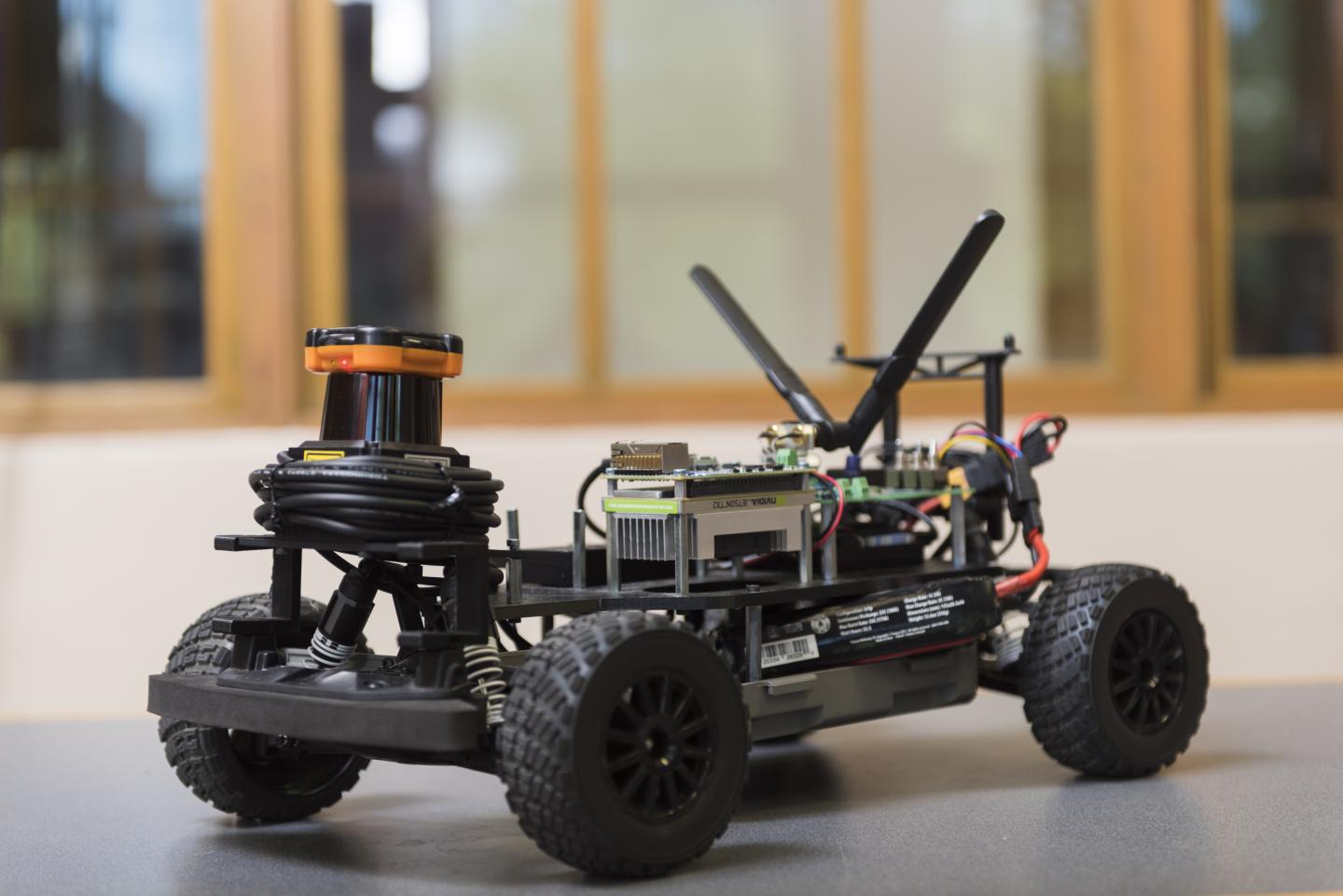
Credit: Hannah O’Leary, Oregon State University

CORVALLIS, Ore. – An autonomous systems expert at Oregon State University is helping to lead an effort to build research infrastructure for the safety, performance and security of driverless cars, supported by a $1.5 million grant from the National Science Foundation.

The project, a collaborative effort with the University of Pennsylvania and Clemson University, will put one-tenth-scale autonomous cars into the hands of researchers nationwide. They are working with the smaller cars because they are less expensive and safer to use.

Houssam Abbas, assistant professor of electrical and computer engineering in the College of Engineering at Oregon State, is one of the project’s principal investigators. He has been using the miniature vehicles for his own research areas such as cyber-physical security, and he has a bigger vision for the impact the cars could have for other researchers.

“If you want to see these autonomous systems developed with high performance and a high guarantee of safety and security, then you need everybody to pitch in,” Abbas said. “And so we are going to help that process. It’s really about being part of a larger community.”

Testing autonomous systems on full-scale vehicles can be prohibitively expensive – a base model can cost more than $300,000. Abbas says he priced one out at $700,000 that was loaded with everything he would need for his research.

In contrast, the one-tenth-sized cars will be free to the more than 30 labs collaborating on the grant. The smaller cars are also safer to use when testing out new systems.

Over the next three years, Abbas will work with lead principal investigator Rahul Mangharam of the University of Pennsylvania and Venkat Krovi of Clemson University to develop a fleet of about 80 cars; a simulator for autonomous driving supporting multiple cars, environments and configurations to test the cars; a comprehensive manual; a community Q&A site; lecture notes and videos for a course based on the scaled-down cars; and a demonstration kit for community-building events such as talks, tutorials and short courses.

Researchers receiving cars will contribute code and add to the design and documentation. The main product of the grant project is not the cars themselves, which will ultimately be donated to high schools and other groups , but the infrastructure that allows researchers to buy parts, download code and documentation, and build their own research or teaching platforms.

“The objective is to enable and catalyze research on autonomous systems for research groups that normally would not have the means, the resources or the skills to build an autonomous car,” Abbas said.

###

Media Contact
Houssam Abbas
[email protected]

Original Source

https://beav.es/ZBQ

Tags: Computer ScienceElectrical Engineering/ElectronicsMechanical EngineeringMultimedia/Networking/Interface DesignTechnology/Engineering/Computer ScienceVehicles
Share12Tweet8Share2ShareShareShare2

Related Posts

Microtubules Found to Actively Ensure Accurate Chromosome Distribution During Cell Division

March 25, 2026

Aversive Learning Hijacks Brain Sugar Sensor

March 25, 2026

Isolated H2-Reduced Clusters Boost CO2-to-Methanol Catalysis

March 25, 2026

In-Sensor Cryptography Links Physical Process to Digital Identity

March 25, 2026
Please login to join discussion

POPULAR NEWS

  • blank

    Revolutionary AI Model Enhances Precision in Detecting Food Contamination

    96 shares
    Share 38 Tweet 24
  • Imagine a Social Media Feed That Challenges Your Views Instead of Reinforcing Them

    1003 shares
    Share 397 Tweet 248
  • Uncovering Functions of Cavernous Malformation Proteins in Organoids

    54 shares
    Share 22 Tweet 14
  • Promising Outcomes from First Clinical Trials of Gene Regulation in Epilepsy

    51 shares
    Share 20 Tweet 13

About

We bring you the latest biotechnology news from best research centers and universities around the world. Check our website.

Follow us

Recent News

In-Sensor Cryptography Links Physical Process to Digital Identity

Can Psychosocial Factors Influence Cancer Risk?

Depression Factors in Elderly: Pre vs. Post-COVID Analysis

Subscribe to Blog via Email

Success! An email was just sent to confirm your subscription. Please find the email now and click 'Confirm' to start subscribing.

Join 78 other subscribers
  • Contact Us

Bioengineer.org © Copyright 2023 All Rights Reserved.

Welcome Back!

Login to your account below

Forgotten Password?

Retrieve your password

Please enter your username or email address to reset your password.

Log In
No Result
View All Result
  • Homepages
    • Home Page 1
    • Home Page 2
  • News
  • National
  • Business
  • Health
  • Lifestyle
  • Science

Bioengineer.org © Copyright 2023 All Rights Reserved.