• HOME
  • NEWS
  • EXPLORE
    • CAREER
      • Companies
      • Jobs
    • EVENTS
    • iGEM
      • News
      • Team
    • PHOTOS
    • VIDEO
    • WIKI
  • BLOG
  • COMMUNITY
    • FACEBOOK
    • INSTAGRAM
    • TWITTER
Saturday, February 7, 2026
BIOENGINEER.ORG
No Result
View All Result
  • Login
  • HOME
  • NEWS
  • EXPLORE
    • CAREER
      • Companies
      • Jobs
        • Lecturer
        • PhD Studentship
        • Postdoc
        • Research Assistant
    • EVENTS
    • iGEM
      • News
      • Team
    • PHOTOS
    • VIDEO
    • WIKI
  • BLOG
  • COMMUNITY
    • FACEBOOK
    • INSTAGRAM
    • TWITTER
  • HOME
  • NEWS
  • EXPLORE
    • CAREER
      • Companies
      • Jobs
        • Lecturer
        • PhD Studentship
        • Postdoc
        • Research Assistant
    • EVENTS
    • iGEM
      • News
      • Team
    • PHOTOS
    • VIDEO
    • WIKI
  • BLOG
  • COMMUNITY
    • FACEBOOK
    • INSTAGRAM
    • TWITTER
No Result
View All Result
Bioengineer.org
No Result
View All Result
Home NEWS Science News Chemistry

‘Poisoned arrowhead’ used by warring bacteria could lead to new antibiotics

Bioengineer by Bioengineer
October 1, 2019
in Chemistry
Reading Time: 3 mins read
0
IMAGE
Share on FacebookShare on TwitterShare on LinkedinShare on RedditShare on Telegram

IMAGE

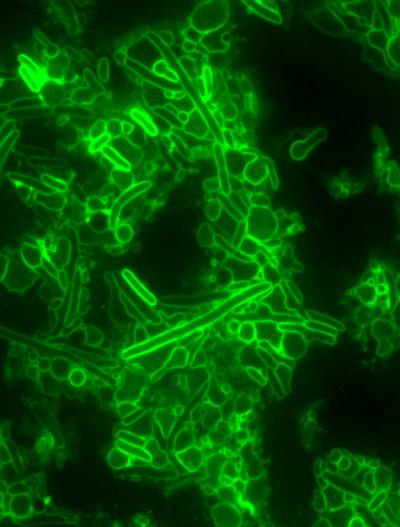
Credit: T.E. Wood et al. (2019)

A weapon bacteria use to vanquish their competitors could be copied to create new forms of antibiotics, according to Imperial College London research.

Researchers have uncovered a novel weapon in the arsenal of bacteria that works in a similar way to common antibiotics.

By discovering the mechanism of this new weapon, the team say new antibiotics could be designed to fill the gap left by rising levels of antibiotic resistance.

Lead author Professor Alain Filloux, from the MRC Centre for Molecular Bacteriology and Infection in the Department of Life Sciences at Imperial, said: “Bacteria evolved alongside each other for billions of years and have designed many strategies to fight and kill each other to prevail in the environment.

“This new ‘toxic arrowhead’ is one of the tools developed for this, and finding all the other possible strategies employed for bacterial warfare would help researchers and the pharmaceutical industry replenish the currently dwindling pipeline of antibiotics.”

The new study, published today in Cell Reports, looked at the Type VI Secretion System (T6SS) – a ‘molecular crossbow’ that some bacteria use to launch toxic packages at rival bacteria. Bacteria fight for dominance to control food sources and space, allowing them to thrive in their environment.

The team discovered a new kind of toxic arrowhead used by the bacterium Pseudomonas aeruginosa, called VgrG2b, with the toxin found at the very tip. By analysing the atomic structure of the toxin, the team showed that it is an enzyme known as a metallopeptidase, which cuts up proteins.

Once fired into a rival bacterium, VgrG2b targets the cell envelope, between the inner and outer bacterial membranes and encompassing the cell wall. Dr Abderrahman Hachani, now at the University of Melbourne, said: “This vital area provides structural integrity to the cell, regulates its growth, and acts as a protective barrier against the external environment.”

VgrG2b prevents the cell from dividing, causing it instead to bulge and eventually explode as the integrity of the cell fails.

This form of attack is similar to how a group of antibiotics, called beta-lactams, work. These antibiotics include penicillin, and as is the case with many classes of antibiotics, many harmful bacteria are becoming increasingly resistant to them.

Dr Thomas Wood, now at Harvard Medical School, said: “The impact of VgrG2b on target cells mimics the action of beta-lactam antibiotics. Yet it is clear that its mode of action is different. By further understanding and characterising the molecular targets of VgrG2b, and how the toxin works, this research would support the design of new antibiotics.”

###

The research was supported by the Medical Research Council and the Wellcome Trust.

Media Contact
Hayley Dunning
[email protected]

Original Source

https://www.imperial.ac.uk/news/193148/poisoned-arrowhead-used-warring-bacteria-could/

Related Journal Article

http://dx.doi.org/10.1016/j.celrep.2019.08.094

Tags: BacteriologyBiochemistryBiologyBiomechanics/BiophysicsCell BiologyMicrobiology
Share12Tweet8Share2ShareShareShare2

Related Posts

blank

Breakthrough in Environmental Cleanup: Scientists Develop Solar-Activated Biochar for Faster Remediation

February 7, 2026
blank

Cutting Costs: Making Hydrogen Fuel Cells More Affordable

February 6, 2026

Scientists Develop Hand-Held “Levitating” Time Crystals

February 6, 2026

Observing a Key Green-Energy Catalyst Dissolve Atom by Atom

February 6, 2026
Please login to join discussion

POPULAR NEWS

  • Robotic Ureteral Reconstruction: A Novel Approach

    Robotic Ureteral Reconstruction: A Novel Approach

    82 shares
    Share 33 Tweet 21
  • Digital Privacy: Health Data Control in Incarceration

    63 shares
    Share 25 Tweet 16
  • Study Reveals Lipid Accumulation in ME/CFS Cells

    57 shares
    Share 23 Tweet 14
  • Breakthrough in RNA Research Accelerates Medical Innovations Timeline

    53 shares
    Share 21 Tweet 13

About

We bring you the latest biotechnology news from best research centers and universities around the world. Check our website.

Follow us

Recent News

Florida Cane Toad: Complex Spread and Selective Evolution

Exploring Decision-Making in Dementia Caregivers’ Mobility

Succinate Receptor 1 Limits Blood Cell Formation, Leukemia

Subscribe to Blog via Email

Enter your email address to subscribe to this blog and receive notifications of new posts by email.

Join 73 other subscribers
  • Contact Us

Bioengineer.org © Copyright 2023 All Rights Reserved.

Welcome Back!

Login to your account below

Forgotten Password?

Retrieve your password

Please enter your username or email address to reset your password.

Log In
No Result
View All Result
  • Homepages
    • Home Page 1
    • Home Page 2
  • News
  • National
  • Business
  • Health
  • Lifestyle
  • Science

Bioengineer.org © Copyright 2023 All Rights Reserved.