• HOME
  • NEWS
  • EXPLORE
    • CAREER
      • Companies
      • Jobs
    • EVENTS
    • iGEM
      • News
      • Team
    • PHOTOS
    • VIDEO
    • WIKI
  • BLOG
  • COMMUNITY
    • FACEBOOK
    • INSTAGRAM
    • TWITTER
Saturday, February 7, 2026
BIOENGINEER.ORG
No Result
View All Result
  • Login
  • HOME
  • NEWS
  • EXPLORE
    • CAREER
      • Companies
      • Jobs
        • Lecturer
        • PhD Studentship
        • Postdoc
        • Research Assistant
    • EVENTS
    • iGEM
      • News
      • Team
    • PHOTOS
    • VIDEO
    • WIKI
  • BLOG
  • COMMUNITY
    • FACEBOOK
    • INSTAGRAM
    • TWITTER
  • HOME
  • NEWS
  • EXPLORE
    • CAREER
      • Companies
      • Jobs
        • Lecturer
        • PhD Studentship
        • Postdoc
        • Research Assistant
    • EVENTS
    • iGEM
      • News
      • Team
    • PHOTOS
    • VIDEO
    • WIKI
  • BLOG
  • COMMUNITY
    • FACEBOOK
    • INSTAGRAM
    • TWITTER
No Result
View All Result
Bioengineer.org
No Result
View All Result
Home NEWS Science News Chemistry

New synthetic polymer degradable under very mild acidic conditions

Bioengineer by Bioengineer
September 25, 2019
in Chemistry
Reading Time: 2 mins read
0
IMAGE
Share on FacebookShare on TwitterShare on LinkedinShare on RedditShare on Telegram

IMAGE

Credit: Ehime University

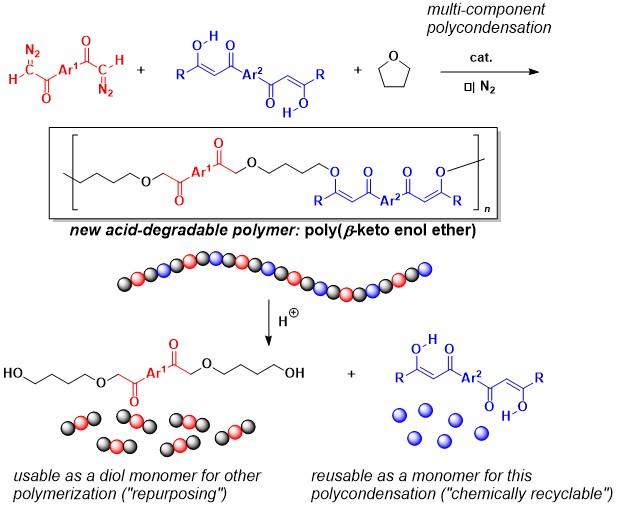
A research team in Ehime University prepared a new type of synthetic polymer, which can be degraded into a combination of well-defined low molecular weight compounds under very mild acidic conditions. The new polymer, poly(β-keto enol ether), has great potential to be utilized as an environmentally friendly material in the near future.

The research team, led by E. Ihara and H. Shimomoto, has been utilizing unique reactivities of a diazocarbonyl group for polymer synthesis where they have succeeded in preparing a variety of polymers with unprecedented chemical structures by the polymerization of some bis(diazocarbonyl) compounds bearing two diazocarbonyl groups in one molecule. Now they have found that three-component polymerization of an appropriated combination of a bis(diazocarbonyl) compound, bis(1,3-diketone), and tetrahydrofuran (THF) as monomers yields a new type of polymer structure containing the β-keto enol ether framework in the main chain, which has been known to be readily cleaved with a small amount of acid.

The polymerization catalyzed by a Rh catalyst proceeded as they expected, affording poly(β-keto enol ether) with a molecular weight higher than 10000. More importantly, the polymer was found to be cleanly degraded into a combination of two low molecular weight compounds in high yield under mild acidic conditions; one of the degraded products was the monomer itself, bis(1,3-diketone) (indicating recyclability of the monomer), and the other one was a dihydroxy compound derived from the bis (diazocarbonyl) compound and THF used as other monomers.

The acid-sensitivity of the β-keto enol ether framework of the polymer was so high that the degradation proceeded even in a chloroform solution because the solvent usually contains a very small amount of acid spontaneously generated from the solvent molecule under an ambient condition. On the other hand, in other solvents without an acidic trace, such as dimethylsulfoxide, the polymer did not degrade at all, demonstrating the extremely high sensitivity of the polymer structure to an acidic stimulus.

The highly acid-sensitive degradability can be useful for some important applications. For example, a drug-encapsulating material made of the polymer would release the incorporated active component by rapidly responding to a mild acidic environment. In addition, materials made of the polymer can be easily degraded to the above-described low molecular weight compounds, including one of the monomers, after they are used in neutral conditions. Synthetic polymers with such degradability are especially desired because of the serious environmental damage caused by non-degradable synthetic polymeric materials.

###

Media Contact
Public Relations Division
[email protected]

Related Journal Article

http://dx.doi.org/10.1021/acs.macromol.9b00653

Tags: Chemistry/Physics/Materials Sciences
Share13Tweet8Share2ShareShareShare2

Related Posts

blank

Breakthrough in Environmental Cleanup: Scientists Develop Solar-Activated Biochar for Faster Remediation

February 7, 2026
blank

Cutting Costs: Making Hydrogen Fuel Cells More Affordable

February 6, 2026

Scientists Develop Hand-Held “Levitating” Time Crystals

February 6, 2026

Observing a Key Green-Energy Catalyst Dissolve Atom by Atom

February 6, 2026
Please login to join discussion

POPULAR NEWS

  • Robotic Ureteral Reconstruction: A Novel Approach

    Robotic Ureteral Reconstruction: A Novel Approach

    82 shares
    Share 33 Tweet 21
  • Digital Privacy: Health Data Control in Incarceration

    63 shares
    Share 25 Tweet 16
  • Study Reveals Lipid Accumulation in ME/CFS Cells

    57 shares
    Share 23 Tweet 14
  • Breakthrough in RNA Research Accelerates Medical Innovations Timeline

    53 shares
    Share 21 Tweet 13

About

We bring you the latest biotechnology news from best research centers and universities around the world. Check our website.

Follow us

Recent News

Evaluating Pediatric Emergency Care Quality in Ethiopia

TPMT Expression Predictions Linked to Azathioprine Side Effects

Improving Dementia Care with Enhanced Activity Kits

Subscribe to Blog via Email

Success! An email was just sent to confirm your subscription. Please find the email now and click 'Confirm' to start subscribing.

Join 73 other subscribers
  • Contact Us

Bioengineer.org © Copyright 2023 All Rights Reserved.

Welcome Back!

Login to your account below

Forgotten Password?

Retrieve your password

Please enter your username or email address to reset your password.

Log In
No Result
View All Result
  • Homepages
    • Home Page 1
    • Home Page 2
  • News
  • National
  • Business
  • Health
  • Lifestyle
  • Science

Bioengineer.org © Copyright 2023 All Rights Reserved.