• HOME
  • NEWS
  • EXPLORE
    • CAREER
      • Companies
      • Jobs
    • EVENTS
    • iGEM
      • News
      • Team
    • PHOTOS
    • VIDEO
    • WIKI
  • BLOG
  • COMMUNITY
    • FACEBOOK
    • INSTAGRAM
    • TWITTER
Monday, February 2, 2026
BIOENGINEER.ORG
No Result
View All Result
  • Login
  • HOME
  • NEWS
  • EXPLORE
    • CAREER
      • Companies
      • Jobs
        • Lecturer
        • PhD Studentship
        • Postdoc
        • Research Assistant
    • EVENTS
    • iGEM
      • News
      • Team
    • PHOTOS
    • VIDEO
    • WIKI
  • BLOG
  • COMMUNITY
    • FACEBOOK
    • INSTAGRAM
    • TWITTER
  • HOME
  • NEWS
  • EXPLORE
    • CAREER
      • Companies
      • Jobs
        • Lecturer
        • PhD Studentship
        • Postdoc
        • Research Assistant
    • EVENTS
    • iGEM
      • News
      • Team
    • PHOTOS
    • VIDEO
    • WIKI
  • BLOG
  • COMMUNITY
    • FACEBOOK
    • INSTAGRAM
    • TWITTER
No Result
View All Result
Bioengineer.org
No Result
View All Result
Home NEWS Science News Biology

Chinese scientists develop novel biophotovoltaics system

Bioengineer by Bioengineer
September 20, 2019
in Biology
Reading Time: 2 mins read
0
IMAGE
Share on FacebookShare on TwitterShare on LinkedinShare on RedditShare on Telegram

IMAGE

Credit: Image from LI Yin’s group, Institute of Microbiology, Chinese Academy of Sciences

Researchers from the Institute of Microbiology of the Chinese Academy of Sciences have reported a novel biophotovoltaics (BPV) system based on a synthetic microbial consortium with constrained electron flow. This BPV system can stably operate for more than 40 days, setting a new BPV longevity milestone, according to a recent article in Nature Communications.

BPV is an emerging technology that employs biological photosynthetic materials (mainly living photosynthetic microorganisms) to convert solar energy into electricity. BPV is more environmentally friendly and potentially more cost-effective than semiconductor-based photovoltaics (PV), given the toxicity and hard-to-recycle nature of PV materials.

However, the power densities of BPV systems reported to date have been low, since photosynthetic microorganisms have a weak capacity to transfer electrons outside cells. To circumvent this problem, researchers have created a two-species microbial consortium.

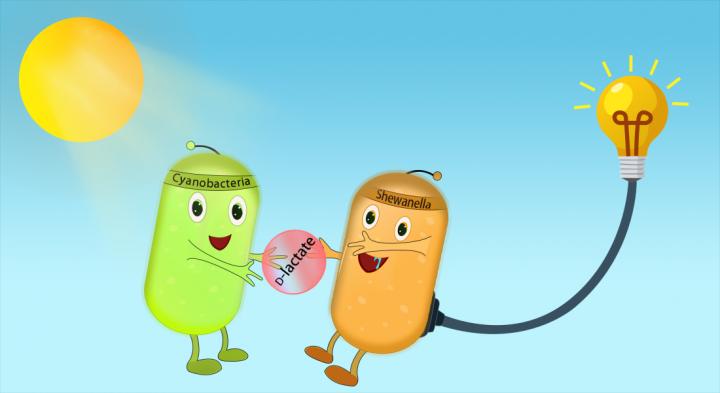
This microbial consortium is composed of photosynthetic cyanobacteria and the exoelectrogenic bacteria Shewanella, with the latter inherently possessing strong exoelectrogenic activity. D-lactate was selected as the energy carrier responsible for directed energy transfer between cyanobacteria and Shewanella (Fig. 1).

In this microbial consortium, cyanobacteria capture solar energy and fix CO2 to synthesize D-lactate, while Shewanella produce electricity by oxidizing D-lactate, thus creating a constrained electron flow from photons to D-lactate, then to electricity.

Through genetic manipulation, as well as manipulation of the growth medium and device, the two very different microorganisms are able to work together effectively. This BPV system generates a power density of 150 mW·m-2 in a temporal separation setup, which is approximately one order of magnitude greater than mediator-less BPV devices with conventional configurations.

The researchers further demonstrated that this BPV system can stably operate for more than 40 days at an average power density of 135 mWm-2 in a spatial-temporal separation setup with medium replenishment. This represents the greatest longevity and power output per device of any BPV system reported to date.

###

The study, entitled “Development of a longevous two-species biophotovoltaics with constrained electron flow,” is the first report of a BPV system using a synthetic microbial consortium. Research was supported by the Key Research Program of the Chinese Academy of Sciences.

Media Contact
JI Haili
[email protected]

Related Journal Article

http://dx.doi.org/10.1038/s41467-019-12190-w

Tags: BiologyMicrobiology
Share14Tweet9Share2ShareShareShare2

Related Posts

Scientists Discover New RNA Associated with Cancer Patient Survival

Scientists Discover New RNA Associated with Cancer Patient Survival

February 2, 2026
Fungal Diversity in Paphiopedilum Roots and Soils

Fungal Diversity in Paphiopedilum Roots and Soils

February 2, 2026

How Light Pollution Interferes with Moth Navigation

February 2, 2026

Genetic Engineering Enhances Worker Cells to Boost Nanostructure Production for Advanced Sensing and Therapeutics

February 2, 2026
Please login to join discussion

POPULAR NEWS

  • Enhancing Spiritual Care Education in Nursing Programs

    157 shares
    Share 63 Tweet 39
  • Robotic Ureteral Reconstruction: A Novel Approach

    81 shares
    Share 32 Tweet 20
  • Digital Privacy: Health Data Control in Incarceration

    63 shares
    Share 25 Tweet 16
  • Study Reveals Lipid Accumulation in ME/CFS Cells

    57 shares
    Share 23 Tweet 14

About

We bring you the latest biotechnology news from best research centers and universities around the world. Check our website.

Follow us

Recent News

Study Indicates Significantly Reduced Cervical Cancer Screenings Needed for HPV-Vaccinated Women

“‘Ghost’ Providers Impede Medicaid Patients’ Access to Healthcare Services”

Scientists Discover New RNA Associated with Cancer Patient Survival

Subscribe to Blog via Email

Enter your email address to subscribe to this blog and receive notifications of new posts by email.

Join 73 other subscribers
  • Contact Us

Bioengineer.org © Copyright 2023 All Rights Reserved.

Welcome Back!

Login to your account below

Forgotten Password?

Retrieve your password

Please enter your username or email address to reset your password.

Log In
No Result
View All Result
  • Homepages
    • Home Page 1
    • Home Page 2
  • News
  • National
  • Business
  • Health
  • Lifestyle
  • Science

Bioengineer.org © Copyright 2023 All Rights Reserved.