• HOME
  • NEWS
  • EXPLORE
    • CAREER
      • Companies
      • Jobs
    • EVENTS
    • iGEM
      • News
      • Team
    • PHOTOS
    • VIDEO
    • WIKI
  • BLOG
  • COMMUNITY
    • FACEBOOK
    • INSTAGRAM
    • TWITTER
Monday, May 11, 2026
BIOENGINEER.ORG
No Result
View All Result
  • Login
  • HOME
  • NEWS
  • EXPLORE
    • CAREER
      • Companies
      • Jobs
        • Lecturer
        • PhD Studentship
        • Postdoc
        • Research Assistant
    • EVENTS
    • iGEM
      • News
      • Team
    • PHOTOS
    • VIDEO
    • WIKI
  • BLOG
  • COMMUNITY
    • FACEBOOK
    • INSTAGRAM
    • TWITTER
  • HOME
  • NEWS
  • EXPLORE
    • CAREER
      • Companies
      • Jobs
        • Lecturer
        • PhD Studentship
        • Postdoc
        • Research Assistant
    • EVENTS
    • iGEM
      • News
      • Team
    • PHOTOS
    • VIDEO
    • WIKI
  • BLOG
  • COMMUNITY
    • FACEBOOK
    • INSTAGRAM
    • TWITTER
No Result
View All Result
Bioengineer.org
No Result
View All Result
Home NEWS Science News Chemistry

UBC engineers create ways to keep stone waste out of landfills

Bioengineer by Bioengineer
September 19, 2019
in Chemistry
Reading Time: 3 mins read
0
IMAGE
Share on FacebookShare on TwitterShare on LinkedinShare on RedditShare on Telegram

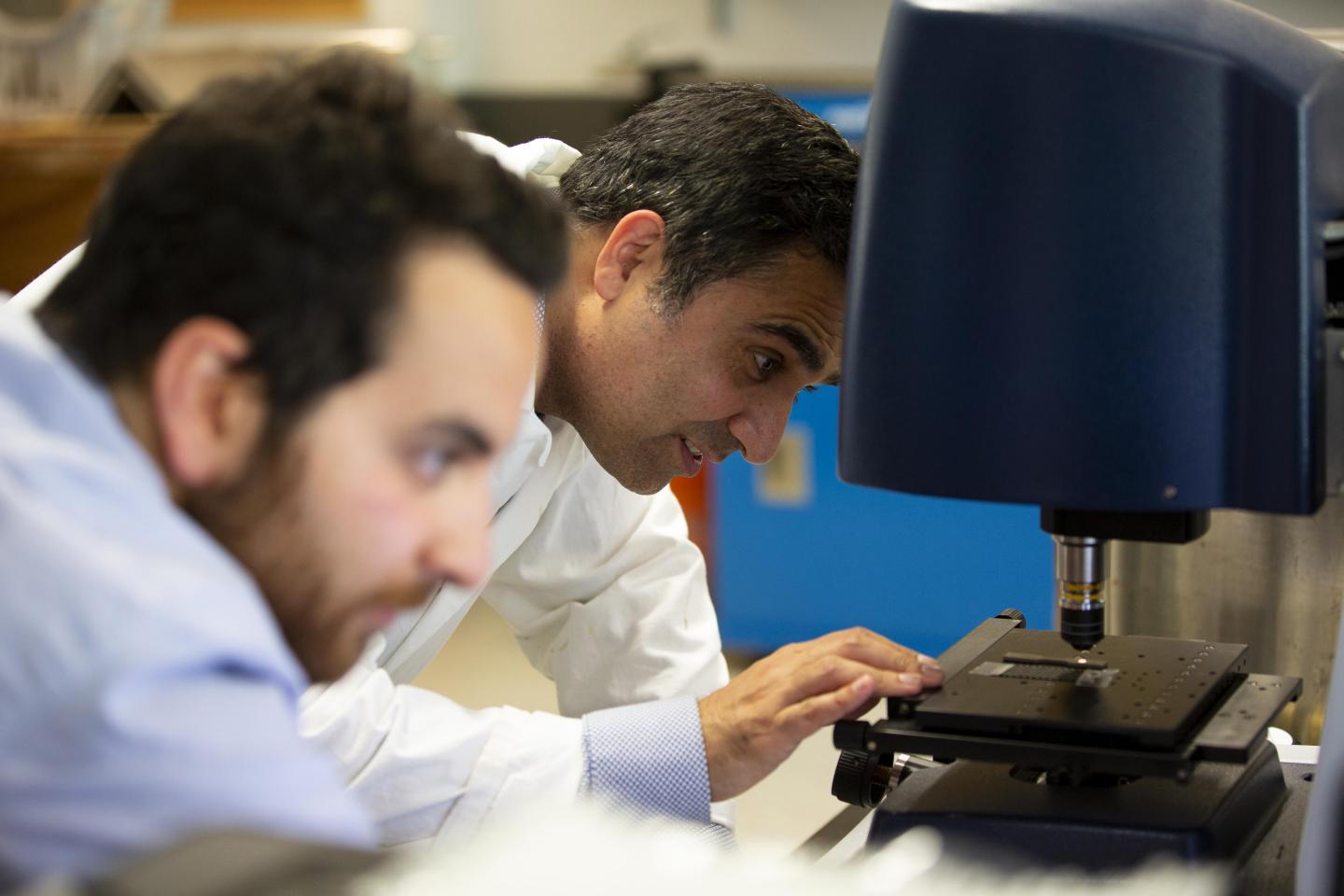
Discarded materials mixed into a slurry for a second life
IMAGE

Credit: UBCO

Using polymers and natural stone slurry waste, UBC Okanagan researchers are manufacturing environmentally friendly stone composites.

These new composites are made of previously discarded materials left behind during the cutting of natural structural or ornamental blocks for buildings, construction supplies or monuments. While reusing the waste material of natural stone production is common in cement, tile and concrete, adding the stone slurry to polymers is a new and innovative idea, explains School of Engineering Professor Abbas Milani.

A growing industrial demand for multifunctional bio-friendly raw materials is pushing researchers to develop value-added and energy-saving biocomposites and processes, he explains.

“Because the slurry is a waste material, it comes at a lower cost for recycled composite production,” says Milani, director of UBC’s Materials and Manufacturing Research Institute (MMRI).

Milani and his colleagues recently received UBC eminence funding to establish a cluster of research excellence in biocomposites. The cluster will develop novel agricultural and forestry-based bio-and recycled composites to minimize the impact of conventional plastics and waste on the environment.

The powdered stone waste used in the project provides flexibility to the new particulate polymer matrix composite. It can be mixed at different ratios into the finished product through appropriate heat or pressure to meet structural requirements or aesthetic choices, defined by industry and customers.

“This green stone composite can easily be integrated into a variety of applications,” says UBC Research Associate Davoud Karimi. “These composites can be used in decorations and sanitation products ranging from aerospace to automotive applications.”

The researchers varied the amount of stone added to the composites then tested several parameters to determine strength, durability and density along with thermal conductivity. The molding and mechanical tests were conducted in the Composites Research Network Okanagan Laboratory with collaboration from the MMRI.

By adding the stone waste to the composites, researchers determined that it not only increased the virgin polymer’s strength and durability, but the composites’ conductivity increased proportionally based on the amount of stone added.

“The increased strength is important, but the increased conductivity (up to 500 per cent) opens a huge door to several new potential applications, including 3D printing with recycled composites,” explains Milani.

“Any time we can divert waste from landfills and generate a product with the potential of economic benefit is a win-win,” Milani adds. “We hope that these sorts of products, that are carefully designed with the aid of multi-disciplinary researchers focused on 3R measures (repairable, reusable, and recyclable), can significantly contribute to the economy of our region and Canada as a whole.”

###

The research was funded by the Natural Sciences and Engineering Research Council (NSERC) and the National Research Institute for Science Policy (NRISP). It was recently published in two prestigious journals Composite Structures and Composites Part B: Engineering.

Media Contact
Patty Wellborn
[email protected]

Original Source

https://news.ok.ubc.ca/2019/09/19/ubc-engineers-create-ways-to-keep-stone-waste-out-of-landfills/

Related Journal Article

http://dx.doi.org/10.1016/j.compstruct.2019.111331

Tags: Biomedical/Environmental/Chemical EngineeringChemistry/Physics/Materials SciencesCivil EngineeringEcology/EnvironmentPolymer Chemistry
Share12Tweet8Share2ShareShareShare2

Related Posts

Miniature Sensor Uses Light to Detect Touch — Chemistry

Miniature Sensor Uses Light to Detect Touch

May 8, 2026
Iron Minerals Determine Whether Dissolved Organic Matter Fuels Microbes or Becomes Long-Term Carbon Storage — Chemistry

Iron Minerals Determine Whether Dissolved Organic Matter Fuels Microbes or Becomes Long-Term Carbon Storage

May 8, 2026

Kate Evans Appointed Associate Lab Director for Biological and Environmental Systems Science at ORNL

May 8, 2026

Advancing Multiscale Modeling and Overcoming Operational Challenges in Autothermal COâ‚‚-to-Methanol Reactors

May 8, 2026
Please login to join discussion

POPULAR NEWS

  • Research Indicates Potential Connection Between Prenatal Medication Exposure and Elevated Autism Risk

    840 shares
    Share 336 Tweet 210
  • New Study Reveals Plants Can Detect the Sound of Rain

    727 shares
    Share 290 Tweet 181
  • Salmonella Haem Blocks Macrophages, Boosts Infection

    61 shares
    Share 24 Tweet 15
  • Breastmilk Balances E. coli and Beneficial Bacteria in Infant Gut Microbiomes

    57 shares
    Share 23 Tweet 14

About

We bring you the latest biotechnology news from best research centers and universities around the world. Check our website.

Follow us

Recent News

New Post-Hoc Analysis Explores Daily Oral Orforglipron Use in Adults Over 65 with Obesity, Regardless of Diabetes Status

Evaluating Digoxin Use in Patients with Symptomatic Rheumatic Heart Disease

Evaluating the Effectiveness and Safety of Digitalis Glycosides in Treating Heart Failure

Subscribe to Blog via Email

Enter your email address to subscribe to this blog and receive notifications of new posts by email.

Join 82 other subscribers
  • Contact Us

Bioengineer.org © Copyright 2023 All Rights Reserved.

Welcome Back!

Login to your account below

Forgotten Password?

Retrieve your password

Please enter your username or email address to reset your password.

Log In
No Result
View All Result
  • Homepages
    • Home Page 1
    • Home Page 2
  • News
  • National
  • Business
  • Health
  • Lifestyle
  • Science

Bioengineer.org © Copyright 2023 All Rights Reserved.