• HOME
  • NEWS
  • EXPLORE
    • CAREER
      • Companies
      • Jobs
    • EVENTS
    • iGEM
      • News
      • Team
    • PHOTOS
    • VIDEO
    • WIKI
  • BLOG
  • COMMUNITY
    • FACEBOOK
    • INSTAGRAM
    • TWITTER
Thursday, January 15, 2026
BIOENGINEER.ORG
No Result
View All Result
  • Login
  • HOME
  • NEWS
  • EXPLORE
    • CAREER
      • Companies
      • Jobs
        • Lecturer
        • PhD Studentship
        • Postdoc
        • Research Assistant
    • EVENTS
    • iGEM
      • News
      • Team
    • PHOTOS
    • VIDEO
    • WIKI
  • BLOG
  • COMMUNITY
    • FACEBOOK
    • INSTAGRAM
    • TWITTER
  • HOME
  • NEWS
  • EXPLORE
    • CAREER
      • Companies
      • Jobs
        • Lecturer
        • PhD Studentship
        • Postdoc
        • Research Assistant
    • EVENTS
    • iGEM
      • News
      • Team
    • PHOTOS
    • VIDEO
    • WIKI
  • BLOG
  • COMMUNITY
    • FACEBOOK
    • INSTAGRAM
    • TWITTER
No Result
View All Result
Bioengineer.org
No Result
View All Result
Home NEWS Science News

Artificial materials reconstruct the porpoise’s echolocation

Bioengineer by Bioengineer
September 19, 2019
in Science News
Reading Time: 2 mins read
0
IMAGE
Share on FacebookShare on TwitterShare on LinkedinShare on RedditShare on Telegram

IMAGE

Credit: ©Science China Press

Over millions of years, porpoises have developed powerful biosonar with high accuracy and intelligence to detect and track preys in underwater noisy environment. The sound source in a porpoise is about one half of the wavelength of its emitted acoustic waves. According to textbook sonar theories, it is difficult to control the directional sound waves for target detection. Porpoises, with remarkable sonar detection capabilities, have been known as natural legend of echolocation. How to reconstruct their acoustic super-structures is a huge challenge for artificial design.

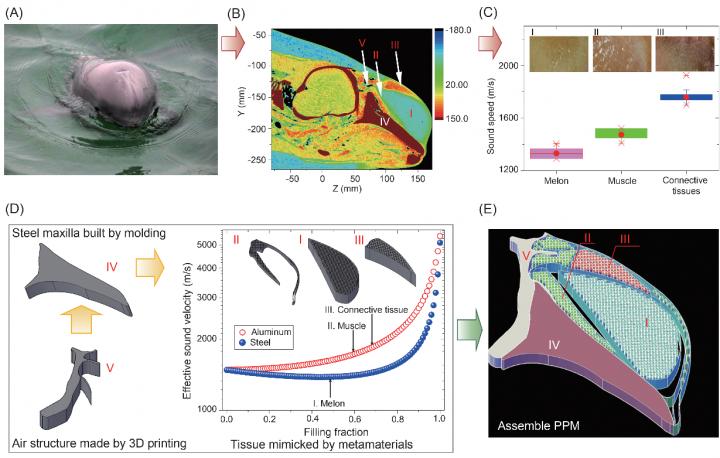
In one research work published in the National Science Review (NSR), the research groups of Prof. Yu Zhang from Xiamen University and Prof. Nicholas Xuanlai Fang from Massachusetts Institute of Technology made exciting progress in this research area. They proposed to reconstruct the finless porpoises’ physical model via hybrid metamaterials based on computer tomography imaging and gradient sound speed measurement (Fig. 1).

This physical-based porpoise model (PPM) can manipulate the directional sound beams through the multiphase artificial materials such as air sacs, solid structure, and gradient materials. The directional device can produce transient specular reflected and elastic waves by interacting with an underwater target, which is very similar to finless porpoise biosonar (Fig. 2). This advantage allows to significantly improve the detection accuracy and suppress the perturbations from environment noise and reverberation interferences such as sea interfaces and non-detected targets.

Acoustic field simulations and experimental measurements found that the PPM increased the main lobe energy in a wide range of frequency. However, the finless porpoise usually uses narrow-band sonar, suggesting that this physical model further improves the sonar performance. In addition, experimental measurements indicated that this device increased the signal-to-noise ratio for underwater target detection. Thus, PPM might have good performances in directionally detecting underwater targets and suppressing false target interferences.

The physical-based porpoise model bridges the gap between biosonar and artificial systems by mimicking biological materials. The physical modeling study of porpoises not only helps us to explore the natural mystery of porpoise’s biosonar, but also to promote the development of bioinspired technology, so as to achieve the goal of “From the nature but Beyond the nature”. The principle of wave manipulation in complex multiphase media is universal. The bioinspired devices might be widely used in the fields of underwater acoustic sensing, nondestructive testing, and medical ultrasound, etc.

###

See the article: Physical Modeling and Validation of Porpoise’s Directional Emission via Hybrid Metamaterial

Erqian Dong, Yu Zhang, Zhongchang Song, Tianye Zhang, Chen Cai and Nicholas X Fang.

Natl Sci Rev, 2019, doi: 10.1093/nsr/nwz085

https://doi.org/10.1093/nsr/nwz085

Media Contact
YAN Bei
[email protected]

Related Journal Article

http://dx.doi.org/10.1093/nsr/nwz085

Tags: Technology/Engineering/Computer Science
Share12Tweet8Share2ShareShareShare2

Related Posts

blank

Unlocking Soybean Root Traits: A Genome Study

January 15, 2026

Exploring Quinoxalinyl and Quinolinyl Compounds as ALK5 Inhibitors

January 15, 2026

EuroMOMO Estimates European Excess Mortality Trends

January 15, 2026

Prenatal, Birth Factors Linked to Child Autism Risk

January 15, 2026
Please login to join discussion

POPULAR NEWS

  • Enhancing Spiritual Care Education in Nursing Programs

    155 shares
    Share 62 Tweet 39
  • PTSD, Depression, Anxiety in Childhood Cancer Survivors, Parents

    147 shares
    Share 59 Tweet 37
  • Robotic Ureteral Reconstruction: A Novel Approach

    76 shares
    Share 30 Tweet 19
  • Study Reveals Lipid Accumulation in ME/CFS Cells

    53 shares
    Share 21 Tweet 13

About

We bring you the latest biotechnology news from best research centers and universities around the world. Check our website.

Follow us

Recent News

Unlocking Soybean Root Traits: A Genome Study

Exploring Quinoxalinyl and Quinolinyl Compounds as ALK5 Inhibitors

EuroMOMO Estimates European Excess Mortality Trends

Subscribe to Blog via Email

Enter your email address to subscribe to this blog and receive notifications of new posts by email.

Join 71 other subscribers
  • Contact Us

Bioengineer.org © Copyright 2023 All Rights Reserved.

Welcome Back!

Login to your account below

Forgotten Password?

Retrieve your password

Please enter your username or email address to reset your password.

Log In
No Result
View All Result
  • Homepages
    • Home Page 1
    • Home Page 2
  • News
  • National
  • Business
  • Health
  • Lifestyle
  • Science

Bioengineer.org © Copyright 2023 All Rights Reserved.