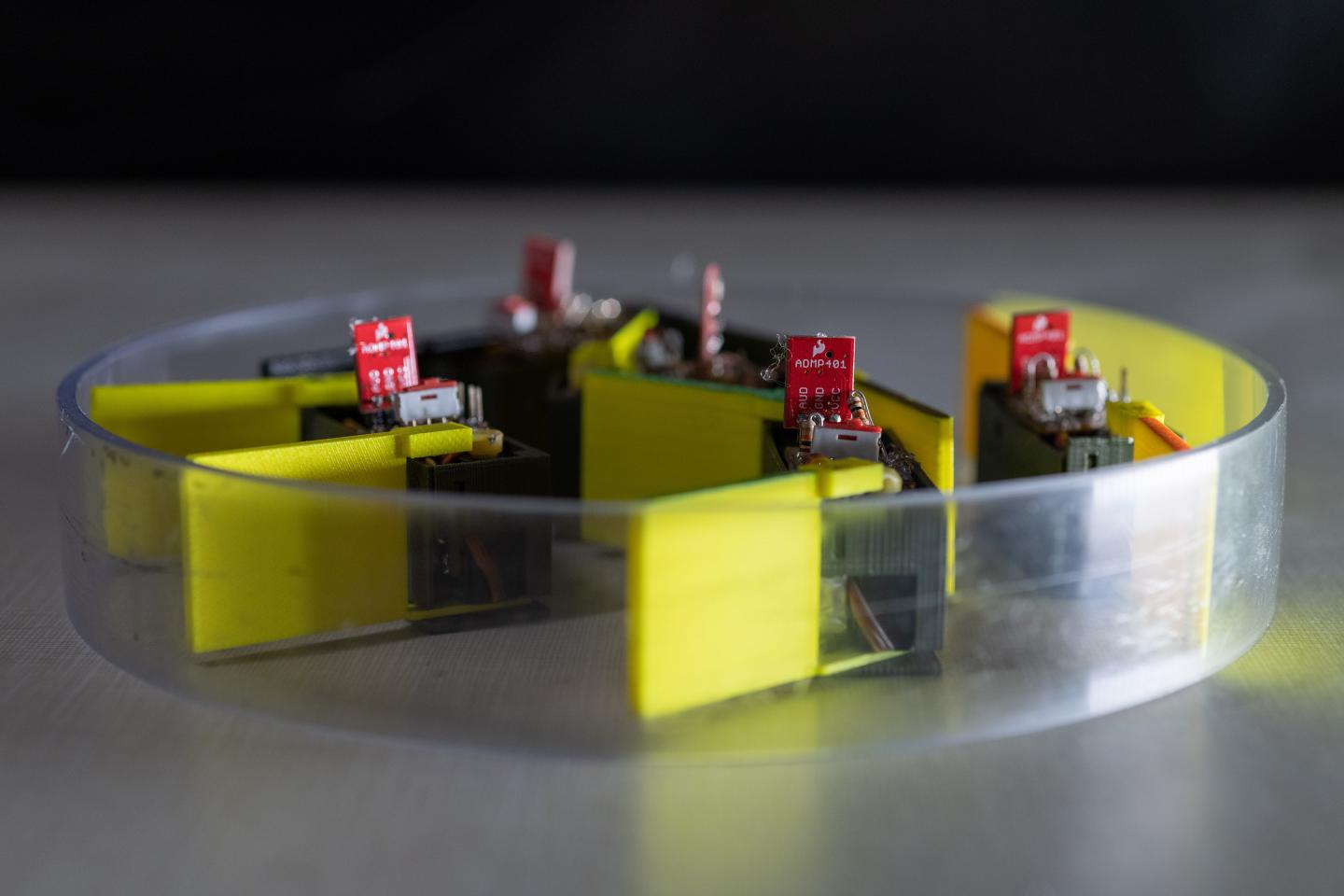
Credit: Rob Felt, Georgia Tech)
RESEARCH TRIANGLE PARK, N.C. — A U.S. Army project took a new approach to developing robots — researchers built robots entirely from smaller robots known as smarticles, unlocking the principles of a potentially new locomotion technique.
Researchers at Georgia Institute of Technology and Northwestern University published their findings in the journal Science Robotics.
The research could lead to robotic systems capable of changing their shapes, modalities and functions, said Sam Stanton, program manager, complex dynamics and systems at the Army Research Office, an element of U.S. Army Combat Capabilities Development Command’s Army Research Laboratory, the Army’s corporate research laboratory.
“For example, as envisioned by the Army Functional Concept for Maneuver, a robotic swarm may someday be capable of moving to a river and then autonomously forming a structure to span the gap,” he said.
The 3D-printed smarticles — short for smart active particles — can do just one thing: flap their two arms. But when five of these smarticles are confined in a circle, they begin to nudge one another, forming a robophysical system known as a “supersmarticle” that can move by itself. Adding a light or sound sensor allows the supersmarticle to move in response to the stimulus — and even be controlled well enough to navigate a maze.
The notion of making robots from smaller robots — and taking advantage of the group capabilities that arise by combining individuals — could provide mechanically based control over very small robots. Ultimately, the emergent behavior of the group could provide a new locomotion and control approach for small robots that could potentially change shapes.
“These are very rudimentary robots whose behavior is dominated by mechanics and the laws of physics,” said Dan Goldman, a Dunn Family Professor in the School of Physics at the Georgia Institute of Technology and the project’s principal investigator. “We are not looking to put sophisticated control, sensing and computation on them all. As robots become smaller and smaller, we’ll have to use mechanics and physics principles to control them because they won’t have the level of computation and sensing we would need for conventional control.”
The foundation for the research came from an unlikely source: a study of construction staples. By pouring these heavy-duty staples into a container with removable sides, former doctoral student Nick Gravish — now a faculty member at the University of California San Diego — created structures that would stand by themselves after the container’s walls were removed.
Shaking the staple towers eventually caused them to collapse, but the observations led to a realization that simple entangling of mechanical objects could create structures with capabilities well beyond those of the individual components.
“Dan Goldman’s research is identifying physical principles that may prove essential for engineering emergent behavior in future robot collectives as well as new understanding of fundamental tradeoffs in system performance, responsiveness, uncertainty, resiliency and adaptivity,” Stanton said.
The researchers used a 3D printer to create battery-powered smarticles, which have motors, simple sensors and limited computing power. The devices can change their location only when they interact with other devices while enclosed by a ring.
“Even though no individual robot could move on its own, the cloud composed of multiple robots could move as it pushed itself apart and shrink as it pulled itself together,” Goldman said. “If you put a ring around the cloud of little robots, they start kicking each other around and the larger ring — what we call a supersmarticle — moves around randomly.”
The researchers noticed that if one small robot stopped moving, perhaps because its battery died, the group of smarticles would begin moving in the direction of that stalled robot. The researchers learned to could control the movement by adding photo sensors to the robots that halt the arm flapping when a strong beam of light hits one of them.
“If you angle the flashlight just right, you can highlight the robot you want to be inactive, and that causes the ring to lurch toward or away from it, even though no robots are programmed to move toward the light,” Goldman said. “That allowed steering of the ensemble in a very rudimentary, stochastic way.”
In future work, Goldman envisions more complex interactions that use the simple sensing and movement capabilities of the smarticles. “People have been interested in making a certain kind of swarm robots that are composed of other robots,” he said. “These structures could be reconfigured on demand to meet specific needs by tweaking their geometry.”
Swarming formations of robotic systems could be used to enhance situational awareness and mission-command capabilities for small Army units in difficult-to-maneuver environments like cities, forests, caves or other rugged terrain.
###
The research project also received funding from National Science Foundation.
The CCDC Army Research Laboratory (ARL) is an element of the U.S. Army Combat Capabilities Development Command. As the Army’s corporate research laboratory, ARL discovers, innovates and transitions science and technology to ensure dominant strategic land power. Through collaboration across the command’s core technical competencies, CCDC leads in the discovery, development and delivery of the technology-based capabilities required to make Soldiers more effective to win our Nation’s wars and come home safely. CCDC is a major subordinate command of the U.S. Army Futures Command.
Media Contact
Lisa Bistreich-Wolfe
[email protected]
Original Source
https:/
Related Journal Article
http://dx.