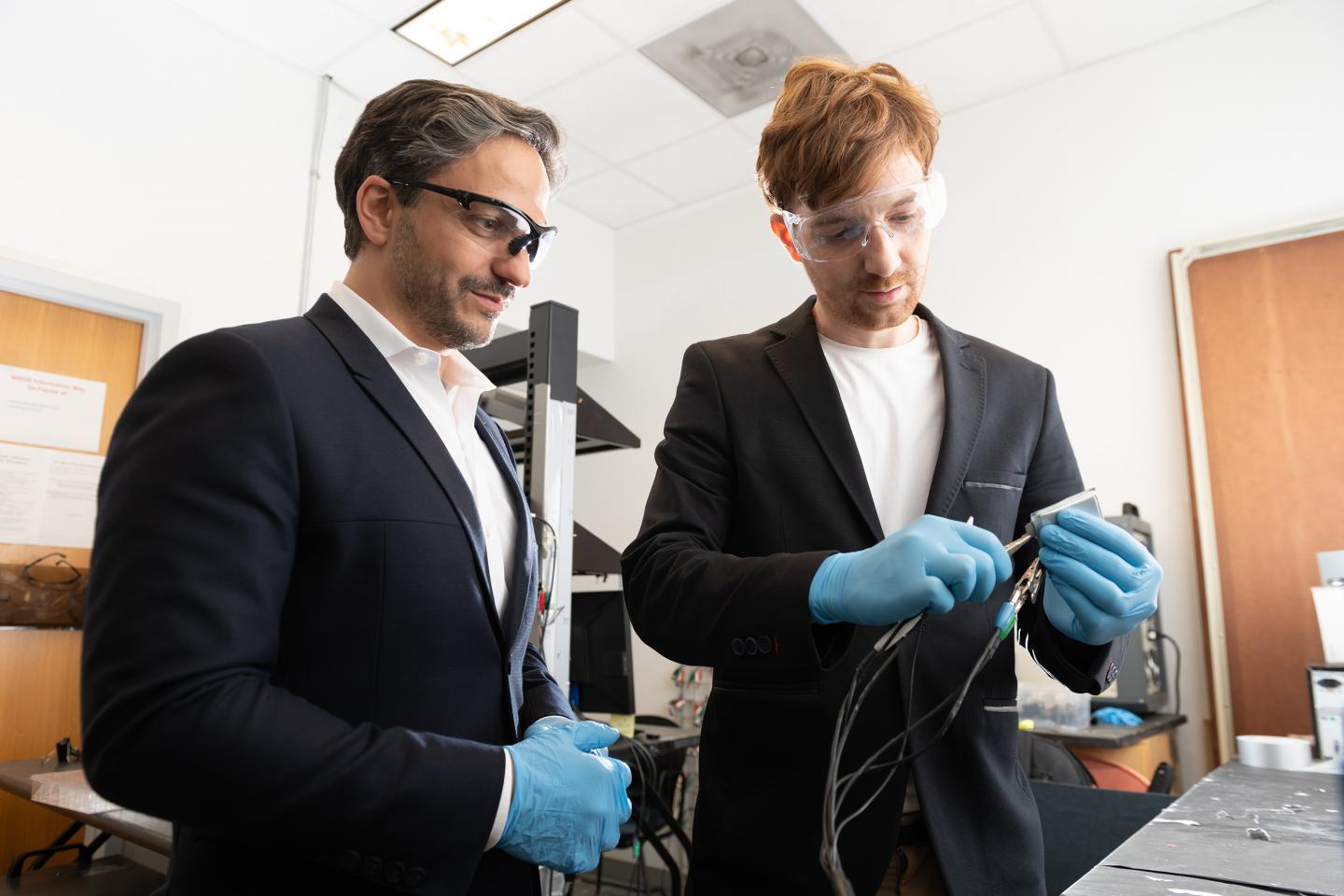
Credit: Allison Carter, Georgia Tech
RESEARCH TRIANGLE PARK, N.C. — Less expensive, lighter and safer batteries are a vital need for warfighters; a new Army project may offer a solution.
The growing popularity of lithium-ion batteries in recent years has put a strain on the world’s supply of cobalt and nickel — two metals integral to current battery designs — and sent prices surging.
In a bid to develop alternative designs for lithium-based batteries with less reliance on those scarce metals, researchers at the Georgia Institute of Technology, funded by Army Research Office, have developed a promising new cathode and electrolyte system that replaces expensive metals and traditional liquid electrolyte with lower cost transition metal fluorides and a solid polymer electrolyte.
The Army Research Office is an element of the U.S. Army Combat Capabilities Development Command’s Army Research Laboratory, the Army’s corporate research laboratory.
“Electrodes made from transition metal fluorides have long shown stability problems and rapid failure, leading to significant skepticism about their ability to be used in next generation batteries,” said Gleb Yushin, a professor in Georgia Tech’s School of Materials Science and Engineering. “But we’ve shown that when used with a solid polymer electrolyte, the metal fluorides show remarkable stability — even at higher temperatures — which could eventually lead to safer, lighter and cheaper lithium-ion batteries.”
In a typical lithium-ion battery, energy is released during the transfer of lithium ions between two electrodes — an anode and a cathode, with a cathode typically comprising lithium and transition metals such as cobalt, nickel and manganese. The ions flow between the electrodes through a liquid electrolyte.
“Professor Yushin has identified a novel approach to enable the use of Iron Fluoride cathodes and addresses issues with dimensional changes and parasitic side reactions to develop Lithium batteries,” said Dr. Robert Mantz, division chief, electrochemistry, Army Research Office. “Soldier-wearable technologies are expected to increase significantly, as will the need for power and energy sources to operate them. This research could make battery power more readily available to Soldiers in a form that is safe and easily transportable.”
For the study, published in the journal Nature Materials, the research team fabricated a new type of cathode from iron fluoride active material and a solid polymer electrolyte nanocomposite. Iron fluorides have more than double the lithium capacity of traditional cobalt- or nickel-based cathodes. In addition, iron is 300 times less expensive than cobalt and 150 times less costly than nickel.
To produce such a cathode, the researchers developed a process to infiltrate a solid polymer electrolyte into the prefabricated iron fluoride electrode. They then hot pressed the entire structure to increase density and reduce any voids.
Two central features of the polymer-based electrolyte are its ability to flex and accommodate the swelling of the iron fluoride while cycling and its ability to form a very stable and flexible interphase with iron fluoride. Traditionally, that swelling and massive side reactions have been key problems with using iron fluoride in previous battery designs.
“Cathodes made from iron fluoride have enormous potential because of their high capacity, low material costs and very broad availability of iron,” Yushin said. “But the volume changes during cycling as well as parasitic side reactions with liquid electrolytes and other degradation issues have limited their use previously. Using a solid electrolyte with elastic properties solves many of these problems.”
The researchers then tested several variations of the new solid-state batteries to analyze their performance over more than 300 cycles of charging and discharging at elevated temperature of 122 degrees Fahrenheit, noting that they outperformed previous designs using metal fluoride even when these were kept cool at room temperatures.
The researchers found that the key to the enhanced battery performance was the solid polymer electrolyte. In previous attempts to use metal fluorides, it was believed that metallic ions migrated to the surface of the cathode and eventually dissolved into the liquid electrolyte, causing a capacity loss, particularly at elevated temperatures. In addition, metal fluorides catalyzed massive decomposition of liquid electrolytes when cells were operating above 100 degrees Fahrenheit. However, at the connection between the solid electrolyte and the cathode, such dissolving doesn’t take place and the solid electrolyte remains remarkably stable, preventing such degradations, the researchers wrote.
“The polymer electrolyte we used was very common, but many other solid electrolytes and other battery or electrode architectures — such as core-shell particle morphologies — should be able to similarly dramatically mitigate or even fully prevent parasitic side reactions and attain stable performance characteristics,” said Kostiantyn Turcheniuk, research scientist in Yushin’s lab and a co-author of the manuscript.
In the future, the researchers aim to develop new and improved solid electrolytes to enable fast charging and also to combine solid and liquid electrolytes in new designs that are fully compatible with conventional cell manufacturing technologies employed in large battery factories.
“The successful implementation of these materials into batteries would enable significant increases in battery safety and weight, thus reducing the weight of batteries required for Soldier power,” Mantz said.
###
The CCDC Army Research Laboratory (ARL) is an element of the U.S. Army Combat Capabilities Development Command. As the Army’s corporate research laboratory, ARL discovers, innovates and transitions science and technology to ensure dominant strategic land power. Through collaboration across the command’s core technical competencies, CCDC leads in the discovery, development and delivery of the technology-based capabilities required to make Soldiers more effective to win our Nation’s wars and come home safely. CCDC is a major subordinate command of the U.S. Army Futures Command.
Media Contact
Lisa Bistreich-Wolfe
[email protected]
Original Source
https:/
Related Journal Article
http://dx.