Suggesting an unconventional way to manipulate the properties of 2D materials in the presence of a Bose-Einstein condensate, and an alternative strategy to design high-temperature superconductors
Credit: IBS
Understanding how particles behave at the twilight zone between the macro and the quantum world gives us access to fascinating phenomena, interesting from both the fundamental and application-oriented physics perspectives. For example, ultra-thin graphene-like materials are a fantastic playground to examine electrons’ transport and interactions. Recently, researchers at the Center for Theoretical Physics of Complex Systems (PCS), within the Institute for Basic Science (IBS, South Korea), in collaboration with the Rzhanov Institute of Semiconductor Physics (Russia) have reported on a novel electron scattering phenomenon in 2D materials. The paper is published in Physical Review Letters.
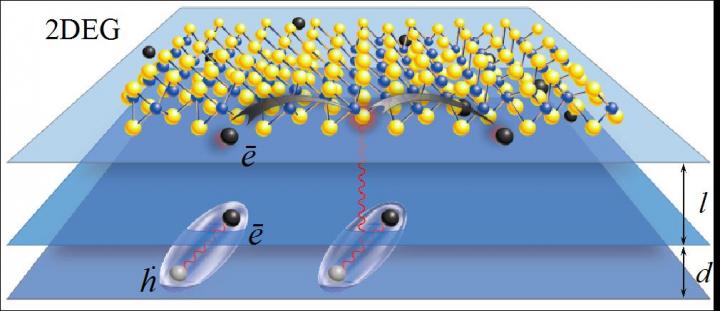
The team considered a sample which consists of two subsystems: one made of particles with integer spin (bosons) and the other made of particles with half-integer spin (fermions).
For the bosonic component, they modelled a gas of excitons (electron-positron pairs). At low temperatures, quantum mechanics can force a large number of bosonic particles to form a Bose-Einstein condensate (BEC). This state of matter has been reported in different materials, in particular, gallium arsenide (GaAs), and it has been predicted in molybdenum disulphide (MoS2).
The fermionic subsystem is a 2D electron gas (2DEG), where electrons are limited to move in two dimensions. It exhibits intriguing magnetic and electric phenomena, including superconductivity, that is, the passage of current without resistivity. These phenomena are related to electron scattering, which is mainly due to impurities and phonons. The latter are vibrations of the crystal lattice. Their name derives from the Greek ‘phonos’, meaning sound, since long-wavelength phonons give rise to sound, but they also play a role in the temperature-dependent electrical conductivity of metals.
Bosons and fermions are very different at the quantum level, so what happens when we combine BEC and 2DEG? Kristian Villegas, Meng Sun, Vadim Kovalev, and Ivan Savenko have modelled electron transport in such hybrid system.
Beyond the conventional phonons and impurities, the team described an unconventional electron scattering mechanism in BEC-2DEG hybrid systems: the interactions of an electron with one or two Bogoliubov quanta (or bogolons) – excitations of the BEC with small momenta. Although phonons and bogolons share some common features, the team found that they have important differences.
According to the models, in high-quality MoS2 at a certain range of temperatures, resistivity caused by pairs of bogolons proved to be dominating over resistivity caused by single bogolons, acoustic phonons, single-bogolons, and impurities. The reason of such difference is the mechanism of interaction between electrons and bogolons, which is of electric nature, as opposed to electron-phonon interaction described by the deformations of the sample.
This research might be useful for the design of novel high-temperature superconductors. An apparent paradox links conductivity and superconductivity: bad conductors are usually good superconductors. In the case of electron-phonon interactions, some materials that show poor conductivity, because of strong scattering of electrons by phonons, can become good superconductors at very low temperatures. For the same reason, noble metals, such as gold, are good conductors, but bad superconductors. If this holds true also for electron-bogolon interactions, then the researchers hypothesise that designing a bad conductor, with high resistivity caused by electron-2 bogolons interactions, might lead to “good” superconductors.
“This work not only opens perspectives in designing hybrid structures with controllable dissipation, it reports on fundamentally different temperature-dependence of scattering at low and high temperatures and sheds light on optically controlled condensate-mediated superconductivity,” explains Ivan Savenko, the leader of the Light-Matter Interaction in Nanostructures (LUMIN) team at PCS.
###
Media Contact
Dahee Carol Kim
[email protected]
Related Journal Article
http://dx.