• HOME
  • NEWS
  • EXPLORE
    • CAREER
      • Companies
      • Jobs
    • EVENTS
    • iGEM
      • News
      • Team
    • PHOTOS
    • VIDEO
    • WIKI
  • BLOG
  • COMMUNITY
    • FACEBOOK
    • INSTAGRAM
    • TWITTER
Thursday, June 25, 2026
BIOENGINEER.ORG
No Result
View All Result
  • Login
  • HOME
  • NEWS
  • EXPLORE
    • CAREER
      • Companies
      • Jobs
        • Lecturer
        • PhD Studentship
        • Postdoc
        • Research Assistant
    • EVENTS
    • iGEM
      • News
      • Team
    • PHOTOS
    • VIDEO
    • WIKI
  • BLOG
  • COMMUNITY
    • FACEBOOK
    • INSTAGRAM
    • TWITTER
  • HOME
  • NEWS
  • EXPLORE
    • CAREER
      • Companies
      • Jobs
        • Lecturer
        • PhD Studentship
        • Postdoc
        • Research Assistant
    • EVENTS
    • iGEM
      • News
      • Team
    • PHOTOS
    • VIDEO
    • WIKI
  • BLOG
  • COMMUNITY
    • FACEBOOK
    • INSTAGRAM
    • TWITTER
No Result
View All Result
Bioengineer.org
No Result
View All Result
Home NEWS Science News Chemistry

New Record: PLQE of 70.3% in lead-free halide double perovskites

Bioengineer by Bioengineer
July 22, 2019
in Chemistry
Reading Time: 2 mins read
0
IMAGE
Share on FacebookShare on TwitterShare on LinkedinShare on RedditShare on Telegram

IMAGE

Credit: ©Science China Press

Illumination consumes more than 20 percent of electricity. Thus, finding an efficient, stable, single-phase warm white-light material is very important. Lead hybrid perovskites have drawn interest for excellent photoelectric performance and simple synthesis. Lead perovskites with white-light emission have been studied, but the photoluminescence quantum efficiencies (PLQEs) are low. However, the large-scale application of lead perovskites is hindered by toxicity and instability. Therefore, the substitution of Pb with less toxic or non-toxic elements and the replacement of organic cations with relatively stable inorganic cations are conceived.

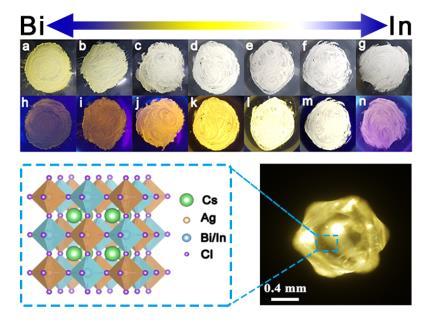
Very recently, Keli Han’s group in State Key Laboratory of Molecular Reaction Dynamics, Dalian Institute of Chemical Physics, Chinese Academy of Science reports a series of bulk lead-free double perovskites: Cs2AgBi1-xInxCl6 (0 The Cs2AgBi0.125In0.875Cl6 nanocrystals and microcrystals are synthesized. They reveal that the PLQE decreases with the size decreasing, due to the enhancement of PL quenching effect caused by the increase of permanent defects. Furthermore, the Cs2AgBi0.125In0.875Cl6 bulk crystal possesses excellent stability. Therefore, it’s promising as a new highly efficient warm white-light emitting material in applications of LEDs.

###

This work was supported by the National Natural Science Foundation of China (grant No. 21533010, No. 21525315), the National Key Research and Development Program of China (grant 2017YFA0204800), DICP DMTO201601, DICP ZZBS201703, and the Science Challenging Program (JCKY2016212A501).

See the article: Han P, Zhang X, Mao X, Yang B, Yang S, Feng Z, Wei D, Deng W, Pullerits T, Han K. Size effect of lead-free halide double perovskite on luminescence property. Sci China Chem, 2019. DOI: 10.1007/s11426-019-9520-1.
https://link.springer.com/article/10.1007/s11426-019-9520-1

Media Contact
Keli Han
[email protected]

Related Journal Article

http://dx.doi.org/10.1007/s11426-019-9520-1

Tags: Chemistry/Physics/Materials Sciences
Share12Tweet8Share2ShareShareShare2

Related Posts

AI and Physics Collaborate to Design Advanced Hydrogen Storage Materials

June 25, 2026

International Team Including Dresden Scientists Develops Novel Designer Proteins for Advanced Study of Living Tissue

June 25, 2026

New Study Uncovers Key Factors Driving Water Chemistry in Nanoscale Environments

June 25, 2026

Plasma Technology Extends Catalyst Lifespan in Hydrogen Production

June 24, 2026
Please login to join discussion

POPULAR NEWS

  • Saying Goodbye to PGY-6: Pediatric Fellowship Realities

    103 shares
    Share 41 Tweet 26
  • Multi-Hospital Study Reveals Long Covid Burden Is Twice as High as Current Estimates

    92 shares
    Share 36 Tweet 23
  • Detection of EDCs in Breast Milk and Infant Urine Up to Six Months Highlights Early Exposure Risks

    77 shares
    Share 31 Tweet 19
  • New Drug Candidate Developed at McMaster Shows Potential for Treating Brain Cancer

    58 shares
    Share 23 Tweet 15

About

We bring you the latest biotechnology news from best research centers and universities around the world. Check our website.

Follow us

Recent News

Tracking Lanthanide-Labeled Microplastics in Plants

POSTECH Researchers Slash Cost of Reconstituted Cell-Free Systems by 95%

AI and Physics Collaborate to Design Advanced Hydrogen Storage Materials

Subscribe to Blog via Email

Success! An email was just sent to confirm your subscription. Please find the email now and click 'Confirm' to start subscribing.

Join 82 other subscribers
  • Contact Us

Bioengineer.org © Copyright 2023 All Rights Reserved.

Welcome Back!

Login to your account below

Forgotten Password?

Retrieve your password

Please enter your username or email address to reset your password.

Log In
No Result
View All Result
  • Homepages
    • Home Page 1
    • Home Page 2
  • News
  • National
  • Business
  • Health
  • Lifestyle
  • Science

Bioengineer.org © Copyright 2023 All Rights Reserved.