• HOME
  • NEWS
  • EXPLORE
    • CAREER
      • Companies
      • Jobs
    • EVENTS
    • iGEM
      • News
      • Team
    • PHOTOS
    • VIDEO
    • WIKI
  • BLOG
  • COMMUNITY
    • FACEBOOK
    • INSTAGRAM
    • TWITTER
Saturday, February 7, 2026
BIOENGINEER.ORG
No Result
View All Result
  • Login
  • HOME
  • NEWS
  • EXPLORE
    • CAREER
      • Companies
      • Jobs
        • Lecturer
        • PhD Studentship
        • Postdoc
        • Research Assistant
    • EVENTS
    • iGEM
      • News
      • Team
    • PHOTOS
    • VIDEO
    • WIKI
  • BLOG
  • COMMUNITY
    • FACEBOOK
    • INSTAGRAM
    • TWITTER
  • HOME
  • NEWS
  • EXPLORE
    • CAREER
      • Companies
      • Jobs
        • Lecturer
        • PhD Studentship
        • Postdoc
        • Research Assistant
    • EVENTS
    • iGEM
      • News
      • Team
    • PHOTOS
    • VIDEO
    • WIKI
  • BLOG
  • COMMUNITY
    • FACEBOOK
    • INSTAGRAM
    • TWITTER
No Result
View All Result
Bioengineer.org
No Result
View All Result
Home NEWS Science News Biology

Identification of autophagy gene regulation mechanism related to dementia and Lou Gehrig’s disease

Bioengineer by Bioengineer
July 18, 2019
in Biology
Reading Time: 2 mins read
0
IMAGE
Share on FacebookShare on TwitterShare on LinkedinShare on RedditShare on Telegram

IMAGE

Credit: @ Korea brain Research Institute

Korea Brain Research Institute (KBRI, President Seo Pan-ghill) announced on July 10 that the international joint research team where Senior Researcher Jeong Yoon-ha and John Hopkins School of Medicine collaborated, found that ‘cell autophagy* gene’ called ATG7 is related to the onset of frontotemporal dementia and Lou Gehrig’s disease.

  • Autophagy: It refers to the phenomenon where a cell discomposes and recycles unnecessary organelles or components. It can be regarded as the self-cleaning taking place within the cell.

    • The research outcome was published in the July issue of ‘Autophagy‘, which is an international journal and the name of the paper and authors are as follows.
  • Paper: Upregulation of ATG7 Attenuates Motor Neuron Dysfunction Associated with Depletion of TARDBP/TDP-43
  • Author: Aneesh Donde*, Mingkuan Sun*, Yun Ha Jeong* (co-first author), Xinrui Wen, Jonathan Ling, Sophie Lin, Kerstin Braunstein, Shuke Nie, Sheng Wang, Liam Chen and Philip C. Wong (corresponding author)

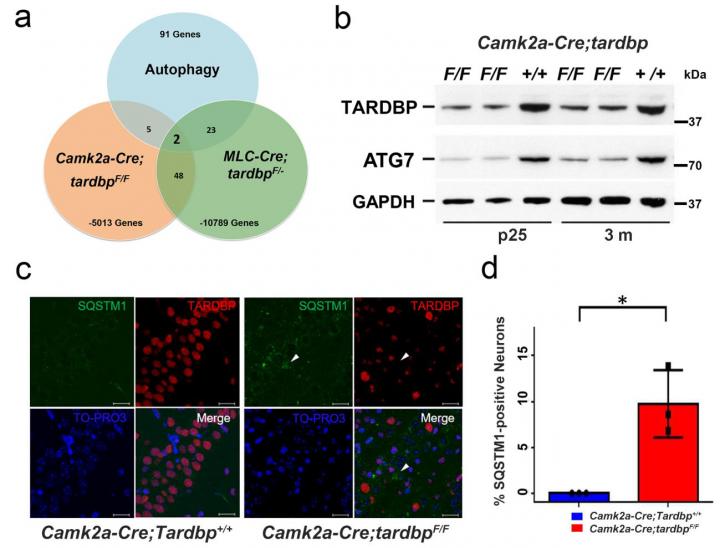
    • The research team found that when the genes are manipulated to make sure that a certain protein called TDP-43* is not created in mice and fruit flies, then the activity of gene ATG7, which is essential for cell autophagy, was inhibited and neuronal degeneration occurred.
  • It is a transcriptional regulation protein and it is known as the major pathogenesis of amyotrophic lateral sclerosis (ALS) and frontotemporal dementia (FTD).
  • ATG7: Essential gene for autophagy

    • On the contrary, when the gene is manipulated to increase the ATG7 gene expression for activation of autophagy in fruit flies, for which the TBPH* gene expression is inhibited, it is found that neurodegenerative and ataxia symptoms were improved.
  • TBPH: Gene of fruit flies that is equivalent to TDP-43 present in humans

    • The result of this study is meaningful in that the study confirmed the fact that TDP-43 protein regulates the activation of ATG7, which is responsible for the autophagy of neurons as well as the specific process of neuronal degeneration at the gene level.

    • Cells improve the activity of overall cells by consuming damaged or old organelles or some structures (This is what we call autophagy). If the activity of gene ATG7, which is key to this process, is reduced, then the damaged and old organelles still remain, causing problems in the muscle cells and neurons.

    • Dr. Jeong Yoon-ha of the KBRI expected that “this research would contribute towards the development of a new treatment for neuro-degenerative diseases, aiming to activate the autophagy function of cell”.

###

Media Contact
Jeong Yoonha
[email protected]

Related Journal Article

http://dx.doi.org/10.1080/15548627.2019.1635379

Tags: BiologyCell BiologyGenesGenetics
Share12Tweet8Share2ShareShareShare2

Related Posts

Florida Cane Toad: Complex Spread and Selective Evolution

Florida Cane Toad: Complex Spread and Selective Evolution

February 7, 2026
New Study Uncovers Mechanism Behind Burn Pit Particulate Matter–Induced Lung Inflammation

New Study Uncovers Mechanism Behind Burn Pit Particulate Matter–Induced Lung Inflammation

February 6, 2026

DeepBlastoid: Advancing Automated and Efficient Evaluation of Human Blastoids with Deep Learning

February 6, 2026

Navigating the Gut: The Role of Formic Acid in the Microbiome

February 6, 2026
Please login to join discussion

POPULAR NEWS

  • Robotic Ureteral Reconstruction: A Novel Approach

    Robotic Ureteral Reconstruction: A Novel Approach

    82 shares
    Share 33 Tweet 21
  • Digital Privacy: Health Data Control in Incarceration

    63 shares
    Share 25 Tweet 16
  • Study Reveals Lipid Accumulation in ME/CFS Cells

    57 shares
    Share 23 Tweet 14
  • Breakthrough in RNA Research Accelerates Medical Innovations Timeline

    53 shares
    Share 21 Tweet 13

About

We bring you the latest biotechnology news from best research centers and universities around the world. Check our website.

Follow us

Recent News

Phage-Antibiotic Combo Beats Resistant Peritoneal Infection

Boosting Remote Healthcare: Stepped-Wedge Trial Insights

Barriers and Boosters of Seniors’ Physical Activity in Karachi

Subscribe to Blog via Email

Enter your email address to subscribe to this blog and receive notifications of new posts by email.

Join 73 other subscribers
  • Contact Us

Bioengineer.org © Copyright 2023 All Rights Reserved.

Welcome Back!

Login to your account below

Forgotten Password?

Retrieve your password

Please enter your username or email address to reset your password.

Log In
No Result
View All Result
  • Homepages
    • Home Page 1
    • Home Page 2
  • News
  • National
  • Business
  • Health
  • Lifestyle
  • Science

Bioengineer.org © Copyright 2023 All Rights Reserved.