• HOME
  • NEWS
  • EXPLORE
    • CAREER
      • Companies
      • Jobs
    • EVENTS
    • iGEM
      • News
      • Team
    • PHOTOS
    • VIDEO
    • WIKI
  • BLOG
  • COMMUNITY
    • FACEBOOK
    • INSTAGRAM
    • TWITTER
Friday, September 25, 2026
BIOENGINEER.ORG
No Result
View All Result
  • Login
  • HOME
  • NEWS
  • EXPLORE
    • CAREER
      • Companies
      • Jobs
        • Lecturer
        • PhD Studentship
        • Postdoc
        • Research Assistant
    • EVENTS
    • iGEM
      • News
      • Team
    • PHOTOS
    • VIDEO
    • WIKI
  • BLOG
  • COMMUNITY
    • FACEBOOK
    • INSTAGRAM
    • TWITTER
  • HOME
  • NEWS
  • EXPLORE
    • CAREER
      • Companies
      • Jobs
        • Lecturer
        • PhD Studentship
        • Postdoc
        • Research Assistant
    • EVENTS
    • iGEM
      • News
      • Team
    • PHOTOS
    • VIDEO
    • WIKI
  • BLOG
  • COMMUNITY
    • FACEBOOK
    • INSTAGRAM
    • TWITTER
No Result
View All Result
Bioengineer.org
No Result
View All Result
Home NEWS Science News Chemistry

OU researchers developing new methods and smart wellbore materials for geothermal drilling

Bioengineer by Bioengineer
July 15, 2019
in Chemistry
Reading Time: 2 mins read
0
IMAGE
Share on FacebookShare on TwitterShare on LinkedinShare on RedditShare on Telegram

IMAGE

Credit: University of Oklahoma

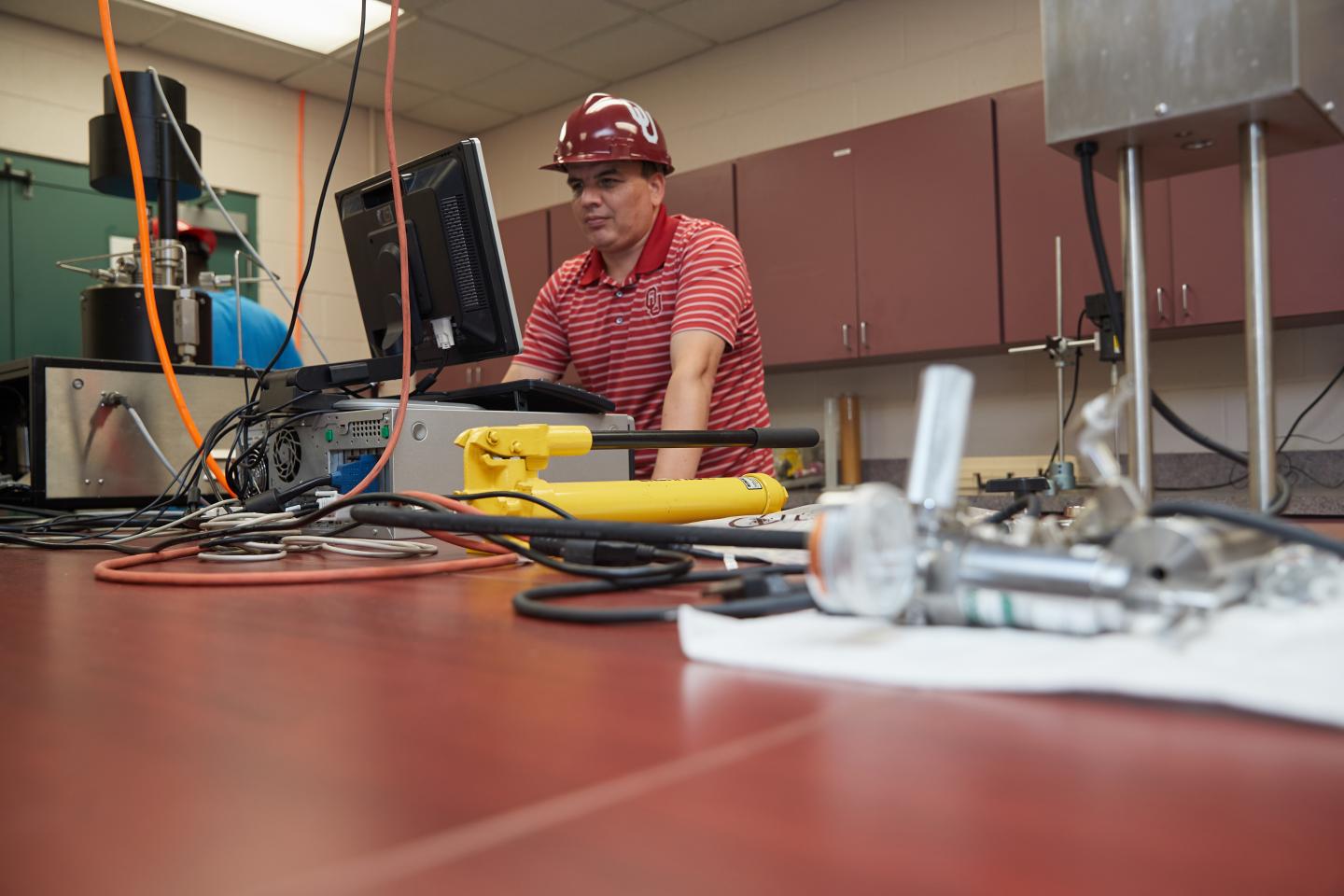
A University of Oklahoma research team is developing smart lost circulation materials that use shape memory polymers activated by geothermal temperatures to prevent the loss of fluid in fractured rocks near the wellbore. These materials expand within the fractures to reduce non-drilling time and strengthen the wellbore in high-temperature drilling operations. The U.S. Department of Energy’s Geothermal Technologies Office funded the early-stage research with a $1.79 million grant. In addition, the project has more than $0.5 million cost share from various entities.

“The cost of drilling a geothermal well is prohibitive without new technologies to address the challenge of drilling the type of rock found in a geothermal well,” said Saeed Salehi, project principle investigator and professor of petroleum and geological engineering, Mewbourne College of Earth and Energy,. “The shape polymers under development for this project are novel expandable and programmable polymers that activate when drilling a high-temperature geothermal drilling operations.”

Salehi is working on the three-phase project with Ramadan Ahmed and Catalin Teodoriu, petroleum and geological engineering professors, Mewbourne College of Earth and Energy, and collaborators Dahi Taleghani, Pennsylvania State University, and Guoqiang Li, Louisiana State University. Professor Li is an expert in shape memory polymers, which help in the synthesis and testing of these materials in high temperature. Professor Dahi is a computational expert, which will help when the computational models are run.

In the first phase of the project, the team will develop a combination of lost circulation prevention methods and smart wellbore strengthening materials to address the problems in geothermal wells. The materials include novel expandable and programmable polymers, degradable thermoplastic composites and ceramics mixed with lost circulation materials that will be tested in a drilling and wellbore strengthening simulator.

In the second phase, the team will conduct flow loop tests on the materials using one of OU’s high-temperature flow loops modified for testing. And, in the last phase, computational models will be run to design the best combination of techniques, material sizes and concentration for application in the wells. For more information about this research, please contact Professor Salehi at [email protected].

###

Media Contact
Jana Smith
[email protected]

Original Source

https://bit.ly/2YTyU0H

Tags: Earth ScienceEnergy Sources
Share12Tweet8Share2ShareShareShare2

Related Posts

Tea Compounds Show Surprising Power Against Cancer and Aging Proteins

Tea Compounds Show Surprising Power Against Cancer and Aging Proteins

September 25, 2026
Volcanic Rock Buoys Could End Microplastic Pollution in Oyster Farms

Volcanic Rock Buoys Could End Microplastic Pollution in Oyster Farms

September 25, 2026

Metal-Organic Framework Nanoparticles Turn Biopolymer Hydrogel into Antibacterial Wound Dressing

September 25, 2026

Fig Latex and Sodium Phytate Team Up to Tenderize and Protect Cooked Beef

September 25, 2026
Please login to join discussion

POPULAR NEWS

  • New Study Maps How Hospital AI Turns Information Chaos into Faster, Cheaper Care

    29 shares
    Share 12 Tweet 7
  • AI Forecasting Reshapes Doctor Schedules in a Pediatric Emergency Room

    29 shares
    Share 12 Tweet 7
  • Damiana Plant Polysaccharides Extend Lifespan in Worms and Flies, Study Finds

    29 shares
    Share 12 Tweet 7
  • Forever Chemicals in Pregnancy Tied to Higher Gestational Diabetes Risk, Vitamin D May Blunt the Effect

    29 shares
    Share 12 Tweet 7

About

We bring you the latest biotechnology news from best research centers and universities around the world. Check our website.

Follow us

Recent News

New Study Maps How Hospital AI Turns Information Chaos into Faster, Cheaper Care

AI Forecasting Reshapes Doctor Schedules in a Pediatric Emergency Room

Damiana Plant Polysaccharides Extend Lifespan in Worms and Flies, Study Finds

Subscribe to Blog via Email

Enter your email address to subscribe to this blog and receive notifications of new posts by email.

Join 85 other subscribers
  • Contact Us

Bioengineer.org © Copyright 2023 All Rights Reserved.

Welcome Back!

Login to your account below

Forgotten Password?

Retrieve your password

Please enter your username or email address to reset your password.

Log In
No Result
View All Result
  • Homepages
    • Home Page 1
    • Home Page 2
  • News
  • National
  • Business
  • Health
  • Lifestyle
  • Science

Bioengineer.org © Copyright 2023 All Rights Reserved.