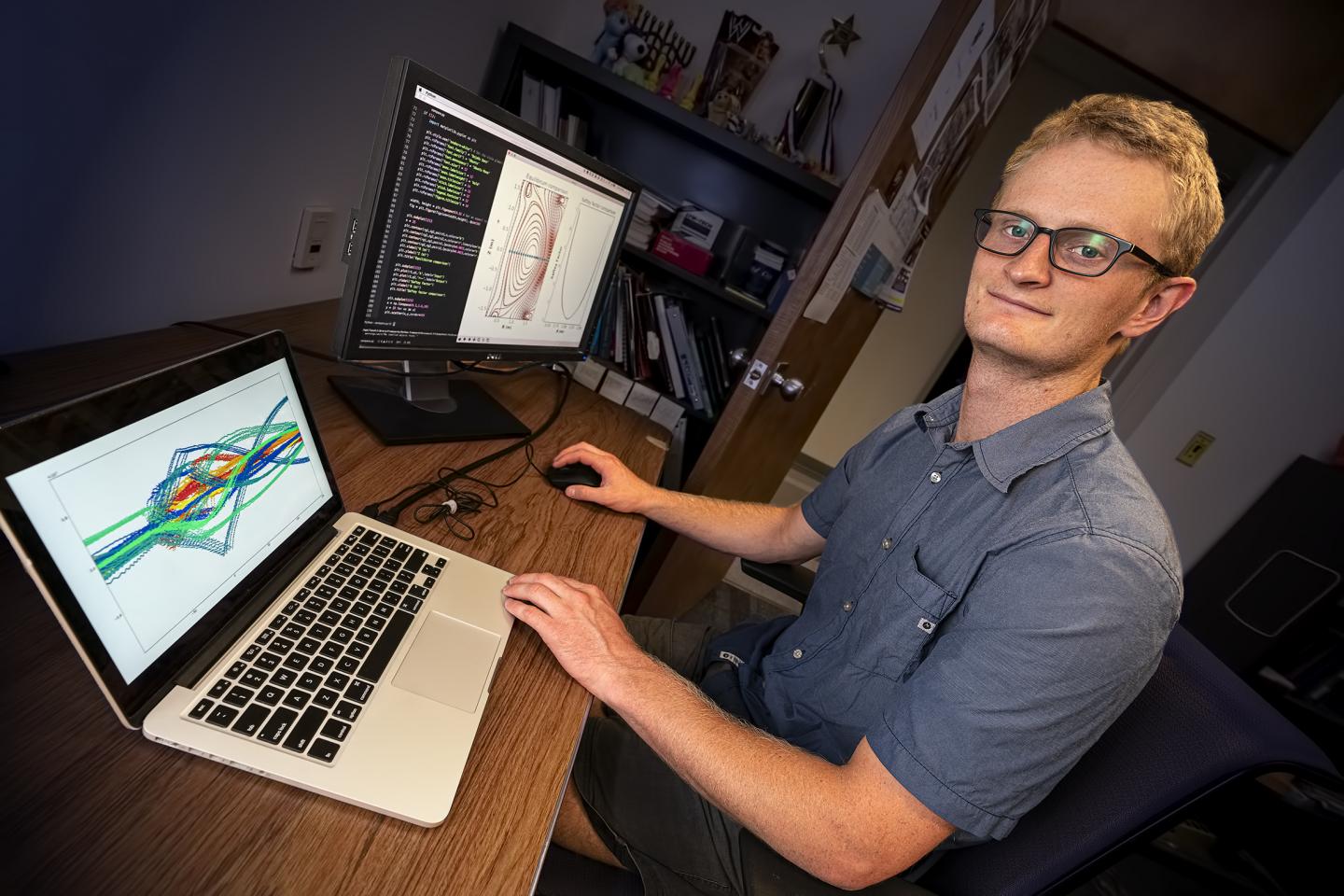
Credit: Elle Starkman/PPPL Office of Communications
Scientists seeking to bring to Earth the fusion that powers the sun and stars must control the hot, charged plasma — the state of matter composed of free-floating electrons and atomic nuclei, or ions — that fuels fusion reactions. For scientists who confine the plasma in magnetic fields, a key task calls for mapping the shape of the fields, a process known as measuring the equilibrium, or stability, of the plasma. At the U.S. Department of Energy’s (DOE) Princeton Plasma Physics Laboratory (PPPL), researchers have proposed a new measurement technique to avoid problems expected when mapping the fields on large and powerful future tokamaks, or magnetic fusion devices, that house the reactions.
Neutron bombardments
Such tokamaks, including ITER, the large international experiment under construction in France, will produce neutron bombardments that could damage the interior diagnostics now used to map the fields in current facilities. PPPL is therefore proposing use of an alternative diagnostic system that could operate in high-neutron environments.
The system, a type of plasma diagnostic called “Electron Cyclotron Emission (ECE),” measures the temperature of the electrons cycling around the field lines. “By using an ECE system, we can learn about the plasma temperature and about fluctuations in the plasma,” said Andrew “Oak” Nelson, a graduate student in plasma physics at PPPL and first author of a Plasma Physics and Controlled Fusion paper that reports the research. “This proposed method could be developed into a stand-alone mapping tool or used with existing tools.”
The method combines ECE data with a fast-camera image used to measure the boundary of the plasma. The combination provides “diagnostics which can be robustly designed in high-neutron environments,” according to the paper. The process works as follows:
- Researchers observe the radiation that the cycling electrons emit;
- The radiation provides data about the temperature and modes, or instabilities, that grow in the plasma;
- The data allow measurement of the “q-profile” — the helicity, or spiraling, of the magnetic field;
- Measurement of the helicity enables tokamak operators to map and control the equilibrium of the plasma.
Reversing a process
This technique, which researchers tested on a simulated discharge of the National Spherical Torus Experiment (NSTX) at PPPL prior to its upgrade, reverses a process normally used in fusion research. “People usually get the q-profile from the equilibrium,” said Nelson, “but our paper shows that that you can also get the equilibrium from knowing the q-profile.”
Working closely with Nelson was his advisor, PPPL physicist Egemen Kolemen, an assistant professor at Princeton University’s Department of Mechanical and Aerospace Engineering. “Oak is an extremely talented student,” Kolemen said. “The method he developed allows construction of the state of the fusion plasma using only a single diagnostic, ECE. This will be useful for many tokamaks including ITER, because combining many different diagnostics is problematic and error prone.”
Researchers now plan to test the ECE technique on a wide variety of plasma discharges. A proven and fully developed technique could provide a valuable system for mapping the crucial magnetic fields in ITER and next-generation tokamaks.
###
Support for this work comes from the DOE Office of Science. Coauthors of the paper include Max Austin of the University of Texas at Austin.
PPPL, on Princeton University’s Forrestal Campus in Plainsboro, N.J., is devoted to creating new knowledge about the physics of plasmas — ultra-hot, charged gases — and to developing practical solutions for the creation of fusion energy. The Laboratory is managed by the University for the U.S. Department of Energy’s Office of Science, which is the single largest supporter of basic research in the physical sciences in the United States and is working to address some of the most pressing challenges of our time. For more information, visit energy.gov/science.
Media Contact
John Greenwald
[email protected]
Original Source
https:/
Related Journal Article
http://dx.