• HOME
  • NEWS
  • EXPLORE
    • CAREER
      • Companies
      • Jobs
    • EVENTS
    • iGEM
      • News
      • Team
    • PHOTOS
    • VIDEO
    • WIKI
  • BLOG
  • COMMUNITY
    • FACEBOOK
    • INSTAGRAM
    • TWITTER
Sunday, November 29, 2026
BIOENGINEER.ORG
No Result
View All Result
  • Login
  • HOME
  • NEWS
  • EXPLORE
    • CAREER
      • Companies
      • Jobs
        • Lecturer
        • PhD Studentship
        • Postdoc
        • Research Assistant
    • EVENTS
    • iGEM
      • News
      • Team
    • PHOTOS
    • VIDEO
    • WIKI
  • BLOG
  • COMMUNITY
    • FACEBOOK
    • INSTAGRAM
    • TWITTER
No Result
View All Result
Bioengineer.org
No Result
View All Result
Home NEWS Science News Chemistry

Black (nano)gold combat climate change

Bioengineer by Bioengineer
July 3, 2019
in Chemistry
Reading Time: 2 mins read
0
IMAGE
Share on FacebookShare on TwitterShare on LinkedinShare on RedditShare on Telegram

IMAGE

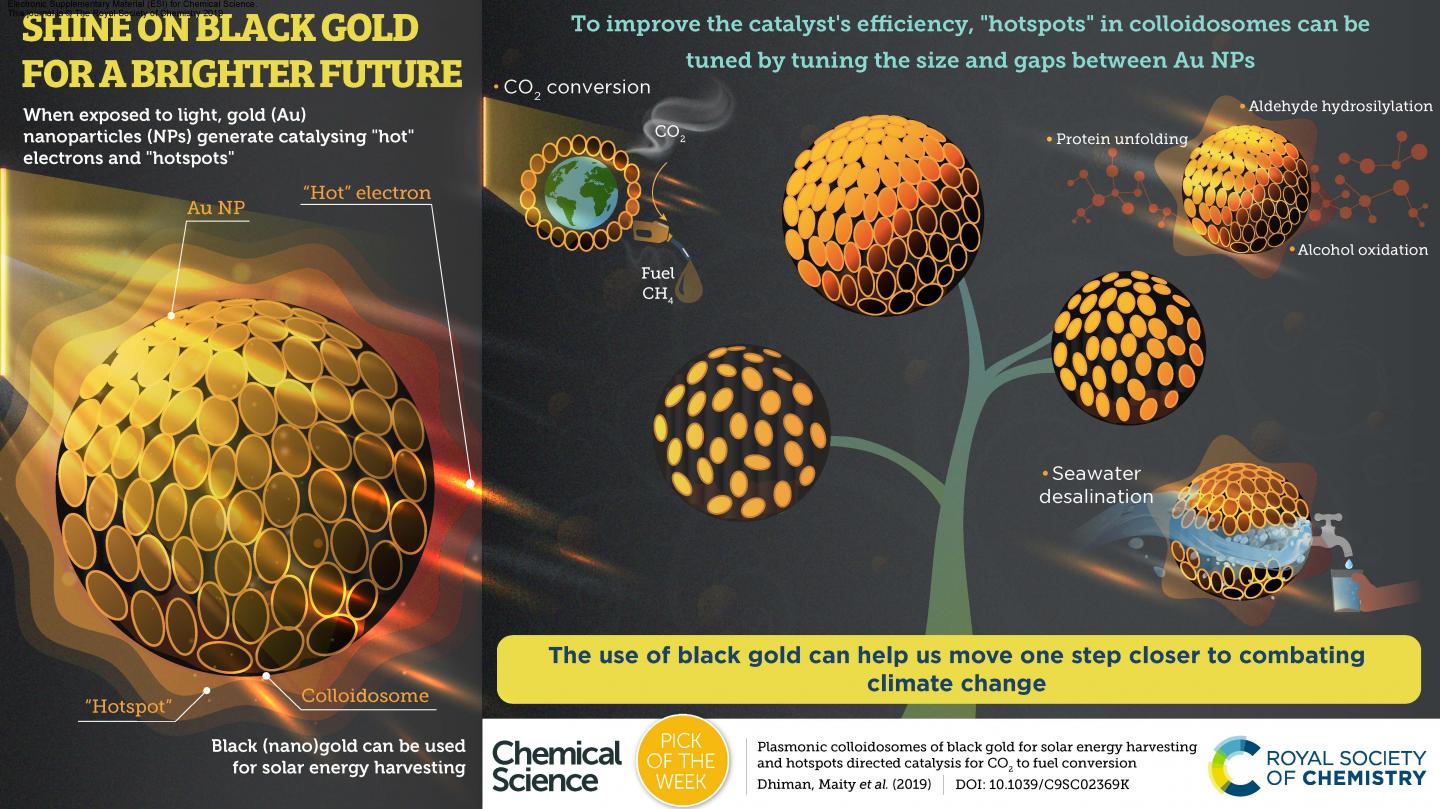
Credit: Royal Society of Chemistry, Chemical Science

Global warming is a serious threat to the planet and the living beings. One of the main cause of global warming is the increase in the atmospheric CO2 level. The main source of this CO2 is from the burning of fossil fuels in our daily lives (electricity, vehicles, industry and many more).

Researchers at TIFR have developed the solution phase synthesis of Dendritic Plasmonic Colloidosomes (DPCs) with varying interparticle distances between the gold Nanoparticles (NPs) using a cycle-by-cycle growth approach by optimizing the nucleation-growth step. These DPCs absorbed the entire visible and near-infrared region of solar light, due to interparticle plasmonic coupling as well as the heterogeneity in the Au NP sizes, which transformed golden gold material to black gold.

Black (nano)gold was able to catalyze CO2 to methane (fuel) conversion at atmospheric pressure and temperature, using solar energy. They also observed the significant effect of the plasmonic hotspots on the performance of these DPCs for the purification of seawater to drinkable water via steam generation, temperature jump assisted protein unfolding, oxidation of cinnamyl alcohol using pure oxygen as the oxidant, and hydrosilylation of aldehydes.

This was attributed to varying interparticle distances and particle sizes in these DPCs. The results indicate the synergistic effects of EM and thermal hotspots as well as hot electrons on DPCs performance. Thus, DPCs catalysts can effectively be utilized as Vis-NIR light photo-catalysts, and the design of new plasmonic nanocatalysts for a wide range of other chemical reactions may be possible using the concept of plasmonic coupling.

Raman thermometry and SERS (Surface-enhanced Raman Spectroscopy) provided information about the thermal and electromagnetic hotspots and local temperatures which was found to be dependent on the interparticle plasmonic coupling. The spatial distribution of the localized surface plasmon modes by STEM-EELS plasmon mapping confirmed the role of the interparticle distances in the SPR (Surface Plasmon Resonance) of the material.

Thus, in this work, by using the techniques of nanotechnology, the researchers transformed golden gold to black gold, by changing the size and gaps between gold nanoparticles. Similar to the real trees, which use CO2, sunlight and water to produce food, the developed black gold acts like an artificial tree that uses CO2, sunlight and water to produce fuel, which can be used to run our cars. Notably, black gold can also be used to convert sea water into drinkable water using the heat that black gold generates after it captures sunlight.

This work is a way forward to develop “Artificial Trees” which capture and convert CO2 to fuel and useful chemicals. Although at this stage, the production rate of fuel is low, in coming years, these challenges can be resolved. We may be able to convert CO2 to fuel using sunlight at atmospheric condition, at a commercially viable scale and CO2 may then become our main source of clean energy.

###

Media Contact
Vivek Polshettiwar
vivekpol@tifr.res.in

Related Journal Article

http://dx.doi.org/10.1039/C9SC02369K

Tags: Chemistry/Physics/Materials Sciences
Share12Tweet8Share2ShareShareShare2

Related Posts

Freeze-Drying Preserves Antioxidants and Lightness in Cactus Cladode Powders

Freeze-Drying Preserves Antioxidants and Lightness in Cactus Cladode Powders

November 29, 2026
Plant Compound Alpha-Mangostin Inhibits Mycobacterium Tuberculosis Gyrase B in Laboratory Tests

Plant Compound Alpha-Mangostin Inhibits Mycobacterium Tuberculosis Gyrase B in Laboratory Tests

November 29, 2026

Acylhydrazone Betulinic Acid Derivative Lowers Blood Glucose in Diabetic Mice

November 29, 2026

Green Ultraviolet Spectrophotometric Method Accurately Quantifies Veterinary Carprofen in Chewable Tablets

November 29, 2026
Please login to join discussion

POPULAR NEWS

  • Natural Plant Fiber Composites Match Synthetic Performance in Multilayer Armor Systems

    Natural Plant Fiber Composites Match Synthetic Performance in Multilayer Armor Systems

    29 shares
    Share 12 Tweet 7
  • Plant Compound Alpha-Mangostin Inhibits Mycobacterium Tuberculosis Gyrase B in Laboratory Tests

    29 shares
    Share 12 Tweet 7
  • Suspected Pediatric Transverse Myelitis Case Managed Without Advanced Imaging in Gaza

    29 shares
    Share 12 Tweet 7
  • Head Nurse Mentorship Pilot Tracks Feasibility and Preliminary Management Competency Gains

    29 shares
    Share 12 Tweet 7

About

We bring you the latest biotechnology news from best research centers and universities around the world. Check our website.

Follow us

Recent News

Freeze-Drying Preserves Antioxidants and Lightness in Cactus Cladode Powders

MOGAD Relapses Frequently Strike Initial Central Nervous System Anatomical Locations

Computational Modeling Identifies Novel Triphenylamine Dye Q4-TPA for Efficient Solar Cells

Subscribe to Blog via Email

Enter your email address to subscribe to this blog and receive notifications of new posts by email.

Join 90 other subscribers
  • Contact Us

Bioengineer.org © Copyright 2023 All Rights Reserved.

Welcome Back!

Login to your account below

Forgotten Password?

Retrieve your password

Please enter your username or email address to reset your password.

Log In
No Result
View All Result
  • Homepages
    • Home Page 1
    • Home Page 2
  • News
  • National
  • Business
  • Health
  • Lifestyle
  • Science

Bioengineer.org © Copyright 2023 All Rights Reserved.