• HOME
  • NEWS
  • EXPLORE
    • CAREER
      • Companies
      • Jobs
    • EVENTS
    • iGEM
      • News
      • Team
    • PHOTOS
    • VIDEO
    • WIKI
  • BLOG
  • COMMUNITY
    • FACEBOOK
    • INSTAGRAM
    • TWITTER
Monday, May 11, 2026
BIOENGINEER.ORG
No Result
View All Result
  • Login
  • HOME
  • NEWS
  • EXPLORE
    • CAREER
      • Companies
      • Jobs
        • Lecturer
        • PhD Studentship
        • Postdoc
        • Research Assistant
    • EVENTS
    • iGEM
      • News
      • Team
    • PHOTOS
    • VIDEO
    • WIKI
  • BLOG
  • COMMUNITY
    • FACEBOOK
    • INSTAGRAM
    • TWITTER
  • HOME
  • NEWS
  • EXPLORE
    • CAREER
      • Companies
      • Jobs
        • Lecturer
        • PhD Studentship
        • Postdoc
        • Research Assistant
    • EVENTS
    • iGEM
      • News
      • Team
    • PHOTOS
    • VIDEO
    • WIKI
  • BLOG
  • COMMUNITY
    • FACEBOOK
    • INSTAGRAM
    • TWITTER
No Result
View All Result
Bioengineer.org
No Result
View All Result
Home NEWS Science News Chemistry

The highest energy gamma rays discovered by the Tibet ASgamma experiment

Bioengineer by Bioengineer
July 3, 2019
in Chemistry
Reading Time: 2 mins read
0
IMAGE
Share on FacebookShare on TwitterShare on LinkedinShare on RedditShare on Telegram

Astronomy offers new energy window
IMAGE

Credit: Image by IHEP

The Tibet ASgamma experiment, a China-Japan joint research project, has discovered the highest energy cosmic gamma rays ever observed from an astrophysical source – in this case, the “Crab Nebula.” The experiment detected gamma rays ranging from > 100 Teraelectron volts (TeV) (see Fig.1) to an estimated 450 TeV. Previously, the highest gamma-ray energy ever observed was 75 TeV by the HEGRA Cherenkov telescope.

Researchers believe the most energetic of the gamma rays observed by the Tibet ASgamma experiment were produced by interaction between very-high-energy electrons and cosmic microwave background radiation (i.e., remnant radiation from the Big Bang).

The Crab Nebula is a famous supernova remnant in the constellation Taurus. It was first observed as a very bright supernova explosion in1054 AD (see Fig.1). It was noted in official histories of the Song dynasty in ancient China as well as in Meigetsuki, written by the 12th century Japanese poet Fujiwara no Teika. In the modern era, the Crab Nebula has been observed using various types of electromagnetic waves including radio and optical waves, X-rays and gammarays.

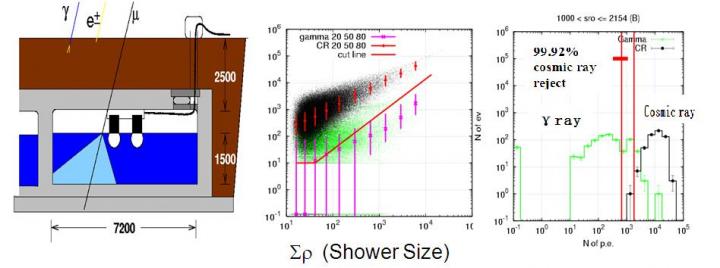
The Tibet ASgamma experiment has been operating since 1990 in Tibet, China, at an altitude of 4300m above sea level. The China-Japan collaboration added new water Cherenkov-type muon detectors under the existing cosmic-ray detectors in 2014 (see Fig.2). These underground muon detectors suppress 99.92% of cosmic-ray background noise (see Fig.3). As a result, 24 gamma-ray candidates above 100 TeV have been detected from the Crab Nebula with low background noise. The highest energy is estimated at 450 TeV (see Fig.2).

The researchers hypothesize the following steps for generating very-high-energy gamma rays: (1) In the nebula, electrons are accelerated up to PeV, i.e., peta (one thousand trillion) electron volts within a few hundred years after the supernova; (2) PeV electrons interact with the cosmic microwave background radiation (CMBR) filling the whole universe; (3) A CMBR photon is kicked up to 450 TeV by the PeV electrons. The researchers thus conclude that the Crab Nebula is now the most powerful natural electron accelerator discovered so far in our galaxy.

This pioneering work opens a new high-energy window for exploring the extreme universe. The detection of gamma rays above 100 TeV is a key to understanding the origin of very-high-energy cosmic rays, which has been a mystery since the discovery of cosmic rays in 1912. With further observations using this new window, we expect to identify the origin of cosmic rays in our galaxy, namely, pevatrons, which accelerate cosmic rays up to PeV energies.

“This is a great first step forward,” said Prof. HUANG Jing, co-spokesperson for the Tibet ASgamma experiment. “It proves that our techniques worked well, and gamma rays with energies up to a few hundred TeV really exist. Our goal is to identify a lot of pevatrons, which have not yet been discovered and are supposed to produce the highest-energy cosmic rays in our galaxy.”

###

Media Contact
GUO Lijun
[email protected]
Tags: Chemistry/Physics/Materials SciencesParticle Physics
Share12Tweet8Share2ShareShareShare2

Related Posts

Miniature Sensor Uses Light to Detect Touch — Chemistry

Miniature Sensor Uses Light to Detect Touch

May 8, 2026
Iron Minerals Determine Whether Dissolved Organic Matter Fuels Microbes or Becomes Long-Term Carbon Storage — Chemistry

Iron Minerals Determine Whether Dissolved Organic Matter Fuels Microbes or Becomes Long-Term Carbon Storage

May 8, 2026

Kate Evans Appointed Associate Lab Director for Biological and Environmental Systems Science at ORNL

May 8, 2026

Advancing Multiscale Modeling and Overcoming Operational Challenges in Autothermal COâ‚‚-to-Methanol Reactors

May 8, 2026
Please login to join discussion

POPULAR NEWS

  • Research Indicates Potential Connection Between Prenatal Medication Exposure and Elevated Autism Risk

    840 shares
    Share 336 Tweet 210
  • New Study Reveals Plants Can Detect the Sound of Rain

    728 shares
    Share 290 Tweet 182
  • Salmonella Haem Blocks Macrophages, Boosts Infection

    62 shares
    Share 25 Tweet 16
  • Breastmilk Balances E. coli and Beneficial Bacteria in Infant Gut Microbiomes

    57 shares
    Share 23 Tweet 14

About

We bring you the latest biotechnology news from best research centers and universities around the world. Check our website.

Follow us

Recent News

Light-Driven CoOOH/TiO2/CoNi-LDH Boosts Protection, Sterilization

New JACIE IEC Certification Pathway Expands Opportunities for Centers Beyond Transplant

Medicaid’s Role in Combating Climate Change Impacts

Subscribe to Blog via Email

Enter your email address to subscribe to this blog and receive notifications of new posts by email.

Join 82 other subscribers
  • Contact Us

Bioengineer.org © Copyright 2023 All Rights Reserved.

Welcome Back!

Login to your account below

Forgotten Password?

Retrieve your password

Please enter your username or email address to reset your password.

Log In
No Result
View All Result
  • Homepages
    • Home Page 1
    • Home Page 2
  • News
  • National
  • Business
  • Health
  • Lifestyle
  • Science

Bioengineer.org © Copyright 2023 All Rights Reserved.