• HOME
  • NEWS
  • EXPLORE
    • CAREER
      • Companies
      • Jobs
    • EVENTS
    • iGEM
      • News
      • Team
    • PHOTOS
    • VIDEO
    • WIKI
  • BLOG
  • COMMUNITY
    • FACEBOOK
    • INSTAGRAM
    • TWITTER
Monday, March 30, 2026
BIOENGINEER.ORG
No Result
View All Result
  • Login
  • HOME
  • NEWS
  • EXPLORE
    • CAREER
      • Companies
      • Jobs
        • Lecturer
        • PhD Studentship
        • Postdoc
        • Research Assistant
    • EVENTS
    • iGEM
      • News
      • Team
    • PHOTOS
    • VIDEO
    • WIKI
  • BLOG
  • COMMUNITY
    • FACEBOOK
    • INSTAGRAM
    • TWITTER
  • HOME
  • NEWS
  • EXPLORE
    • CAREER
      • Companies
      • Jobs
        • Lecturer
        • PhD Studentship
        • Postdoc
        • Research Assistant
    • EVENTS
    • iGEM
      • News
      • Team
    • PHOTOS
    • VIDEO
    • WIKI
  • BLOG
  • COMMUNITY
    • FACEBOOK
    • INSTAGRAM
    • TWITTER
No Result
View All Result
Bioengineer.org
No Result
View All Result
Home NEWS Science News Chemistry

New study shows nanoscale pendulum coupling

Bioengineer by Bioengineer
July 2, 2019
in Chemistry
Reading Time: 2 mins read
0
IMAGE
Share on FacebookShare on TwitterShare on LinkedinShare on RedditShare on Telegram

IMAGE

Credit: D. Navarro

In 1665, Lord Christiaan Huygens found that two pendulum clocks, hung in the same wooden structure, oscillated spontaneously and perfectly in line but in opposite directions: the clocks oscillated in anti-phase. Since then, synchronization of coupled oscillators in nature has been described at several scales: from heart cells to bacteria, neural networks and even in binary star systems -spontaneously synchronized.

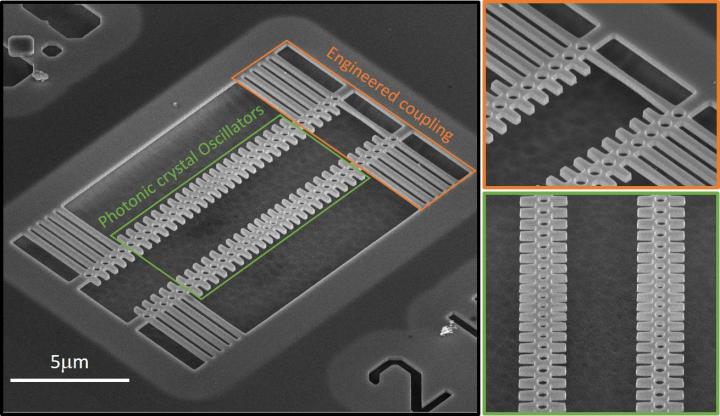
Mechanical oscillators are typical in these systems. In the nanoscale, the challenge is to synchronize these. In these lines, an article published in the journal Physical Review Letters -by a team of researchers from the Institute of Nanoscience and Nanotechnology of the UB (IN2UB) together with ICN2 researchers showed a version of mechanic oscillators at a nanoscale. Through a series of experiments, researchers could synchronize two crystal optomechanical oscillators mechanically coupled, located in the same silicon platform and activated through independent optical impulses. These nanometric oscillators have a size of 15 micrometres per 500 nanometres.

While a mechanical pendulum receives impulses from the clock to keep its movement, the optomechanical pendulums use the pressure from radiation, but interaction of oscillators is the same in both experiments. The study also shows that the collective dynamics can be controlled acting externally on one oscillator only.

“Results show a good base for the creation of reconfigurable networks of optomechanical oscillators thanks to these collective dynamics that are dominated by a weak mechanical coupling. This could have applications in photonics, for instance, for pattern recognition tasks or a more complex cognitive process”, notes Daniel Navarro Urrios, from IN2UB, who led the research.

###

Article reference:

M. F. Colombano, G. Arregui, N. E. Capuj, A. Pitanti, J. Maire, A. Griol, B. Garrido, A. MartĂ­nez, C. M. Sotomayor-Torres, and D. Navarro-Urrios. “Synchronization of optomechanical nanobeams by mechanical interaction”. Physical Review Letters, 1st July 2019. Doi: 10.1103/PhysRevLett.123.017402

Media Contact
Bibiana BonmatĂ­
[email protected]

Original Source

https://www.ub.edu/web/ub/en/menu_eines/noticies/2019/06/032.html

Related Journal Article

http://dx.doi.org/10.1103/PhysRevLett.123.017402

Tags: Chemistry/Physics/Materials SciencesNanotechnology/Micromachines
Share12Tweet8Share2ShareShareShare2

Related Posts

Enhancing Weather Resistance in Perovskite Solar Cells

Enhancing Weather Resistance in Perovskite Solar Cells

March 29, 2026
Innovative Approach Achieves 29.76% Efficiency in All-Perovskite Tandem Solar Cells

Innovative Approach Achieves 29.76% Efficiency in All-Perovskite Tandem Solar Cells

March 29, 2026

Molecular Umbrella Shields Solar Cells for Enhanced Protection

March 29, 2026

Microwave Technology Transforms Moon Dust into Building Materials Without Earth Supplies

March 29, 2026
Please login to join discussion

POPULAR NEWS

  • blank

    Revolutionary AI Model Enhances Precision in Detecting Food Contamination

    96 shares
    Share 38 Tweet 24
  • Imagine a Social Media Feed That Challenges Your Views Instead of Reinforcing Them

    1005 shares
    Share 397 Tweet 248
  • Promising Outcomes from First Clinical Trials of Gene Regulation in Epilepsy

    51 shares
    Share 20 Tweet 13
  • Advancements in EV Battery Technology to Surpass Climate Change-Induced Degradation

    45 shares
    Share 18 Tweet 11

About

We bring you the latest biotechnology news from best research centers and universities around the world. Check our website.

Follow us

Recent News

New Zebrafish Study Sheds Light on Why Haploid Fish Embryos Often Fail to Fully Develop

Boron Neutron Capture Therapy: A Breakthrough in Cancer Treatment

Bacteria Integrate Polyfluoroalkyl Carboxylates into Membranes

Subscribe to Blog via Email

Enter your email address to subscribe to this blog and receive notifications of new posts by email.

Join 78 other subscribers
  • Contact Us

Bioengineer.org © Copyright 2023 All Rights Reserved.

Welcome Back!

Login to your account below

Forgotten Password?

Retrieve your password

Please enter your username or email address to reset your password.

Log In
No Result
View All Result
  • Homepages
    • Home Page 1
    • Home Page 2
  • News
  • National
  • Business
  • Health
  • Lifestyle
  • Science

Bioengineer.org © Copyright 2023 All Rights Reserved.