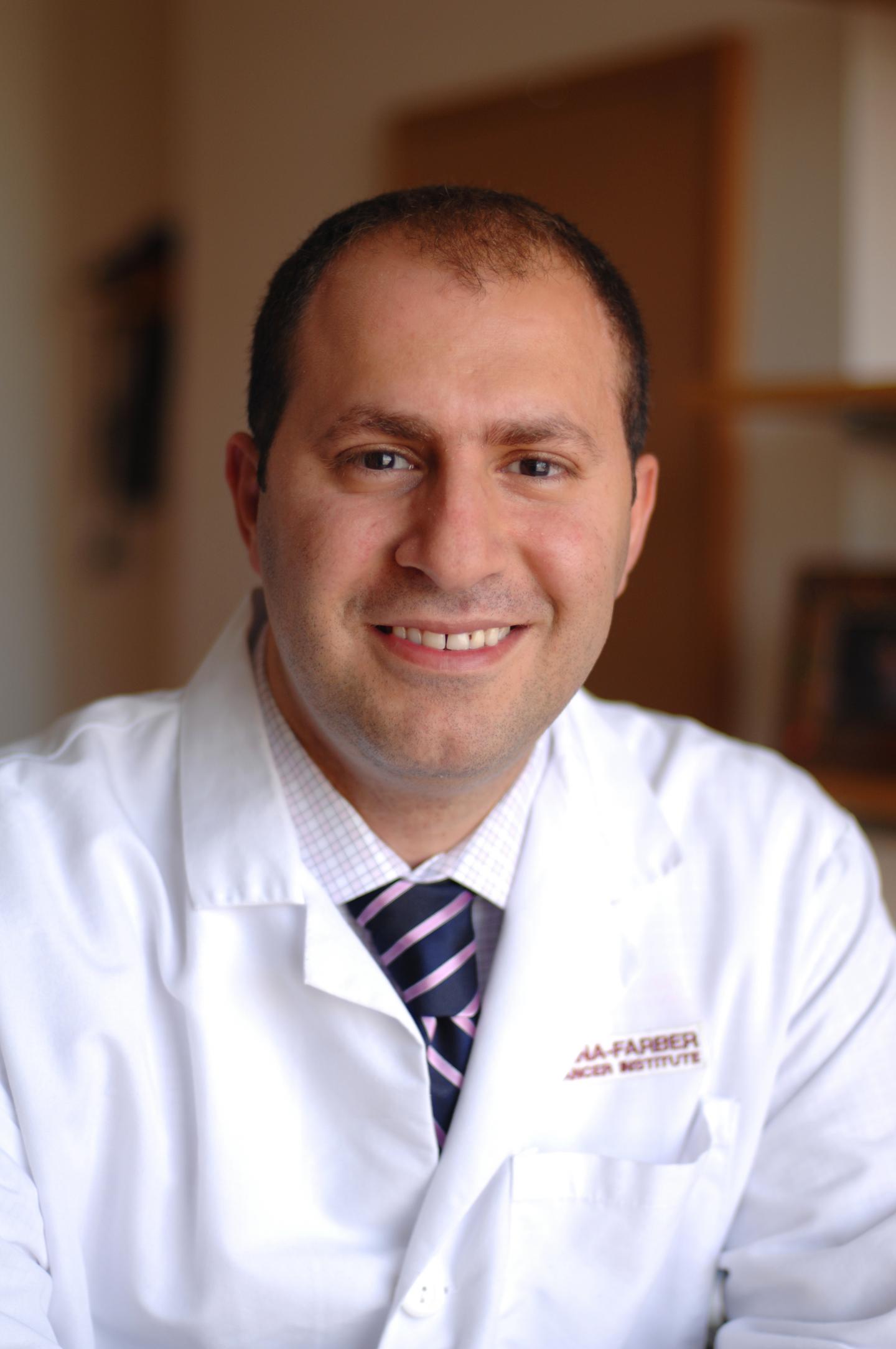
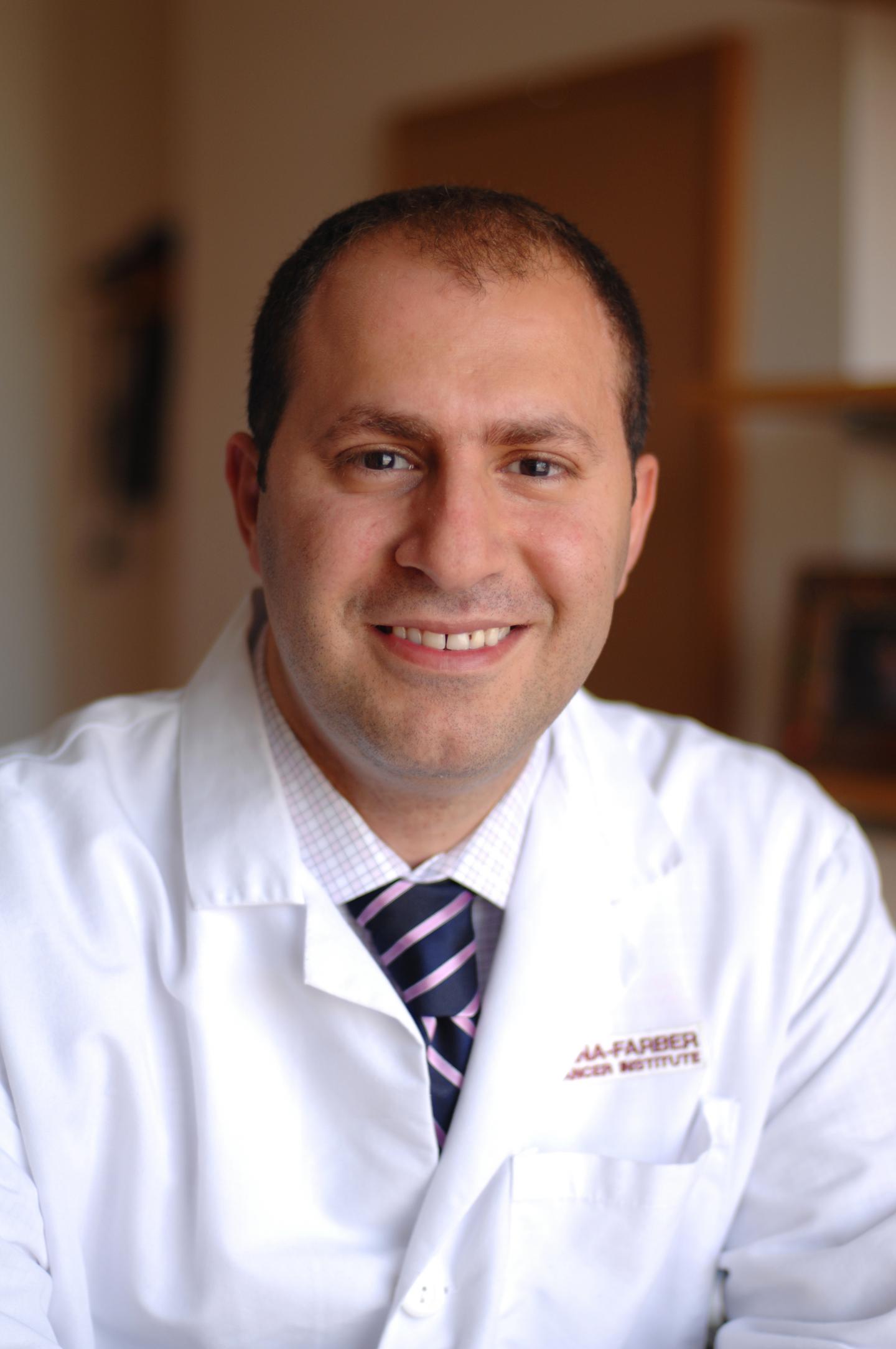
Credit: Dana-Farber Cancer Institute
BOSTON — An experimental kidney cancer drug outperformed the standard first-line therapy for patients with metastatic disease who are considered at risk for poorer than average outcomes, according to results of a randomized phase II clinical trial by researchers at Dana-Farber Cancer Institute.
Individuals who received the drug, cabozantinib, had a longer time to progression – the interval before their cancer worsened – than those taking sunitinib (Sutent), the drug that has been the standard initial treatment for metastatic kidney cancer for the past decade.
Preliminary data also showed that cabozantinib was associated with 20 percent lower risk of death during the study.
Toni K. Choueiri, MD, director of the Lank Center for Genitourinary Oncology at Dana-Farber, is lead author on a report in the Journal of Clinical Oncology summarizing results of the multicenter trial; senior authors are from Duke University Medical Center and Memorial Sloan Kettering Cancer Center.
"These results are very relevant to our practice and our kidney cancer patients – they may change the standard," Choueiri said. "The results also demonstrate that studies sponsored by the National Cancer Institute can accrue rapidly and yield highly relevant results to the field."
Metastatic clear cell renal cell carcinoma (RCC), is largely incurable, but researchers have identified factors used to classify patients as good, intermediate, or poor risk in terms of potential outcomes. The clinical trial included 157 patients, 81 percent considered to be intermediate risk and 19 percent poor risk, who had no previous treatment. In 36 percent of patients, the cancer had spread to the bone – a harbinger of worse outcome.
The most effective drugs for metastatic kidney cancer at present are agents that block angiogenesis by targeting vascular endothelial growth factor (VEGF) and its receptors. Such compounds are designed to interrupt blood supply to the tumors, slowing their growth or shrinking them. Both sunitinib and cabozantinib inhibit VEGF; cabozantinib also blocks the MET and AXL oncogenes, both involved in resistance to VEGF inhibitors.
Cabozantinib, made by Exelixis, Inc., received Food and Drug Administration approval earlier in 2016 for second-line treatment of advanced kidney cancer. The current trial, known as A031203 CABOSUN, is comparing cabozantinib and sunitinib as initial treatment.
The primary endpoint of the trial is progression-free survival, which was a median 8.2 months for cabozantinib and 5.6 months for sunitinib. Cabozantinib reduced the rate of disease progression or death by 34 percent compared with sunitinib.
The overall response rate was better for cabozantinib patients, 46 percent of whom had complete or partial responses compared to 18 percent in the sunitinib group.
The trial wasn't designed to compare overall survival rates between the drugs, but the researchers said preliminary data with a relatively short follow-up showed cabozantinib treatment was associated with a 20 percent decrease in the risk of death.
The safety and side effects profiles of the two drugs were similar and comparable to those observed in kidney cancer patients treated with other VEGF inhibitors, the investigators said.
Patients stopped treatment because of adverse events at equivalent rates with the two drugs.
###
The research was supported by National Institutes of Health grants U109CA180821 and U10CA180882.
About Dana-Farber Cancer Institute
From achieving the first remissions in childhood cancer with chemotherapy in 1948, to developing the very latest new therapies, Dana-Farber Cancer Institute is one of the world's leading centers of cancer research and treatment. It is the only center ranked in the top 4 of U.S. News and World Report's Best Hospitals for both adult and pediatric cancer care.
Dana-Farber sits at the center of a wide range of collaborative efforts to reduce the burden of cancer through scientific inquiry, clinical care, education, community engagement, and advocacy. Dana-Farber/Brigham and Women's Cancer Center provides the latest in cancer care for adults; Dana-Farber/Boston Children's Cancer and Blood Disorders Center for children. The Dana-Farber/Harvard Cancer Center unites the cancer research efforts of five Harvard academic medical centers and two graduate schools, while Dana-Farber Community Cancer Care provides high quality cancer treatment in communities outside Boston's Longwood Medical Area.
Dana-Farber is dedicated to a unique, 50/50 balance between cancer research and care, and much of the Institute's work is dedicated to translating the results of its discovery into new treatments for patients locally and around the world.
Media Contact
Anne Doerr
[email protected]
617-632-5665
@DanaFarber
http://www.dfci.harvard.edu
############
Story Source: Materials provided by Scienmag