• HOME
  • NEWS
  • EXPLORE
    • CAREER
      • Companies
      • Jobs
    • EVENTS
    • iGEM
      • News
      • Team
    • PHOTOS
    • VIDEO
    • WIKI
  • BLOG
  • COMMUNITY
    • FACEBOOK
    • INSTAGRAM
    • TWITTER
Thursday, March 26, 2026
BIOENGINEER.ORG
No Result
View All Result
  • Login
  • HOME
  • NEWS
  • EXPLORE
    • CAREER
      • Companies
      • Jobs
        • Lecturer
        • PhD Studentship
        • Postdoc
        • Research Assistant
    • EVENTS
    • iGEM
      • News
      • Team
    • PHOTOS
    • VIDEO
    • WIKI
  • BLOG
  • COMMUNITY
    • FACEBOOK
    • INSTAGRAM
    • TWITTER
  • HOME
  • NEWS
  • EXPLORE
    • CAREER
      • Companies
      • Jobs
        • Lecturer
        • PhD Studentship
        • Postdoc
        • Research Assistant
    • EVENTS
    • iGEM
      • News
      • Team
    • PHOTOS
    • VIDEO
    • WIKI
  • BLOG
  • COMMUNITY
    • FACEBOOK
    • INSTAGRAM
    • TWITTER
No Result
View All Result
Bioengineer.org
No Result
View All Result
Home NEWS Science News Biology

Structural development of the brain

Bioengineer by Bioengineer
June 21, 2019
in Biology
Reading Time: 2 mins read
0
IMAGE
Share on FacebookShare on TwitterShare on LinkedinShare on RedditShare on Telegram

IMAGE

Credit: Kanazawa University

The human brain consists of neurons arranged into microscopic columns. The cortex, which is the seat of most cerebral functions and forms the largest part of the brain, is divided into uncountable micro-columns. However, the exact development of this columnar structure is elusive to neuroscientists. A research team led by Makoto Sato, has recently reported their study describing the role of a specific protein in the growth of these columns.

The team spanning across Kanazawa University, Ryukoku University, Tokyo Institute of Technology and Imperial College London, used the Drosophila melanogaster (fruit fly) brain for their experiments. The visual centre of the Drosophila brain bears high structural resemblance to the columnar arrangement of the human one, making it an apposite, yet simple model to study. To first visualize these columns, N-cadherin (Ncad), a protein specific to the nervous system, was mapped. The spatial locations of Ncad revealed that during the larval stage of the fly, the visual centre comprised a donut-like structure. As the fly matured to the pupal stage, these structures started stacking on top of each other and indeed transformed into a three-dimensional column.

The research team then carefully analysed these columns and found the presence of three neuron types, namely, R7, R8 and Mi1 within them. While R7 was concentrated towards the central core of the columns, R8 and Mi1 were arranged towards the periphery. Now that the structural composition was clear, understanding the process of column formation was the next step. It was suspected that Ncad, which was heavily present in the columns, played a role in this regard. When Ncad was measured in all three neuron types, it was found that R7 neurons contained more Ncad than the peripheral neurons. Since Ncad is known to give cells adhesive properties, the team concluded that it was the levels of Ncad which determined the location of each of the neuron types within the columns. Heavily adhesive neurons such as R7 formed the core of the columns.

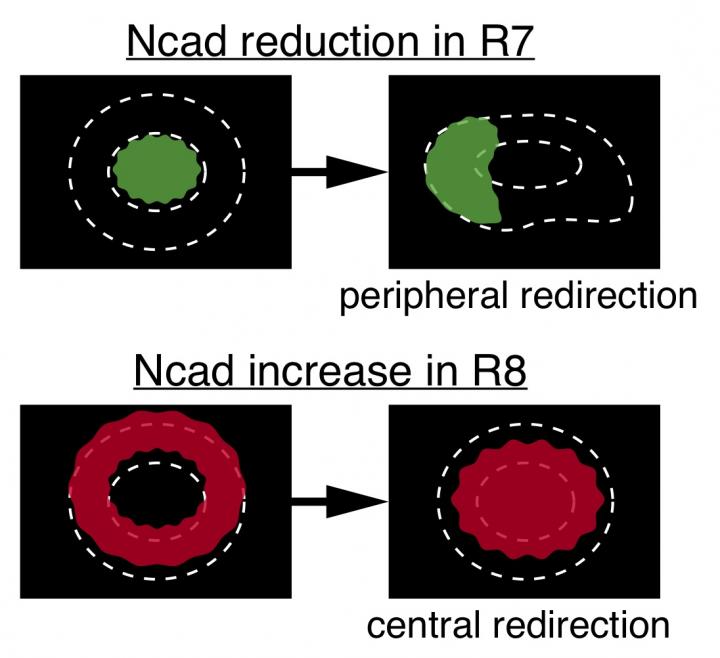
Lastly, to see whether Ncad directly affected the columnar arrangement, it was either completely removed or greatly increased in the neurons. As expected, manipulation of Ncad disturbed the columnar assembly and positions of the neurons. For example, R7 neurons without any Ncad were no longer within the core. However, when Ncad was greatly increased within them, the R8 and Mi1 neurons extended towards the core, possibly due to the strong adhesive properties of Ncad.

This study revealed the role of an adhesive protein in arranging neurons to form the columnar microstructure of the brain. “[Ncad-dependant] differential adhesion and inter-layer interaction may be the essential mechanism underlying the 3D organization of column formation that is evolutionarily conserved from the fly optic lobe to mammalian brains”, conclude the researchers. This discovery can help neuroscientists monitor healthy development of the brain and uncover other molecules involved in the process.

###

Media Contact
Tomoya Sato
[email protected]

Related Journal Article

http://dx.doi.org/10.1523/JNEUROSCI.3107-18.2019

Tags: BiologyCalculations/Problem-SolvingCell BiologyDevelopmental/Reproductive BiologyMolecular Biologyneurobiology
Share12Tweet8Share2ShareShareShare2

Related Posts

How to sway group opinions: Encourage opponents to stay undecided

How to sway group opinions: Encourage opponents to stay undecided

March 23, 2026
Deep Learning Model Maps How Individual Cells Shape Disease Outcomes

Deep Learning Model Maps How Individual Cells Shape Disease Outcomes

March 20, 2026

Removing only 15 female sharks annually could endanger the entire population, scientists warn

March 20, 2026

Scientists Urge Fragrance Industry to Transition from Sustainability Talk to Active Funding of Plant Conservation

March 20, 2026
Please login to join discussion

POPULAR NEWS

  • blank

    Revolutionary AI Model Enhances Precision in Detecting Food Contamination

    96 shares
    Share 38 Tweet 24
  • Imagine a Social Media Feed That Challenges Your Views Instead of Reinforcing Them

    1003 shares
    Share 397 Tweet 248
  • Uncovering Functions of Cavernous Malformation Proteins in Organoids

    54 shares
    Share 22 Tweet 14
  • Promising Outcomes from First Clinical Trials of Gene Regulation in Epilepsy

    51 shares
    Share 20 Tweet 13

About

We bring you the latest biotechnology news from best research centers and universities around the world. Check our website.

Follow us

Recent News

In-Sensor Cryptography Links Physical Process to Digital Identity

Can Psychosocial Factors Influence Cancer Risk?

Depression Factors in Elderly: Pre vs. Post-COVID Analysis

Subscribe to Blog via Email

Success! An email was just sent to confirm your subscription. Please find the email now and click 'Confirm' to start subscribing.

Join 78 other subscribers
  • Contact Us

Bioengineer.org © Copyright 2023 All Rights Reserved.

Welcome Back!

Login to your account below

Forgotten Password?

Retrieve your password

Please enter your username or email address to reset your password.

Log In
No Result
View All Result
  • Homepages
    • Home Page 1
    • Home Page 2
  • News
  • National
  • Business
  • Health
  • Lifestyle
  • Science

Bioengineer.org © Copyright 2023 All Rights Reserved.