• HOME
  • NEWS
  • EXPLORE
    • CAREER
      • Companies
      • Jobs
    • EVENTS
    • iGEM
      • News
      • Team
    • PHOTOS
    • VIDEO
    • WIKI
  • BLOG
  • COMMUNITY
    • FACEBOOK
    • INSTAGRAM
    • TWITTER
Saturday, February 7, 2026
BIOENGINEER.ORG
No Result
View All Result
  • Login
  • HOME
  • NEWS
  • EXPLORE
    • CAREER
      • Companies
      • Jobs
        • Lecturer
        • PhD Studentship
        • Postdoc
        • Research Assistant
    • EVENTS
    • iGEM
      • News
      • Team
    • PHOTOS
    • VIDEO
    • WIKI
  • BLOG
  • COMMUNITY
    • FACEBOOK
    • INSTAGRAM
    • TWITTER
  • HOME
  • NEWS
  • EXPLORE
    • CAREER
      • Companies
      • Jobs
        • Lecturer
        • PhD Studentship
        • Postdoc
        • Research Assistant
    • EVENTS
    • iGEM
      • News
      • Team
    • PHOTOS
    • VIDEO
    • WIKI
  • BLOG
  • COMMUNITY
    • FACEBOOK
    • INSTAGRAM
    • TWITTER
No Result
View All Result
Bioengineer.org
No Result
View All Result
Home NEWS Science News

New way to make low-cost solar cell technology

Bioengineer by Bioengineer
November 15, 2016
in Science News
Reading Time: 2 mins read
0
Share on FacebookShare on TwitterShare on LinkedinShare on RedditShare on Telegram
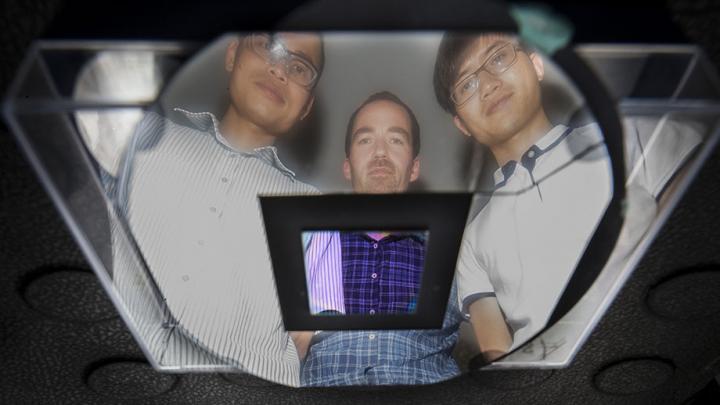
IMAGE

Credit: Jack Fox, ANU.

Researchers at The Australian National University (ANU) have found a new way to fabricate high efficiency semi-transparent perovskite solar cells in a breakthrough that could lead to more efficient and cheaper solar electricity.

Dr Tom White from the ANU Research School of Engineering said the new fabrication method significantly improved the performance of perovskite solar cells, which can combine with conventional silicon solar cells to produce more efficient solar electricity.

He said perovskite solar cells were extremely good at making electricity from visible light – blue, green and red – while conventional silicon solar cells were more efficient at converting infrared light into electricity.

"The prospect of adding a few additional processing steps at the end of a silicon cell production line to make perovskite cells is very exciting and could boost solar efficiency from 25 per cent to 30 per cent," Dr White said.

"By combining these two cells, the perovskite cell and the silicon cell, we are able to make much better use of the solar energy and achieve higher efficiencies than either cell on its own."

While perovskite cells can improve efficiency, they are not yet stable enough to be used on rooftops. Dr White said the new fabrication technique could help develop more reliable perovskite cells.

The new fabrication method involves adding a small amount of the element indium into one of the cell layers during fabrication. That could increase the cell's power output by as much as 25 per cent.

"We have been able to achieve a record efficiency of 16.6 per cent for a semi-transparent perovskite cell, and 24.5 per cent for a perovskite-silicon tandem, which is one of the highest efficiencies reported for this type of cell," said Dr White.

Dr White said the research placed ANU in a small group of labs around the world with the capability to improve silicon solar cell efficiency using perovskites.

The development builds on the state-of-the-art silicon cell research at ANU and is part of a $12.2 million "High-efficiency silicon/perovskite solar cells" project led by University of New South Wales and supported by $3.6 million of funding from the Australian Renewable Energy Agency.

Research partners include Monash University, Arizona State University, Suntech R&D Australia Pty Ltd and Trina Solar.

###

The research is published in Advanced Energy Materials: http://onlinelibrary.wiley.com/doi/10.1002/aenm.201601768/abstract.

Images are available from cloudstor: https://cloudstor.aarnet.edu.au/plus/index.php/s/foXF6owiuDjeYVy.

Media Contact

ANU Media
[email protected]
61-261-257-979
@ANUmedia

http://www.anu.edu.au/media

############

Story Source: Materials provided by Scienmag

Share12Tweet8Share2ShareShareShare2

Related Posts

Evaluating Pediatric Emergency Care Quality in Ethiopia

February 7, 2026

TPMT Expression Predictions Linked to Azathioprine Side Effects

February 7, 2026

Improving Dementia Care with Enhanced Activity Kits

February 7, 2026

Decoding Prostate Cancer Origins via snFLARE-seq, mxFRIZNGRND

February 7, 2026
Please login to join discussion

POPULAR NEWS

  • Robotic Ureteral Reconstruction: A Novel Approach

    Robotic Ureteral Reconstruction: A Novel Approach

    82 shares
    Share 33 Tweet 21
  • Digital Privacy: Health Data Control in Incarceration

    63 shares
    Share 25 Tweet 16
  • Study Reveals Lipid Accumulation in ME/CFS Cells

    57 shares
    Share 23 Tweet 14
  • Breakthrough in RNA Research Accelerates Medical Innovations Timeline

    53 shares
    Share 21 Tweet 13

About

We bring you the latest biotechnology news from best research centers and universities around the world. Check our website.

Follow us

Recent News

Evaluating Pediatric Emergency Care Quality in Ethiopia

TPMT Expression Predictions Linked to Azathioprine Side Effects

Improving Dementia Care with Enhanced Activity Kits

Subscribe to Blog via Email

Success! An email was just sent to confirm your subscription. Please find the email now and click 'Confirm' to start subscribing.

Join 73 other subscribers
  • Contact Us

Bioengineer.org © Copyright 2023 All Rights Reserved.

Welcome Back!

Login to your account below

Forgotten Password?

Retrieve your password

Please enter your username or email address to reset your password.

Log In
No Result
View All Result
  • Homepages
    • Home Page 1
    • Home Page 2
  • News
  • National
  • Business
  • Health
  • Lifestyle
  • Science

Bioengineer.org © Copyright 2023 All Rights Reserved.