Ants adjust their social interactions to accommodate changes in population density
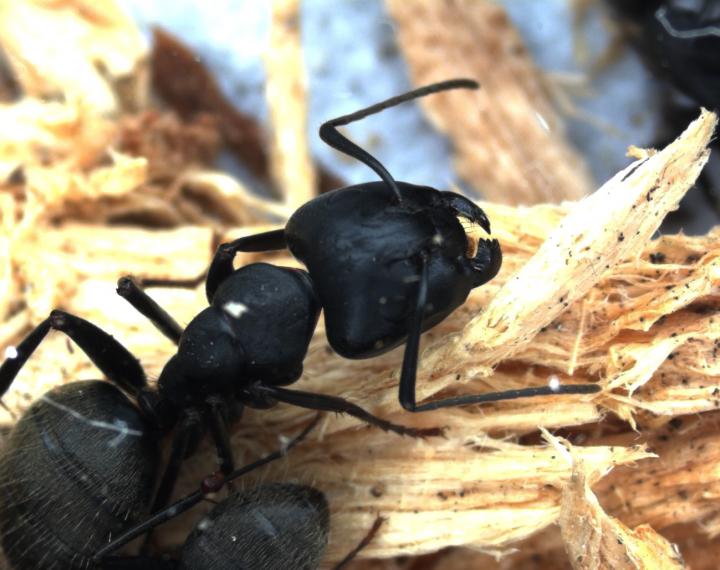
Credit: Adam B. Lazarus, Public Domain
UNIVERSITY PARK, Pa. — Ants adjust their social interactions to accommodate changes in population density, according to researchers at Penn State and Georgetown University. The findings suggest that ant colonies are capable of maintaining their sophisticated social organization despite potentially drastic changes in their environments.
“Ants are among the most ecologically successful groups in nature due to their complex social organization, particularly their division of labor, including food acquisition,” said David Hughes, associate professor of entomology and biology. “The survival of ant colonies depends on their ability to maintain this organization. In our study, we saw remarkable resilience of ant colonies to changes in population density. This finding helps to explain ants’ evolutionary success.”
According to Hughes, changes in ant colony size and population density are natural occurrences. They can increase as the queen reproduces and the colony grows, and they can decrease when the colony decides to split into multiple nest sites.
“To minimize potentially adverse effects due to changes in density and to maintain social balance, ant colonies should try to actively manage the rates of their interactions,” said Hughes. ” Until now, however, few studies have investigated these phenomena.”
The researchers manipulated the population densities of three colonies of carpenter ants by quadrupling the sizes of their nest spaces. They placed the colonies inside wooden camera boxes fitted with infrared lights so they could film the ants under natural dark nesting conditions. The ants were able to leave the nests at any time to enter foraging areas.
The team manually identified the position in the nest of each ant at every point in time — equivalent to more than 6.9 million data points — to investigate whether the increased nest space influenced the spatial organization of the insects. The researchers found that the ants’ positions relative to the others was similar regardless of the population density. When population density was lower, ants simply were separated further in space from each other.
Next, the researchers examined 3,200 ant interactions to analyze whether the increase in nest space influenced their task performance — especially related to trophallaxis, or the transfer of foods from ant to ant. The team’s results appeared May 2, 2019, in eLife.
“As a statistician, I built statistical models that captured how individual ants move within their nests, and how and when they chose to engage in important social behaviors like trophallaxis,” said Ephraim Hanks, associate professor of statistics, Penn State. “These analyses helped to explain how ant populations maintained high levels of community interactions even after their spatial environment was changed.”
Indeed, the team found that — contrary to its expectations, which were that ant interactions would decrease with decreasing population — ant interactions actually did not change with decreased density.
“Our results showcase the kinds of behavioral mechanisms ant colonies apply to achieve social homeostasis in the face of disturbance,” said Hughes. “Specifically, ants actively regulate their spatial distribution and interaction behaviors in a way that allows them to maintain critical elements of their social interaction patterns — such as food and information exchange — in spite of drastic changes in their environment.”
“This work shows that social species like ants can maintain levels of social connection and interaction even when their environment changes drastically,” said Hanks. “As social interactions are a critical driver of the spread of infectious disease, our work shows that changing spatial environments, such as how cities or businesses are laid out, may have little or no effect on the spread of infectious disease, as social species may change their movement patterns to conserve community interactions.”
###
Andreas Modlmeier, former postdoctoral fellow and a leader of the study, and Ryan Bringenberg, former undergraduate student, Penn State; Ewan Colman, postdoctoral fellow, Georgetown University; and Shweta Bansal, assistant professor of biology, Georgetown University.
The National Science Foundation supported this research.
Media Contact
Sara LaJeunesse
[email protected]