• HOME
  • NEWS
  • EXPLORE
    • CAREER
      • Companies
      • Jobs
    • EVENTS
    • iGEM
      • News
      • Team
    • PHOTOS
    • VIDEO
    • WIKI
  • BLOG
  • COMMUNITY
    • FACEBOOK
    • INSTAGRAM
    • TWITTER
Monday, May 11, 2026
BIOENGINEER.ORG
No Result
View All Result
  • Login
  • HOME
  • NEWS
  • EXPLORE
    • CAREER
      • Companies
      • Jobs
        • Lecturer
        • PhD Studentship
        • Postdoc
        • Research Assistant
    • EVENTS
    • iGEM
      • News
      • Team
    • PHOTOS
    • VIDEO
    • WIKI
  • BLOG
  • COMMUNITY
    • FACEBOOK
    • INSTAGRAM
    • TWITTER
  • HOME
  • NEWS
  • EXPLORE
    • CAREER
      • Companies
      • Jobs
        • Lecturer
        • PhD Studentship
        • Postdoc
        • Research Assistant
    • EVENTS
    • iGEM
      • News
      • Team
    • PHOTOS
    • VIDEO
    • WIKI
  • BLOG
  • COMMUNITY
    • FACEBOOK
    • INSTAGRAM
    • TWITTER
No Result
View All Result
Bioengineer.org
No Result
View All Result
Home NEWS Science News Chemistry

Scientists identify a novel neural circuit mediating visually evoked innate defensive responses

Bioengineer by Bioengineer
June 12, 2019
in Chemistry
Reading Time: 2 mins read
0
IMAGE
Share on FacebookShare on TwitterShare on LinkedinShare on RedditShare on Telegram

IMAGE

Credit: LIU Xuemei

Fear overgeneralization (i.e., deficits in the discrimination of safety and threat) is an important pathological characteristic of anxiety-related syndromes such as posttraumatic stress disorder (PTSD), generalized anxiety disorder (GAD) and panic disorder.

However, unlike traditional conditioned fear, the mechanism of processing innate fear is largely unknown.

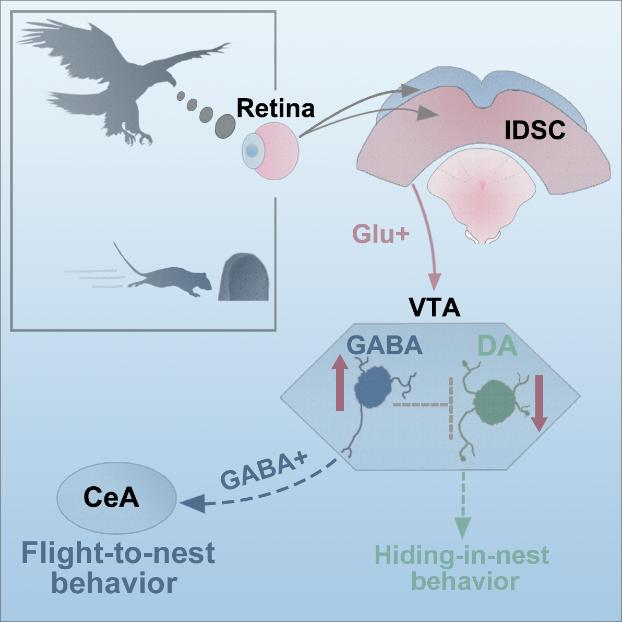
Prof. WANG Liping and his colleagues ZHOU Zheng and LIU Xuemei at the Shenzhen Institutes of Advanced Technology (SIAT) of the Chinese Academy of Sciences revealed that the VTA (ventral tegmental area) GABAergic neural circuit mediates visually evoked innate defensive responses.

In this study, the research group identified for the first time a neural circuit related to the VTAGABA+ neurons that mediates visually evoked innate defensive responses, involving the SC Glut+_ VTAGABA+_ CeA (central nucleus of the amygdala) pathway.

It has been confirmed by neuroscientists that the VTA plays an important role in learned appetitive and aversive behaviors. Interestingly, the researchers revealed that the GABA neurons in VTA were activated by visual threats by fiber photometry. Through viral tracing and both in vivo and in vitro electrophysiological recordings, they showed that VTAGABA+ neurons received direct excitatory inputs from the superior colliculus (SC).

The researchers revealed that VTAGABA+ neurons mediated looming-evoked innate defensive behaviors. These findings demonstrated that SC glutamatergic inputs activated VTAGABA+ neurons and mediated looming-evoked innate defensive behaviors. They further showed that CeA was a downstream target of the SC-VTA GABAergic pathway and it was involved in innate defensive behavior.

This study provides new insights into potential mechanisms of survival across species, as well as the maladaptive behavior in fear- and anxiety-related mental disorders.

The team has been working on the dissection of the neural circuits mediating instinctive emotions for years. In their previous work, they have resolved a novel brain circuit controlling visually evoked innate freezing behaviors via the SC-LP-LA subcortical pathway. They also had pioneering work which first reported that the accelerated innate defensive response to visual threats induced by stress is mediated by the Locus Coeruleus (LC) directed TH+ projections to the SC. The current study published in Neuron is another key milestone in their systematic work.

###

Media Contact
ZHANG Xiaomin
[email protected]

Related Journal Article

http://dx.doi.org/10.1016/j.neuron.2019.05.027

Tags: BiologyBiomedical/Environmental/Chemical EngineeringDepression/AngerneurobiologyNeurochemistryStress/Anxiety
Share12Tweet8Share2ShareShareShare2

Related Posts

Miniature Sensor Uses Light to Detect Touch — Chemistry

Miniature Sensor Uses Light to Detect Touch

May 8, 2026
Iron Minerals Determine Whether Dissolved Organic Matter Fuels Microbes or Becomes Long-Term Carbon Storage — Chemistry

Iron Minerals Determine Whether Dissolved Organic Matter Fuels Microbes or Becomes Long-Term Carbon Storage

May 8, 2026

Kate Evans Appointed Associate Lab Director for Biological and Environmental Systems Science at ORNL

May 8, 2026

Advancing Multiscale Modeling and Overcoming Operational Challenges in Autothermal COâ‚‚-to-Methanol Reactors

May 8, 2026
Please login to join discussion

POPULAR NEWS

  • Research Indicates Potential Connection Between Prenatal Medication Exposure and Elevated Autism Risk

    840 shares
    Share 336 Tweet 210
  • New Study Reveals Plants Can Detect the Sound of Rain

    727 shares
    Share 290 Tweet 181
  • Salmonella Haem Blocks Macrophages, Boosts Infection

    61 shares
    Share 24 Tweet 15
  • Breastmilk Balances E. coli and Beneficial Bacteria in Infant Gut Microbiomes

    57 shares
    Share 23 Tweet 14

About

We bring you the latest biotechnology news from best research centers and universities around the world. Check our website.

Follow us

Recent News

New Post-Hoc Analysis Explores Daily Oral Orforglipron Use in Adults Over 65 with Obesity, Regardless of Diabetes Status

Evaluating Digoxin Use in Patients with Symptomatic Rheumatic Heart Disease

Evaluating the Effectiveness and Safety of Digitalis Glycosides in Treating Heart Failure

Subscribe to Blog via Email

Enter your email address to subscribe to this blog and receive notifications of new posts by email.

Join 82 other subscribers
  • Contact Us

Bioengineer.org © Copyright 2023 All Rights Reserved.

Welcome Back!

Login to your account below

Forgotten Password?

Retrieve your password

Please enter your username or email address to reset your password.

Log In
No Result
View All Result
  • Homepages
    • Home Page 1
    • Home Page 2
  • News
  • National
  • Business
  • Health
  • Lifestyle
  • Science

Bioengineer.org © Copyright 2023 All Rights Reserved.