• HOME
  • NEWS
  • EXPLORE
    • CAREER
      • Companies
      • Jobs
    • EVENTS
    • iGEM
      • News
      • Team
    • PHOTOS
    • VIDEO
    • WIKI
  • BLOG
  • COMMUNITY
    • FACEBOOK
    • INSTAGRAM
    • TWITTER
Saturday, February 7, 2026
BIOENGINEER.ORG
No Result
View All Result
  • Login
  • HOME
  • NEWS
  • EXPLORE
    • CAREER
      • Companies
      • Jobs
        • Lecturer
        • PhD Studentship
        • Postdoc
        • Research Assistant
    • EVENTS
    • iGEM
      • News
      • Team
    • PHOTOS
    • VIDEO
    • WIKI
  • BLOG
  • COMMUNITY
    • FACEBOOK
    • INSTAGRAM
    • TWITTER
  • HOME
  • NEWS
  • EXPLORE
    • CAREER
      • Companies
      • Jobs
        • Lecturer
        • PhD Studentship
        • Postdoc
        • Research Assistant
    • EVENTS
    • iGEM
      • News
      • Team
    • PHOTOS
    • VIDEO
    • WIKI
  • BLOG
  • COMMUNITY
    • FACEBOOK
    • INSTAGRAM
    • TWITTER
No Result
View All Result
Bioengineer.org
No Result
View All Result
Home NEWS Science News Biology

Fishing a line coupled with clockwork for daily rhythm

Bioengineer by Bioengineer
June 6, 2019
in Biology
Reading Time: 2 mins read
0
IMAGE
Share on FacebookShare on TwitterShare on LinkedinShare on RedditShare on Telegram

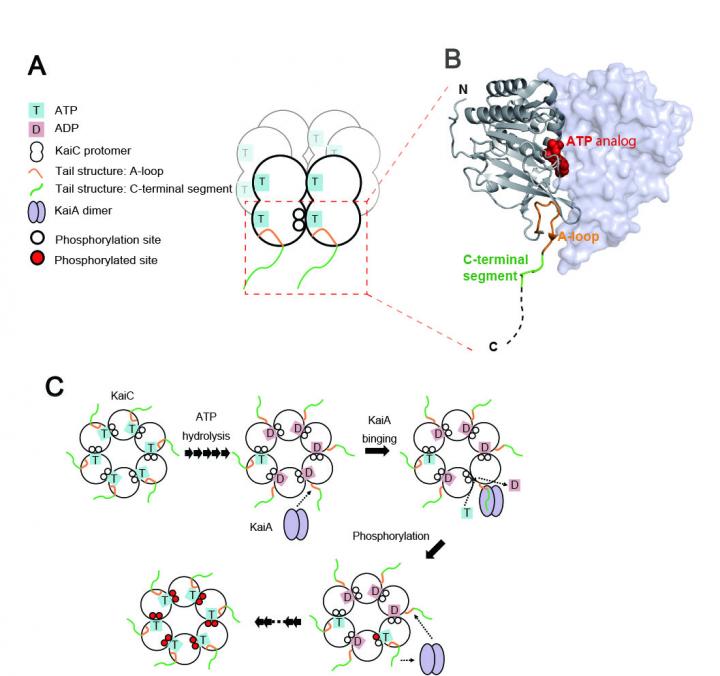
Molecular mechanism of the interplay of clock proteins for generating a circadian oscillation
IMAGE

Credit: Koichi Kato

Organisms on this planet, including human beings, exhibit a biological rhythm that repeats about every 24 h to adapt to the daily environmental alteration caused by the rotation of the earth. This circadian rhythm is regulated by a set of biomolecules working as a biological clock. In cyanobacteria (or blue-green algae), the circadian rhythm is controlled by the assembly and disassembly of three clock proteins, namely, KaiA, KaiB, and KaiC. KaiC forms a hexameric-ring structure and plays a central role in the clock oscillator, which works by consuming ATP, the energy currency molecule of the cell. However, it remains unknown how the clock proteins work autonomously for generating the circadian oscillation.

The research groups at Graduate School of Pharmaceutical Sciences of Nagoya City University and Exploratory Research Center on Life and Living Systems (ExCELLS) and Institute for Molecular Science (IMS) of National Institutes of Natural Sciences investigated this mechanism by native mass spectrometry and nuclear magnetic resonance spectroscopy. They found that KaiC degrades ATP into ADP within its ring structure, which triggers the leaping out of the tail of KaiC from the ring. KaiA captures the exposed KaiC tail, facilitating ADP release from the ring, thereby setting the clock ahead.

This “fishing a line” mechanism explains the clockwork interplay of the KaiA and KaiC proteins. Elucidating this mechanism will provide deep insights into not only the circadian clock in cyanobacteria but also that in plants, animals, and humans under physiological and pathological conditions, including jet lag and sleep disorders.

###

Media Contact
Koichi KATO
[email protected]

Original Source

http://www.nagoya-cu.ac.jp/english/about/research-news/015155.html

Related Journal Article

http://dx.doi.org/10.26508/lsa.201900368

Tags: BiologyCircadian Rhythm
Share13Tweet8Share2ShareShareShare2

Related Posts

Florida Cane Toad: Complex Spread and Selective Evolution

Florida Cane Toad: Complex Spread and Selective Evolution

February 7, 2026
New Study Uncovers Mechanism Behind Burn Pit Particulate Matter–Induced Lung Inflammation

New Study Uncovers Mechanism Behind Burn Pit Particulate Matter–Induced Lung Inflammation

February 6, 2026

DeepBlastoid: Advancing Automated and Efficient Evaluation of Human Blastoids with Deep Learning

February 6, 2026

Navigating the Gut: The Role of Formic Acid in the Microbiome

February 6, 2026
Please login to join discussion

POPULAR NEWS

  • Robotic Ureteral Reconstruction: A Novel Approach

    Robotic Ureteral Reconstruction: A Novel Approach

    82 shares
    Share 33 Tweet 21
  • Digital Privacy: Health Data Control in Incarceration

    63 shares
    Share 25 Tweet 16
  • Study Reveals Lipid Accumulation in ME/CFS Cells

    57 shares
    Share 23 Tweet 14
  • Breakthrough in RNA Research Accelerates Medical Innovations Timeline

    53 shares
    Share 21 Tweet 13

About

We bring you the latest biotechnology news from best research centers and universities around the world. Check our website.

Follow us

Recent News

Phage-Antibiotic Combo Beats Resistant Peritoneal Infection

Boosting Remote Healthcare: Stepped-Wedge Trial Insights

Barriers and Boosters of Seniors’ Physical Activity in Karachi

Subscribe to Blog via Email

Enter your email address to subscribe to this blog and receive notifications of new posts by email.

Join 73 other subscribers
  • Contact Us

Bioengineer.org © Copyright 2023 All Rights Reserved.

Welcome Back!

Login to your account below

Forgotten Password?

Retrieve your password

Please enter your username or email address to reset your password.

Log In
No Result
View All Result
  • Homepages
    • Home Page 1
    • Home Page 2
  • News
  • National
  • Business
  • Health
  • Lifestyle
  • Science

Bioengineer.org © Copyright 2023 All Rights Reserved.