• HOME
  • NEWS
  • EXPLORE
    • CAREER
      • Companies
      • Jobs
    • EVENTS
    • iGEM
      • News
      • Team
    • PHOTOS
    • VIDEO
    • WIKI
  • BLOG
  • COMMUNITY
    • FACEBOOK
    • INSTAGRAM
    • TWITTER
Saturday, February 7, 2026
BIOENGINEER.ORG
No Result
View All Result
  • Login
  • HOME
  • NEWS
  • EXPLORE
    • CAREER
      • Companies
      • Jobs
        • Lecturer
        • PhD Studentship
        • Postdoc
        • Research Assistant
    • EVENTS
    • iGEM
      • News
      • Team
    • PHOTOS
    • VIDEO
    • WIKI
  • BLOG
  • COMMUNITY
    • FACEBOOK
    • INSTAGRAM
    • TWITTER
  • HOME
  • NEWS
  • EXPLORE
    • CAREER
      • Companies
      • Jobs
        • Lecturer
        • PhD Studentship
        • Postdoc
        • Research Assistant
    • EVENTS
    • iGEM
      • News
      • Team
    • PHOTOS
    • VIDEO
    • WIKI
  • BLOG
  • COMMUNITY
    • FACEBOOK
    • INSTAGRAM
    • TWITTER
No Result
View All Result
Bioengineer.org
No Result
View All Result
Home NEWS Science News

Solid-phase extraction of ibuprofen from pharmaceuticals

Bioengineer by Bioengineer
November 14, 2016
in Science News
Reading Time: 2 mins read
0
Share on FacebookShare on TwitterShare on LinkedinShare on RedditShare on Telegram
IMAGE

Credit: Dr. Michal Klivický et al., Bentham Science Publishers

The content of active ingredients in pharmaceuticals is mostly assessed by reversed-phase HPLC. Nevertheless, the excipients in case of suppositories are usually not soluble in commonly used mobile phases solvents (methanol, acetonitrile). That is the reason why a labour intensive and tedious sample pre-treatment is necessary, in order to remove the matrix from the sample.

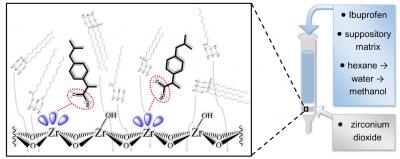
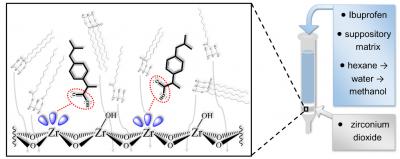
The presence of Lewis acid sites on the surface of metal oxides is responsible for strong interactions with Lewis bases due to ligand exchange. Although this phenomenon is not desirable in chromatography, these interactions might be employed in a sample pre-treatment based on solid phase extraction.

We newly tested this approach on ibuprofen, which is a favourable drug for the management of pain and fever. Due to the inability of infants to swallow tablets, ibuprofen is often administered in the form of suppositories and oral suspensions in paediatric clinics.

Using the zirconium dioxide as the extraction material, efficient trapping of ibuprofen from a hydrophobic suppository matrix was enabled. It demonstrated the pivotal role of interactions between the carboxylic moiety of ibuprofen and the Lewis acid sites on the zirconia surface. The excellent extraction of ibuprofen was also obtained from the hydrophilic environment, which was tested on an oral suspension. Titania as a second tested material was not capable of trapping ibuprofen from pharmaceuticals efficiently due to its weaker ligand exchange properties.

We have described the first successful utilization of the ligand exchange process on zirconia in the extraction of ibuprofen from hydrophobic as well as hydrophilic media using two different dosages forms. The procedure can be applied in cases where excipients or a drug are not soluble in commonly used HPLC solvents and/or if co-eluting peaks from matrix are an issue. The recoveries of ibuprofen were 95 % and 94 % from suppositories and the oral suspension, respectively.

###

For more information about the article, please visit http://benthamscience.com/journals/current-analytical-chemistry/article/135981/

Reference: Klivický, M.; et al (2016). Solid-Phase Extraction of Ibuprofen from Pharmaceuticals via Ligand Exchange Using Zirconium Dioxide. Curr Anal Chem., DOI: 10.2174/1573411012666151022194146

Media Contact

Faizan ul Haq
[email protected]
@BenthamScienceP

http://benthamscience.com/

via scienmag.com

Share12Tweet8Share2ShareShareShare2

Related Posts

Palmitoylation of Tfr1 Drives Platelet Ferroptosis and Exacerbates Liver Damage in Heat Stroke

February 7, 2026

Oxygen-Enhanced Dual-Section Microneedle Patch Improves Drug Delivery and Boosts Photodynamic and Anti-Inflammatory Treatment for Psoriasis

February 7, 2026

Scientists Identify SARS-CoV-2 PLpro and RIPK1 Inhibitors Showing Potent Synergistic Antiviral Effects in Mouse COVID-19 Model

February 7, 2026

Neg-Entropy: The Key Therapeutic Target for Chronic Diseases

February 7, 2026
Please login to join discussion

POPULAR NEWS

  • Robotic Ureteral Reconstruction: A Novel Approach

    Robotic Ureteral Reconstruction: A Novel Approach

    82 shares
    Share 33 Tweet 21
  • Digital Privacy: Health Data Control in Incarceration

    63 shares
    Share 25 Tweet 16
  • Study Reveals Lipid Accumulation in ME/CFS Cells

    57 shares
    Share 23 Tweet 14
  • Breakthrough in RNA Research Accelerates Medical Innovations Timeline

    53 shares
    Share 21 Tweet 13

About

We bring you the latest biotechnology news from best research centers and universities around the world. Check our website.

Follow us

Recent News

Palmitoylation of Tfr1 Drives Platelet Ferroptosis and Exacerbates Liver Damage in Heat Stroke

Oxygen-Enhanced Dual-Section Microneedle Patch Improves Drug Delivery and Boosts Photodynamic and Anti-Inflammatory Treatment for Psoriasis

Scientists Identify SARS-CoV-2 PLpro and RIPK1 Inhibitors Showing Potent Synergistic Antiviral Effects in Mouse COVID-19 Model

Subscribe to Blog via Email

Enter your email address to subscribe to this blog and receive notifications of new posts by email.

Join 73 other subscribers
  • Contact Us

Bioengineer.org © Copyright 2023 All Rights Reserved.

Welcome Back!

Login to your account below

Forgotten Password?

Retrieve your password

Please enter your username or email address to reset your password.

Log In
No Result
View All Result
  • Homepages
    • Home Page 1
    • Home Page 2
  • News
  • National
  • Business
  • Health
  • Lifestyle
  • Science

Bioengineer.org © Copyright 2023 All Rights Reserved.