• HOME
  • NEWS
  • EXPLORE
    • CAREER
      • Companies
      • Jobs
    • EVENTS
    • iGEM
      • News
      • Team
    • PHOTOS
    • VIDEO
    • WIKI
  • BLOG
  • COMMUNITY
    • FACEBOOK
    • INSTAGRAM
    • TWITTER
Monday, January 12, 2026
BIOENGINEER.ORG
No Result
View All Result
  • Login
  • HOME
  • NEWS
  • EXPLORE
    • CAREER
      • Companies
      • Jobs
        • Lecturer
        • PhD Studentship
        • Postdoc
        • Research Assistant
    • EVENTS
    • iGEM
      • News
      • Team
    • PHOTOS
    • VIDEO
    • WIKI
  • BLOG
  • COMMUNITY
    • FACEBOOK
    • INSTAGRAM
    • TWITTER
  • HOME
  • NEWS
  • EXPLORE
    • CAREER
      • Companies
      • Jobs
        • Lecturer
        • PhD Studentship
        • Postdoc
        • Research Assistant
    • EVENTS
    • iGEM
      • News
      • Team
    • PHOTOS
    • VIDEO
    • WIKI
  • BLOG
  • COMMUNITY
    • FACEBOOK
    • INSTAGRAM
    • TWITTER
No Result
View All Result
Bioengineer.org
No Result
View All Result
Home NEWS Science News Chemistry

Efficient triplet pair separation in dibenzopentalene derivatives

Bioengineer by Bioengineer
May 28, 2019
in Chemistry
Reading Time: 2 mins read
0
IMAGE
Share on FacebookShare on TwitterShare on LinkedinShare on RedditShare on Telegram

IMAGE

Credit: ©Science China Press

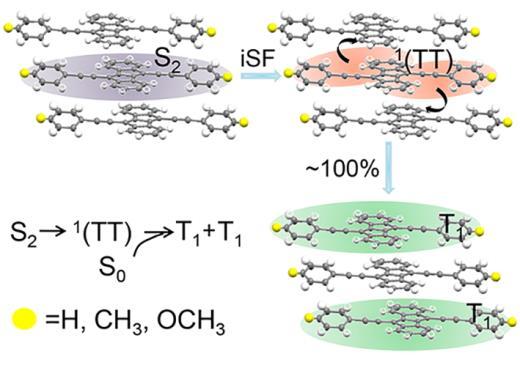
Singlet exciton fission (SF) was considered as an attractive avenue to boost the solar cell efficiencies beyond the Shockley-Queisser limit. In conventional materials, the mechanism of SF is an intermolecular process (named as intermolecular SF, xSF), in which one singlet excited chromophore couples electronically with another ground-state neighbor to form a correlated 1(TT) state (triplet pair). The triplet pair then splits into two independent triplet excited states (T1) at two different molecules.

As a result of the intermolecular nature of the xSF process, its efficiency is significantly influenced by the varied intermolecular electronic coupling degree due to uncontrollable molecular packing and structural order. Intramolecular SF (iSF), in which the essential electronic coupling term can be easily designed and controlled within one molecule, presents a preferable and applicable solution. The disentanglement of the correlated 1(TT) state to produce two long-lived individual triplets is of crucial importance for efficient extraction of excitation energy for photoelectric conversion. However, due to the high binding energy and the confinement of diffusional separation of the two coupled triplets on one molecule, harnessing the triplet energy efficiently via iSF remains a big challenge.

Recently, Professor Fu Hongbing’s group in Capital Normal University studied the evolution of 1(TT) in dibenzopentalene derivatives. The modification of molecular structure tuned the molecular packing distances and displacements.

More importantly, highly efficient triplet pair state separation took place in polycrystalline films with almost 100% yield, irrespective of different intermolecular interactions in these systems. These results suggest the feasibility of converting one correlated 1(TT) to two free T1 efficiently in iSF system and is meaningful for further application in bulk heterojunction organic solar cells.

###

See the article:
Liu Y, Wu Y, Wang L, Wang L, Yao J, Fu H. Efficient triplet pair separation from intramolecular singlet fission in dibenzopentalene derivatives. Sci. China Chem., 2019, DOI: 10.1007/s11426-019-9482-y
http://engine.scichina.com/publisher/scp/journal/SCC/doi/10.1007/s11426-019-9482-y?slug=fulltext

Media Contact
Fu Hongbing
[email protected]

Related Journal Article

http://dx.doi.org/10.1007/s11426-019-9482-y

Tags: Chemistry/Physics/Materials Sciences
Share12Tweet7Share2ShareShareShare1

Related Posts

blank

Advancing Alkene Chemistry: Homologative Difunctionalization Breakthrough

January 8, 2026
Biocompatible Ligand Enables Safe In-Cell Protein Arylation

Biocompatible Ligand Enables Safe In-Cell Protein Arylation

January 8, 2026

Monovalent Pseudo-Natural Products Boost IDO1 Degradation

January 7, 2026

Catalytic Enantioselective [1,2]-Wittig Rearrangement Breakthrough

January 7, 2026
Please login to join discussion

POPULAR NEWS

  • Enhancing Spiritual Care Education in Nursing Programs

    154 shares
    Share 62 Tweet 39
  • PTSD, Depression, Anxiety in Childhood Cancer Survivors, Parents

    146 shares
    Share 58 Tweet 37
  • Robotic Ureteral Reconstruction: A Novel Approach

    69 shares
    Share 28 Tweet 17
  • Impact of Vegan Diet and Resistance Exercise on Muscle Volume

    47 shares
    Share 19 Tweet 12

About

We bring you the latest biotechnology news from best research centers and universities around the world. Check our website.

Follow us

Recent News

Venetoclax Enhances Apoptosis and Autophagy in APL

Revolutionizing Brain Tumor Analysis with Mod-SE(2)

Absolute Gas Thermometry via Brillouin Scattering

Subscribe to Blog via Email

Enter your email address to subscribe to this blog and receive notifications of new posts by email.

Join 71 other subscribers
  • Contact Us

Bioengineer.org © Copyright 2023 All Rights Reserved.

Welcome Back!

Login to your account below

Forgotten Password?

Retrieve your password

Please enter your username or email address to reset your password.

Log In
No Result
View All Result
  • Homepages
    • Home Page 1
    • Home Page 2
  • News
  • National
  • Business
  • Health
  • Lifestyle
  • Science

Bioengineer.org © Copyright 2023 All Rights Reserved.