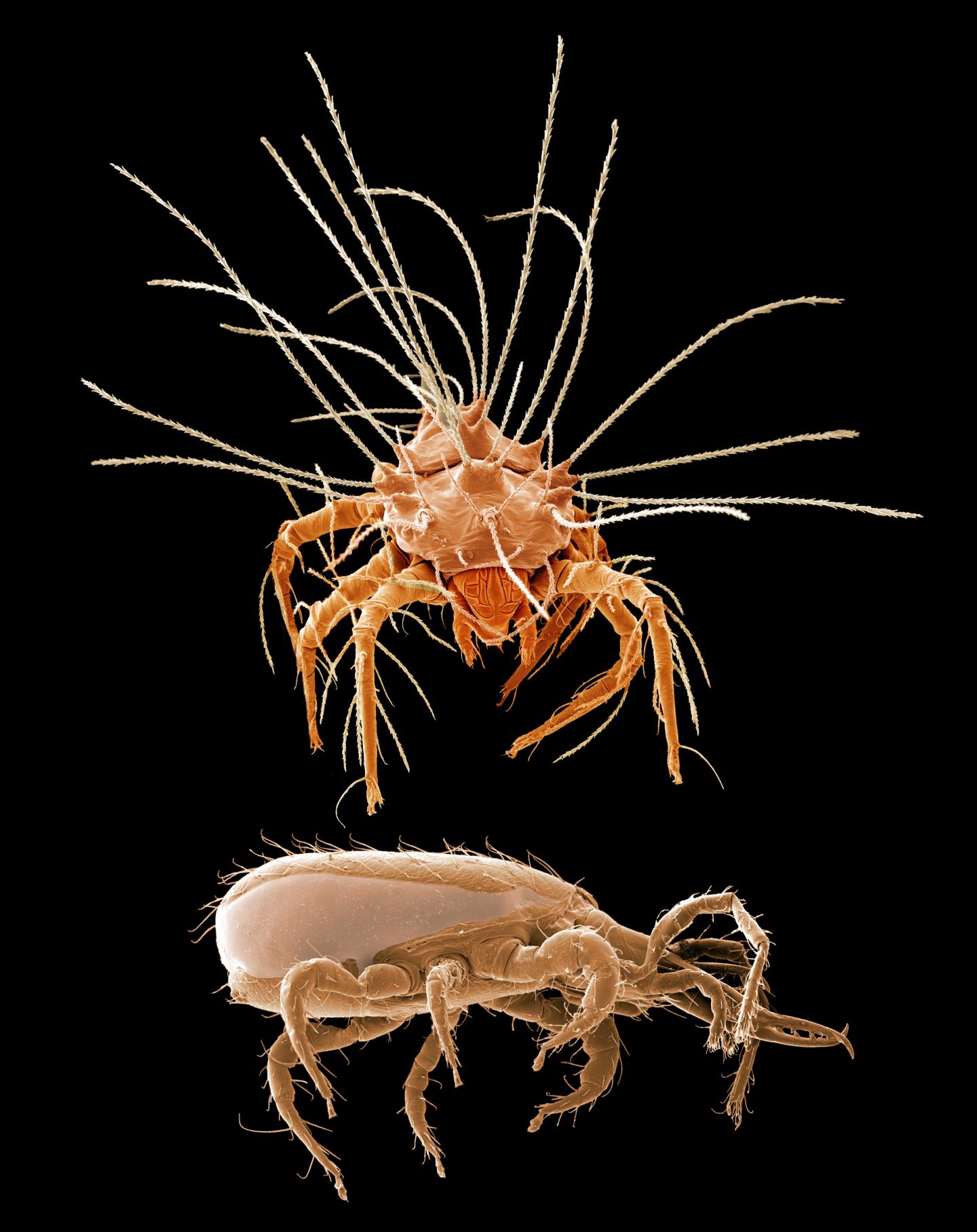
Credit: David Walter
Scientists from the University of Bristol and the Natural History Museum in London have reconstructed the evolutionary history of the chelicerates, the mega-diverse group of 110,000 arthropods that includes spiders, scorpions, mites and ticks.
They found, for the first time, genomic evidence that mites and ticks do not constitute two distantly related lineages, rather they are part of the same evolutionary line. This now makes them the most diverse group of chelicerates, changing our perspective on their biodiversity.
Arthropoda, or jointed-legged animals, make up the majority of animal biodiversity. They both pollinate (bees) and destroy our crops (locusts), are major food sources (shrimps and crabs), and are vectors of serious diseases like malaria and Lyme disease (mosquitoes and ticks).
Arthropods are ancient and fossils show that they have been around for more than 500 million years. The secret of their evolutionary success, which is reflected in their outstanding species diversity, is still unknown. To clarify what makes arthropod so successful we first need to understand how the different arthropod lineages relate to each other.
Co-author of the study, Professor Davide Pisani, from the University of Bristol’s School of Earth Sciences and Biological Sciences, said: “Finding that mites and ticks constitute a single evolutionary lineage is really important for our understanding of how biodiversity is distributed within Chelicerata.
“Spiders, with more than 48,000 described species, have long been considered the most biodiverse chelicerate lineage, but 42,000 mite and 12,000 tick species have been described. So, if mites and ticks are a single evolutionary entity rather than two distantly related ones, they are more diverse than the spiders.”
Dr Greg Edgecombe of the Natural History Museum London added: “Because of their anatomical similarities it has long been suspected that mites and ticks form a natural evolutionary group, which has been named Acari. However, not all anatomists agreed, and genomic data never found any support for this idea before.”
Lead author, Dr Jesus Lozano Fernandez, from Bristol’s School of Biological Sciences, said: “Spiders are iconic terrestrial animals that have always been part of the human imagination and folklore, representing mythological and cultural symbols, as well as often being objects of inner fears or admiration.
“Spiders have long been considered the most biodiverse chelicerate lineage, but our findings show that Acari is, in fact, bigger.”
In order to come up with their findings, the researchers used an almost even representation of mites and ticks (10 and 11 species, respectively), the most complete species-level sampling at the genomic level for these groups so far.
Dr Lozano-Fernandez added: “Regardless of the methods we used, our results converge on the same answer – mites and ticks really do form a natural group. Evolutionary trees like the one we’ve reconstructed provide us with the background information we need to interpret processes of genomic change.
“Our genealogical tree can now be used as the foundation for studies using comparative genomics to address problems of potential biomedical and agricultural relevance, like the identification of the genomic changes that underpinned the evolution of blood-feeding parasitic ticks from ancestors that weren’t blood-feeders.”
###
Media Contact
Davide Pisani
[email protected]