• HOME
  • NEWS
  • EXPLORE
    • CAREER
      • Companies
      • Jobs
    • EVENTS
    • iGEM
      • News
      • Team
    • PHOTOS
    • VIDEO
    • WIKI
  • BLOG
  • COMMUNITY
    • FACEBOOK
    • INSTAGRAM
    • TWITTER
Monday, May 11, 2026
BIOENGINEER.ORG
No Result
View All Result
  • Login
  • HOME
  • NEWS
  • EXPLORE
    • CAREER
      • Companies
      • Jobs
        • Lecturer
        • PhD Studentship
        • Postdoc
        • Research Assistant
    • EVENTS
    • iGEM
      • News
      • Team
    • PHOTOS
    • VIDEO
    • WIKI
  • BLOG
  • COMMUNITY
    • FACEBOOK
    • INSTAGRAM
    • TWITTER
  • HOME
  • NEWS
  • EXPLORE
    • CAREER
      • Companies
      • Jobs
        • Lecturer
        • PhD Studentship
        • Postdoc
        • Research Assistant
    • EVENTS
    • iGEM
      • News
      • Team
    • PHOTOS
    • VIDEO
    • WIKI
  • BLOG
  • COMMUNITY
    • FACEBOOK
    • INSTAGRAM
    • TWITTER
No Result
View All Result
Bioengineer.org
No Result
View All Result
Home NEWS Science News Chemistry

Nature inspires a novel new form of computing, using light

Bioengineer by Bioengineer
May 24, 2019
in Chemistry
Reading Time: 2 mins read
0
IMAGE
Share on FacebookShare on TwitterShare on LinkedinShare on RedditShare on Telegram

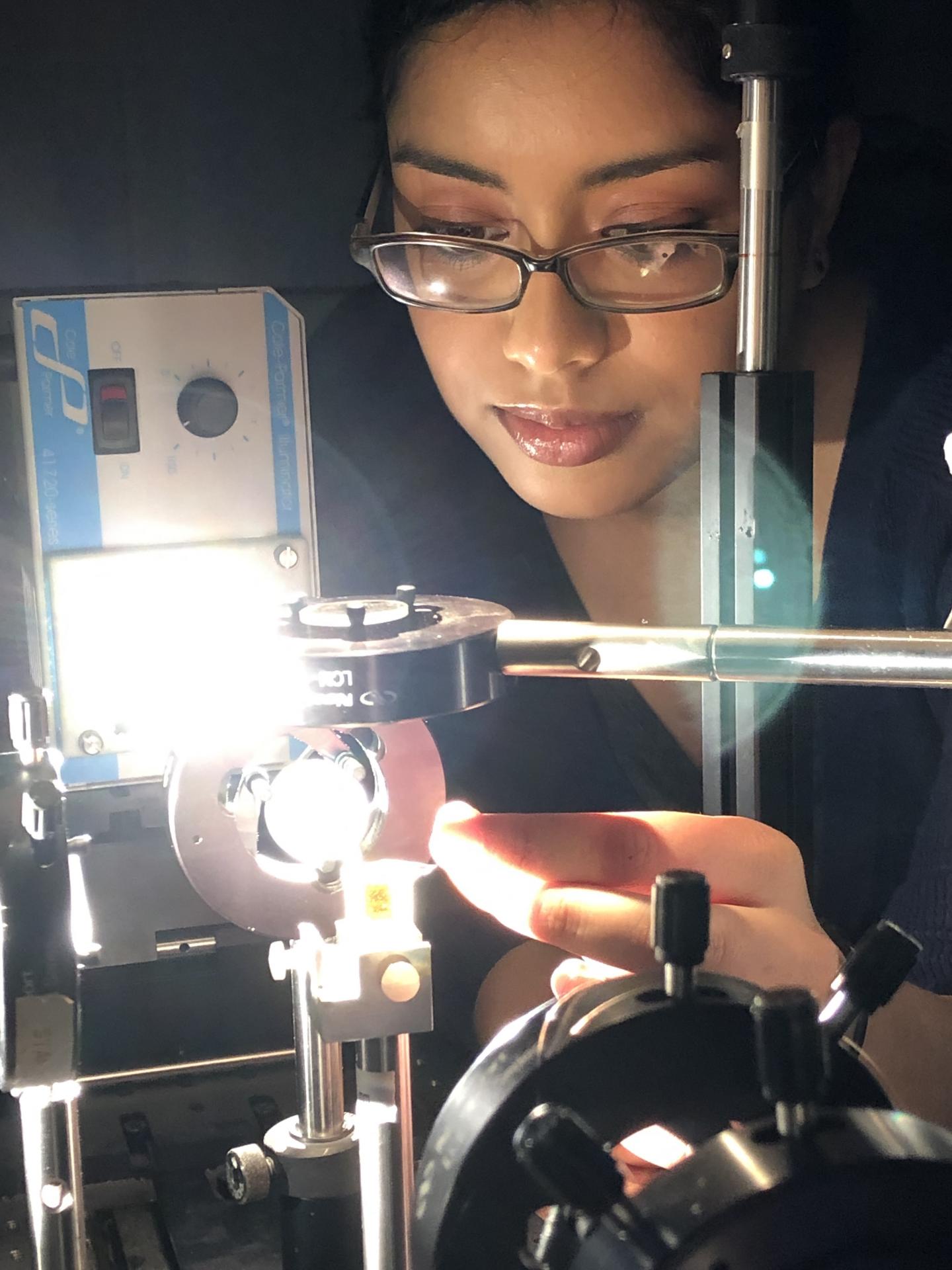
McMaster researchers perform simple calculations by shining light patterns through a translucent cube
IMAGE

Credit: McMaster University

HAMILTON, ON May 24, 2019 – McMaster researchers have developed a simple and highly novel form of computing by shining patterned bands of light and shadow through different facets of a polymer cube and reading the combined results that emerge.

The material in the cube reads and reacts intuitively to the light in much the same way a plant would turn to the sun, or a cuttlefish would change the color of its skin.

The researchers are graduate students in chemistry supervised by Kalaichelvi Saravanamuttu, an associate professor of chemistry and chemical biology whose lab focuses on ideas inspired by natural biological systems.

The researchers were able to use their new process to perform simple addition and subtraction questions.

“These are autonomous materials that respond to stimuli and do intelligent operations,” says Saravanamuttu. “We’re very excited to be able to do addition and subtraction this way, and we are thinking of ways to do other computational functions.”

The researchers’ work, published today in the journal Nature Communications, represents a completely new form of computing, one they say holds the promise of complex and useful functions yet to be imagined, possibly organized along the structures of neural networks.

The form of computing is highly localized, needs no power source and operates completely within the visible spectrum.

The technology is part of a branch of chemistry called nonlinear dynamics, and uses materials designed and manufactured to produce specific reactions to light.

A researcher shines layered stripes of light through the top and sides of a tiny, glass case holding the amber-coloured polymer, itself roughly the size of a die used in a board game. The polymer starts as a liquid and transforms to a gel in reaction to the light.

A neutral carrier beam passes through the cube from the back, toward a camera that reads the results, as refracted by the material in the cube, whose components form spontaneously into thousands of filaments that react to the patterns of light to produce a new three-dimensional pattern that expresses the outcome.

“We don’t want to compete with existing computing technologies,” says co-author Fariha Mahmood, a master’s student in chemistry. “We’re trying to build materials with more intelligent, sophisticated responses.”

###

Media Contact
Wade Hemsworth
[email protected]

Related Journal Article

http://dx.doi.org/10.1038/s41467-019-10166-4

Tags: Chemistry/Physics/Materials SciencesComputer ScienceOpticsPolymer Chemistry
Share14Tweet8Share2ShareShareShare2

Related Posts

Miniature Sensor Uses Light to Detect Touch — Chemistry

Miniature Sensor Uses Light to Detect Touch

May 8, 2026
Iron Minerals Determine Whether Dissolved Organic Matter Fuels Microbes or Becomes Long-Term Carbon Storage — Chemistry

Iron Minerals Determine Whether Dissolved Organic Matter Fuels Microbes or Becomes Long-Term Carbon Storage

May 8, 2026

Kate Evans Appointed Associate Lab Director for Biological and Environmental Systems Science at ORNL

May 8, 2026

Advancing Multiscale Modeling and Overcoming Operational Challenges in Autothermal COâ‚‚-to-Methanol Reactors

May 8, 2026
Please login to join discussion

POPULAR NEWS

  • Research Indicates Potential Connection Between Prenatal Medication Exposure and Elevated Autism Risk

    840 shares
    Share 336 Tweet 210
  • New Study Reveals Plants Can Detect the Sound of Rain

    727 shares
    Share 290 Tweet 181
  • Salmonella Haem Blocks Macrophages, Boosts Infection

    61 shares
    Share 24 Tweet 15
  • Breastmilk Balances E. coli and Beneficial Bacteria in Infant Gut Microbiomes

    57 shares
    Share 23 Tweet 14

About

We bring you the latest biotechnology news from best research centers and universities around the world. Check our website.

Follow us

Recent News

New Post-Hoc Analysis Explores Daily Oral Orforglipron Use in Adults Over 65 with Obesity, Regardless of Diabetes Status

Evaluating Digoxin Use in Patients with Symptomatic Rheumatic Heart Disease

Evaluating the Effectiveness and Safety of Digitalis Glycosides in Treating Heart Failure

Subscribe to Blog via Email

Enter your email address to subscribe to this blog and receive notifications of new posts by email.

Join 82 other subscribers
  • Contact Us

Bioengineer.org © Copyright 2023 All Rights Reserved.

Welcome Back!

Login to your account below

Forgotten Password?

Retrieve your password

Please enter your username or email address to reset your password.

Log In
No Result
View All Result
  • Homepages
    • Home Page 1
    • Home Page 2
  • News
  • National
  • Business
  • Health
  • Lifestyle
  • Science

Bioengineer.org © Copyright 2023 All Rights Reserved.