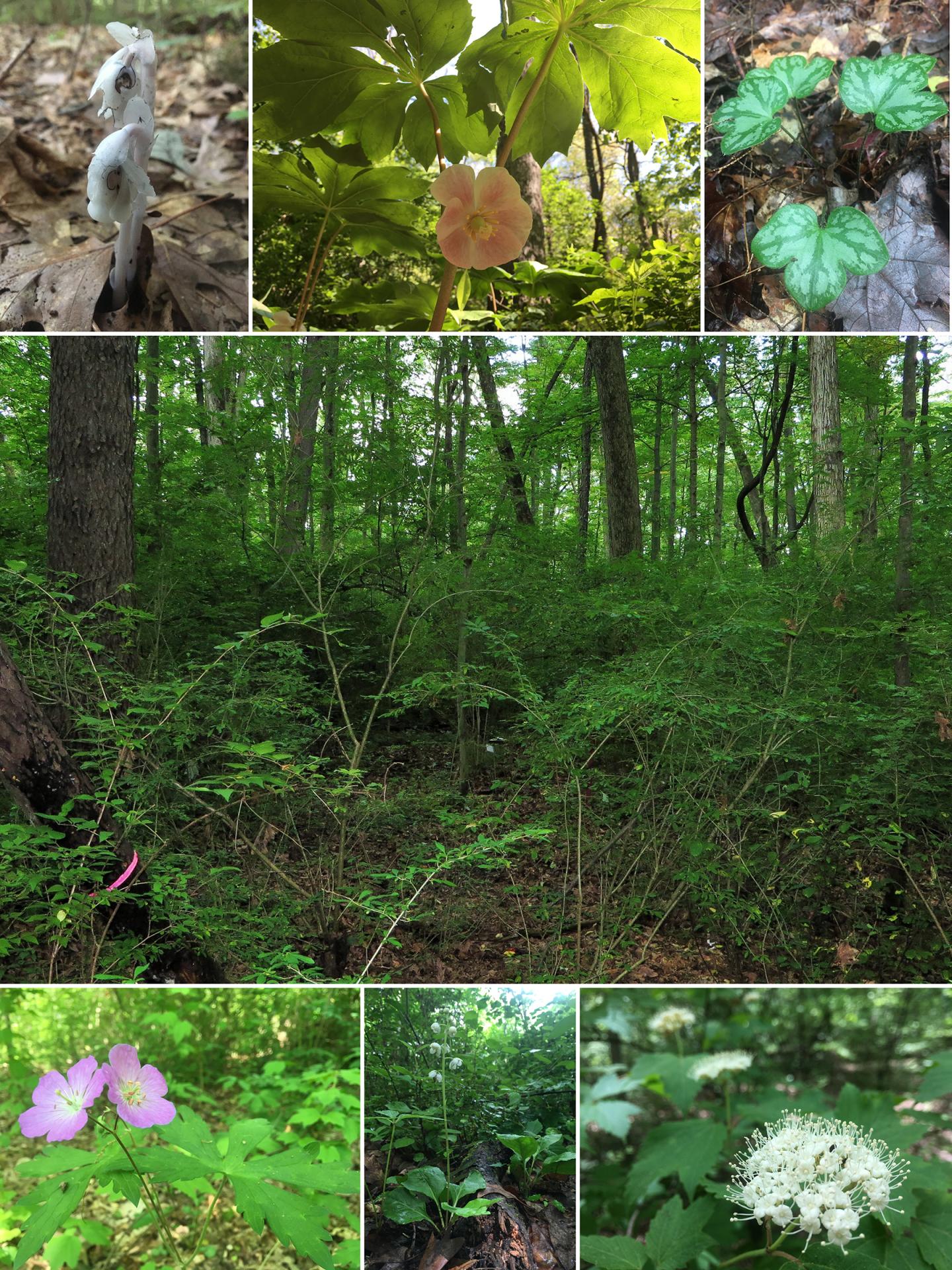
Credit: Erynn Maynard-Bean
Removing invasive shrubs to restore native forest habitat brings a surprising result, according to Penn State researchers, who say desired native understory plants display an unexpected ability and vigor to recolonize open spots.
“The regeneration of native plants that we saw where invasive shrubs had been removed exceeds what we expected from looking at uninvaded parts of the forest,” said researcher Erynn Maynard-Bean, who recently earned her doctoral degree in ecology.
“We believe that’s because invasive shrubs take up residence in the best spots in the forest. They are most successful where there are the most resources — sunlight, soil nutrients and water. Then, when invasive shrubs are removed, the growth of native plants in those locations beats expectations.”
She drew that conclusion after participating in a long-term project in the Arboretum at Penn State, which involved repeated removals of a suite of 18 invasive shrub species and closely monitoring the growth of native plants. That removal experiment was initiated by Margot Kaye, associate professor of forest ecology. In the experiment, after invasives were removed over seven years, plant diversity, native understory species abundance and overstory tree species regeneration, increased.
The study took place in a woodlot known as the Hartley Wood, a unique old-growth tract of about 42 acres adjacent to what is now a municipal park, where the mostly oak, hickory and maple trees escaped the loggers’ blades. A massive white oak that died there in 2000 was determined to have germinated around 1673. But likely because of its proximity to many landscaped homes, the Hartley Wood has been beset by an invasion of exotic plants, and Arboretum managers hope to eliminate them.
Significantly, Maynard-Bean noted, the research demonstrates that sampling the abundance of invasive shrubs and native plants in a forest can minimize negative impacts that invasive shrubs have on native plant numbers.
“We found that seven years of invasive shrub removal boosted natural regeneration of native plants that exceeded the abundance measured in unmanaged forest understories with low levels of shrub invasion,” she said. “In this study, in which invasive shrubs have been prominent in the understory for more than 20 years, an ambient sampling approach underestimates the effect of invasive shrubs and the benefits of their removal.”
This research has allowed the native forest plant community to respond to invasive removal over nearly a decade, and highlights the capacity for that system to rebound, pointed out Kaye, whose research group in the College of Agricultural Sciences has been studying the impacts of woody shrub invasion on eastern forest dynamics for even longer.
The findings of the study, published recently in Invasive Plant Science and Management, are important, Kaye explained, because invasive shrubs are increasing in abundance at the expense of native species across eastern deciduous forests of North America. Interest in invasive shrub removal to restore native habitat is growing but forest managers are not sure about how much natural regeneration of native plants they can expect.
“A lot of people think that when you remove invasive shrubs you have to plant natives, and that is obviously helpful but difficult to afford on a large scale,” Maynard-Bean said. “But there are native plants in the forest that are mixed with the invasives, and if you maintain the removal, the natives will come back in and take over.”
The research is relevant because eastern deciduous forests are becoming more fragmented as urban and suburban areas extend into forests, and associated edges and open spaces have allowed invasive shrubs to make inroads. That does not bode well for wildlife, Maynard-Bean said.
“Native plants in the understory contribute to the health and stability of the forest ecosystem,” she said. “Native shrubs don’t reach the same density in the understory as invasive shrubs do, and that has implications for bird, insect and even forest amphibian communities.”
###
The Arboretum at Penn State, the U.S. Department of Agriculture’s National Institute of Food and Agriculture, Penn State’s Ecology Intercollege Graduate Degree Program and Shaver’s Creek Environmental Center supported this work.
Media Contact
A’ndrea Elyse Messer
[email protected]
Related Journal Article
http://dx.