• HOME
  • NEWS
  • EXPLORE
    • CAREER
      • Companies
      • Jobs
    • EVENTS
    • iGEM
      • News
      • Team
    • PHOTOS
    • VIDEO
    • WIKI
  • BLOG
  • COMMUNITY
    • FACEBOOK
    • INSTAGRAM
    • TWITTER
Sunday, January 11, 2026
BIOENGINEER.ORG
No Result
View All Result
  • Login
  • HOME
  • NEWS
  • EXPLORE
    • CAREER
      • Companies
      • Jobs
        • Lecturer
        • PhD Studentship
        • Postdoc
        • Research Assistant
    • EVENTS
    • iGEM
      • News
      • Team
    • PHOTOS
    • VIDEO
    • WIKI
  • BLOG
  • COMMUNITY
    • FACEBOOK
    • INSTAGRAM
    • TWITTER
  • HOME
  • NEWS
  • EXPLORE
    • CAREER
      • Companies
      • Jobs
        • Lecturer
        • PhD Studentship
        • Postdoc
        • Research Assistant
    • EVENTS
    • iGEM
      • News
      • Team
    • PHOTOS
    • VIDEO
    • WIKI
  • BLOG
  • COMMUNITY
    • FACEBOOK
    • INSTAGRAM
    • TWITTER
No Result
View All Result
Bioengineer.org
No Result
View All Result
Home NEWS Science News Science

Naval Research Laboratory builds autopilot software allowing UAVs to soar on thermals

Bioengineer by Bioengineer
May 10, 2019
in Science
Reading Time: 2 mins read
0
IMAGE
Share on FacebookShare on TwitterShare on LinkedinShare on RedditShare on Telegram

Businesses can acquire Navy technology through patent license agreements
IMAGE

Credit: Naval Research Laboratory

A Navy scientist has re-engineered the software that allows long-endurance drones to powerlessly climb into the sky on bubbles of warm air.

In a U.S. patent application published on May 2, Aaron Kahn, an engineer working on the Autonomous Locator of Thermals (ALOFT) project at the Naval Research Laboratory, reported that he has extensively tested the new software that detects and estimates the position of thermals, i.e., rising columns of warm air that birds use to stay aloft without flapping their wings.

Unlike birds, soaring drones need the benefits of thermal detection and position estimation software as the warm air tends to drift relative to the ground due to winds.

Prior systems relied on batch estimation processes that “require storing large arrays of data, which is not ideal for operation on small microcontrollers with limited memory resources.”

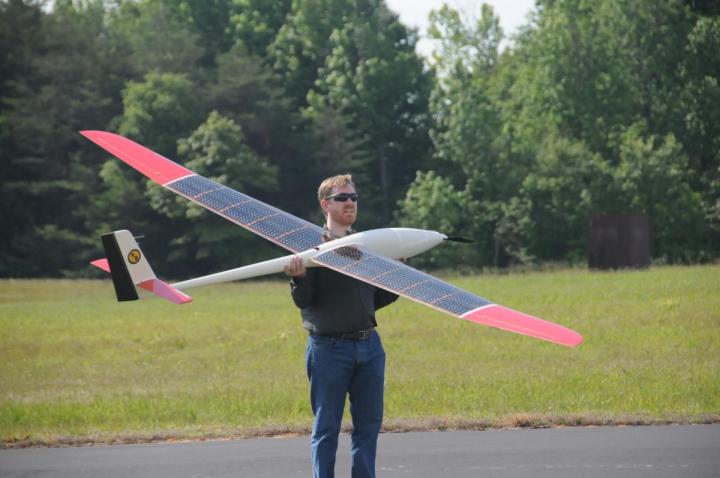
Kahn’s new soaring software uses extended Kalman filtering, a kind of algorithm already used by the Navy for navigating submarines and cruise missiles. Now it can help orbit drones like the tiny CICADA glider or long-endurance solar-soaring UAVs that might also have photovoltaic or fuel cells feeding battery-powered propellers.

Solar-soaring UAVs don’t need large batteries because they harvest energy from the environment using intelligent software, in the case of the autonomous soaring algorithms, or lightweight, integrated solar panels that capture energy from the sun.

“This technique enables an increase in range and endurance of an aircraft without having to add additional fuel/batteries,” according to the Navy’s patent application. “It is possible that the technique could be implemented in an aircraft without requiring any changes to its hardware, only software.
Furthermore, the technique is applicable to both manned and unmanned aircraft. Because the method is parameterized, it can be quickly tailored to a variety of aircraft types.”

Now that the patent application has been published, qualified businesses can evaluate the technology with the intention of licensing it for use in their drones.

Brian Metzger, a senior technology manager at TechLink, guides businesses through Navy tech evaluation and licensing at no charge.

He said there’s a handful of promising solar-soaring UAV companies that will want to evaluate Kahn’s work, but also manned aircraft and glider manufacturers.

“This is really for anyone building air vehicles that can harness thermals,” Metzger said.

###

Businesses interested in evaluating and licensing the technology can contact Brian Metzger at [email protected] or by telephone at 406-994-7782.

Media Contact
Troy Carter
[email protected]

Original Source

https://techlinkcenter.org/naval-research-laboratory-improves-autopilot-algorithm-for-soaring-drones/

Tags: Calculations/Problem-SolvingResearch/DevelopmentRobotry/Artificial IntelligenceSoftware EngineeringTechnology TransferTechnology/Engineering/Computer ScienceVehicles
Share12Tweet8Share2ShareShareShare2

Related Posts

Five or more hours of smartphone usage per day may increase obesity

July 25, 2019
IMAGE

NASA’s terra satellite finds tropical storm 07W’s strength on the side

July 25, 2019

NASA finds one burst of energy in weakening Depression Dalila

July 25, 2019

Researcher’s innovative flood mapping helps water and emergency management officials

July 25, 2019
Please login to join discussion

POPULAR NEWS

  • Enhancing Spiritual Care Education in Nursing Programs

    154 shares
    Share 62 Tweet 39
  • PTSD, Depression, Anxiety in Childhood Cancer Survivors, Parents

    146 shares
    Share 58 Tweet 37
  • Robotic Ureteral Reconstruction: A Novel Approach

    65 shares
    Share 26 Tweet 16
  • Impact of Vegan Diet and Resistance Exercise on Muscle Volume

    47 shares
    Share 19 Tweet 12

About

We bring you the latest biotechnology news from best research centers and universities around the world. Check our website.

Follow us

Recent News

Tailored MobileNetV3Large Framework for Detecting Plant Diseases

How Organizational Support Influences Nurses’ Leadership in Tunisia

Linking Lifestyle Choices to Teen Mental Health Worldwide

Subscribe to Blog via Email

Enter your email address to subscribe to this blog and receive notifications of new posts by email.

Join 71 other subscribers
  • Contact Us

Bioengineer.org © Copyright 2023 All Rights Reserved.

Welcome Back!

Login to your account below

Forgotten Password?

Retrieve your password

Please enter your username or email address to reset your password.

Log In
No Result
View All Result
  • Homepages
    • Home Page 1
    • Home Page 2
  • News
  • National
  • Business
  • Health
  • Lifestyle
  • Science

Bioengineer.org © Copyright 2023 All Rights Reserved.