Credit: ©Science China Press
Various metastable structures are usually found in the phase diagram of most materials. Some structures can only exist under high temperature or high pressure conditions, while others have not yet been predicted to be in the established phase diagrams. The experimental detection of these structures is a big challenge. The inner cavities of carbon nanotubes have been adopted by the research group led by Prof. Jinying Zhang from Xi’an Jiaotong University to produce and stabilize the metastable structures from high pressure or high temperature to ambient conditions. The carbon nanotubes serve as reaction vessels and growth templates to produce metastable structures due to the size effects and special physical and chemical environments of carbon nanotubes. The special nano-space of the carbon nanotube provides high-pressure conditions for material reactions. The pressure is related to the carbon nanotube inner diameters and the matching of the nanotube walls with the encapsulated materials. The carbon nanotube walls simultaneously isolate the as-produced structures from the surrounding environments. The pressure and size effects of the carbon nanotubes stabilize the as-produced metastable structures to ambient conditions. The pressure produced by the carbon nanotubes to the encapsulated materials can reach as high as 60 GPa, resulting in the synthesis of metastable structures from the high pressure areas of phase diagram and new structures out of the phase diagram.
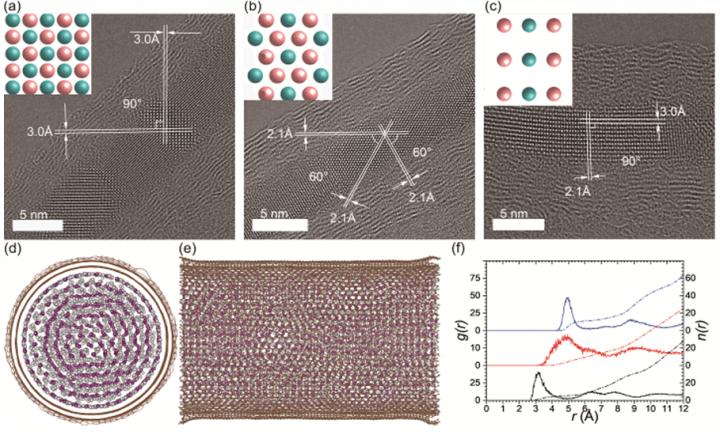
The β and γ phases are usually observed by silver iodides at ambient conditions. The phase structures will transform into α phase with increasing temperature. The tetragonal, rock-salt, and potassium hydroxide-like phases are detected subsequently with increasing pressures. The silver iodides have been encapsulated into two different types of carbon nanotubes. One is multi-walled carbon nanotubes (MWCNTs) with inner diameters of 4 to 8 nm and the other is single-walled carbon nanotubes (SWCNTs) with inner diameters of about 1.4 nm. Two different metastable silver iodide structures, including rock-salt and helix structures, have been produced and stabilized into ambient conditions by using the special nano-cavities of carbon nanotubes. The rock-salt phase is usually observed at pressure between 400 MPa and 11.3 GPa in the phase diagram, while the helix structure has not yet predicted in the phase diagram of silver iodides. The successful synthesis and stabilization of rock-salt and helix structures to ambient conditions by using carbon nanotube nanoreactors provide a new path to the synthesis and application of metastable structures from extreme conditions.
###
This research received funding from the National Natural Science Foundation of China (21771143). J. Zhang is supported by the Cyrus Tang Foundation through Tang Scholar Program.
See the article:
Hongyang Huang, Jinying Zhang, Yifan Zhang, Chengcheng Fu, Jialiang Huang, Yonghong Cheng, Chunming Niu, Xinluo Zhao and Hisanori Shinohara
Rock-salt and helix structures of silver iodides under ambient conditions
Natl Sci Rev (April 2019) doi: 10.1093/nsr/nwz041
https:/
The National Science Review is the first comprehensive scholarly journal released in English in China that is aimed at linking the country’s rapidly advancing community of scientists with the global frontiers of science and technology. The journal also aims to shine a worldwide spotlight on scientific research advances across China.
Media Contact
Jinying Zhang
[email protected]
Related Journal Article
http://dx.