• HOME
  • NEWS
  • EXPLORE
    • CAREER
      • Companies
      • Jobs
    • EVENTS
    • iGEM
      • News
      • Team
    • PHOTOS
    • VIDEO
    • WIKI
  • BLOG
  • COMMUNITY
    • FACEBOOK
    • INSTAGRAM
    • TWITTER
Sunday, May 10, 2026
BIOENGINEER.ORG
No Result
View All Result
  • Login
  • HOME
  • NEWS
  • EXPLORE
    • CAREER
      • Companies
      • Jobs
        • Lecturer
        • PhD Studentship
        • Postdoc
        • Research Assistant
    • EVENTS
    • iGEM
      • News
      • Team
    • PHOTOS
    • VIDEO
    • WIKI
  • BLOG
  • COMMUNITY
    • FACEBOOK
    • INSTAGRAM
    • TWITTER
  • HOME
  • NEWS
  • EXPLORE
    • CAREER
      • Companies
      • Jobs
        • Lecturer
        • PhD Studentship
        • Postdoc
        • Research Assistant
    • EVENTS
    • iGEM
      • News
      • Team
    • PHOTOS
    • VIDEO
    • WIKI
  • BLOG
  • COMMUNITY
    • FACEBOOK
    • INSTAGRAM
    • TWITTER
No Result
View All Result
Bioengineer.org
No Result
View All Result
Home NEWS Science News Science

HKUST physicist contributes to new record of quantum memory efficiency

Bioengineer by Bioengineer
April 27, 2019
in Science
Reading Time: 2 mins read
0
IMAGE
Share on FacebookShare on TwitterShare on LinkedinShare on RedditShare on Telegram

IMAGE

Credit: The Hong Kong University of Science and Technology

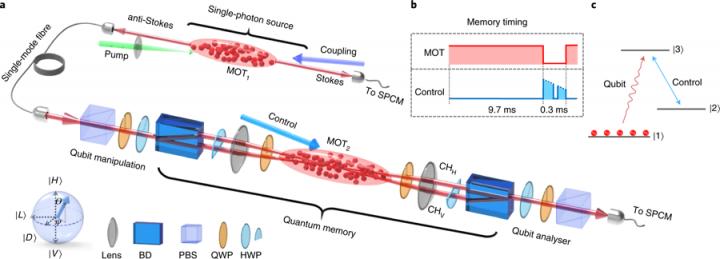
Like memories in computers, quantum memories are essential components for quantum computers – a new generation of data processors that obey quantum mechanics laws and can overcome the limitations of classical computers. They may push boundaries of fundamental science and help create new drugs, explain cosmological mysteries, or enhance accuracy of forecasts and optimization plans with their potent computational power. Quantum computers are expected to be much faster and more powerful than their traditional counterparts as information is calculated in qubits – which unlike the older units (bits) used in classical computers, can represent both 0 and 1 at the same time.

Photonic quantum memories allow for the storage and retrieval of flying single-photon quantum states. However, production of such highly-efficient quantum memories remains a major challenge as it requires perfectly matched photon-matter quantum interface. Meanwhile, the energy of a single photon is too weak and can be easily lost into the noisy sea of stray light background. For a long time, these problems suppressed quantum memory efficiencies to below 50% – a threshold value crucial for practical applications.

Now for the first time in history, a joint research team led by Prof. DU Shengwang from the Department of Physics and William Mong Institute of Nano Science and Technology at HKUST; Prof. ZHANG Shanchao from SCNU who graduated his PhD study at HKUST; Prof. YAN Hui from SCNU and a former postdoctoral fellow at HKUST; as well as Prof. ZHU Shi-Liang from SCNU and Nanjing University, has found a way to boost the efficiency of photonic quantum memories to over 85% with a fidelity of over 99%.

The team created such a quantum memory by trapping billions of rubidium atoms into a hair-like tiny space – those atoms are cooled down to nearly absolute zero temperature (about 0.00001 K) using lasers and magnetic field. The team also found a smart way to distinguish the single photon from the noisy background light sea. The finding brought the dream of an ‘universal’ quantum computer a step closer to reality. Such quantum memories can also be used as repeaters in a quantum network, laying the foundation for a new generation of quantum-based internet.

“In this work, we code a flying qubit onto the polarization of a single photon and store it into the laser-cooled atoms,” said Prof Du. “Although the quantum memory demonstrated in this work is only for one qubit operation, it opens the possibility for emerging quantum technology and engineering in the future.”

The finding was recently published as a cover story of the authoritative journal Nature Photonics – the latest of a series of research from Prof Du’s lab on quantum memory, first begun in 2011.

###

Media Contact
Jamie Wong
[email protected]

Related Journal Article

http://dx.doi.org/10.1038/s41566-019-0368-8

Tags: Computer ScienceElectrical Engineering/ElectronicsMechanical EngineeringTechnology/Engineering/Computer Science
Share13Tweet8Share2ShareShareShare2

Related Posts

Five or more hours of smartphone usage per day may increase obesity

July 25, 2019
IMAGE

NASA’s terra satellite finds tropical storm 07W’s strength on the side

July 25, 2019

NASA finds one burst of energy in weakening Depression Dalila

July 25, 2019

Researcher’s innovative flood mapping helps water and emergency management officials

July 25, 2019
Please login to join discussion

POPULAR NEWS

  • Research Indicates Potential Connection Between Prenatal Medication Exposure and Elevated Autism Risk

    840 shares
    Share 336 Tweet 210
  • New Study Reveals Plants Can Detect the Sound of Rain

    727 shares
    Share 290 Tweet 181
  • Scientists Investigate Possible Connection Between COVID-19 and Increased Lung Cancer Risk

    68 shares
    Share 27 Tweet 17
  • Salmonella Haem Blocks Macrophages, Boosts Infection

    61 shares
    Share 24 Tweet 15

About

We bring you the latest biotechnology news from best research centers and universities around the world. Check our website.

Follow us

Recent News

Evaluating Digoxin Use in Patients with Symptomatic Rheumatic Heart Disease

Evaluating the Effectiveness and Safety of Digitalis Glycosides in Treating Heart Failure

Urdu Fall Risk Questionnaire Adapted for Elderly

Subscribe to Blog via Email

Success! An email was just sent to confirm your subscription. Please find the email now and click 'Confirm' to start subscribing.

Join 82 other subscribers
  • Contact Us

Bioengineer.org © Copyright 2023 All Rights Reserved.

Welcome Back!

Login to your account below

Forgotten Password?

Retrieve your password

Please enter your username or email address to reset your password.

Log In
No Result
View All Result
  • Homepages
    • Home Page 1
    • Home Page 2
  • News
  • National
  • Business
  • Health
  • Lifestyle
  • Science

Bioengineer.org © Copyright 2023 All Rights Reserved.