Junk food irresistible even for birds
Credit: Sarah Knutie
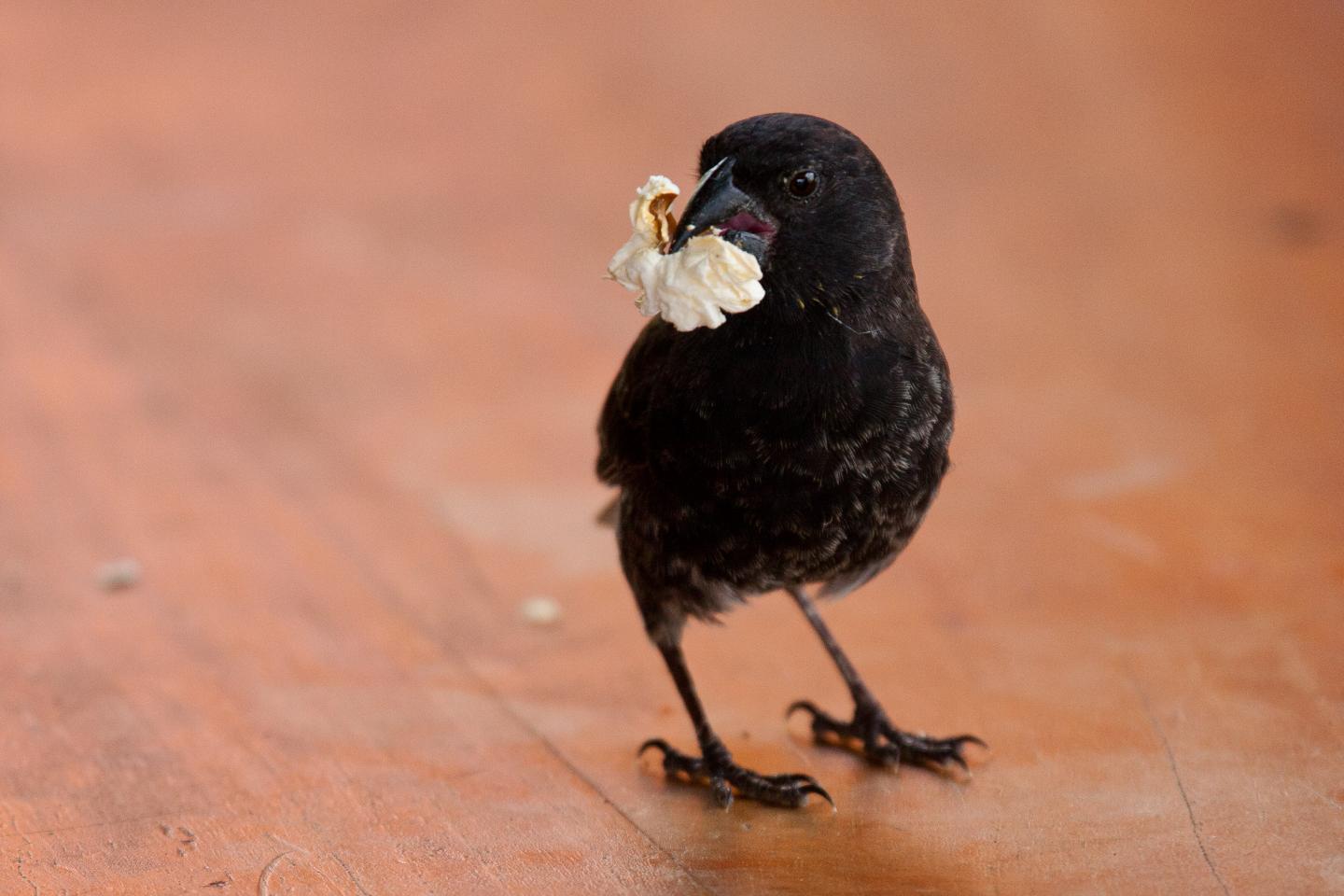
In the Galapagos Islands, Darwin’s finches drawn to junk food are experiencing changes in their gut microbiota and their body mass as compared to finches that don’t encounter human food, according to a new University of Connecticut study.
The study of Darwin’s Finches, published today in Molecular Ecology, builds upon a study on the effects of human activity on finch diet in the same location, says Sarah Knutie, assistant professor of ecology and evolutionary biology at UConn.
Researchers studied fecal samples and body mass data from female finches, who are the main caretakers for nestlings, or baby birds. They collected the fecal samples from birds in urban areas, where they would encounter human food, and in rural areas, where they were less likely to encounter human food, and used those to characterize the birds’ gut microbiota.
Previous studies have shown that finch populations living near humans recognized human food as food, whereas the finches living in areas with less human activity don’t recognize human food as something they can eat.
In total, researchers studied close to 100 finches, focusing on breeding female small ground finches (Geospiza fuliginosa) and medium ground finches (Geospiza fortis) in March 2016 on the eastern coast of Santa Cruz Island, Galapagos Islands, Ecuador.
The Galapagos Islands are an ideal location for studying the effects of fairly recent human impacts on ecosystems. The islands have become more and more populated in the past 30 years, largely due to a growing tourism industry. One of the islands, for example, has a population of about 12,000; and where there are humans, there are impacts to the ecosystem.
The researchers found that the morphology of the finches – their physical characteristics – differs among sites. Finches in urban areas were larger and had higher body mass than their country cousins. In fact, finches living among human populations were between 6 and 13 percent heavier than birds at sites with less or no human presence, says Knutie.
In analyzing fecal samples from the finches, Knutie says, “finches living in areas where there is a lot of human activity have different gut microbiota communities than those living in areas with less human activity.” Specifically, the diversity of gut bacteria was lower at the site with human presence compared to the site without human presence.
The differences in microbiota are also clear, but the consequences are not.
Knutie says that there could be consequences of these changing microbiotas for nestlings and brooding female birds because they are at risk of exposure to the invasive parasite Philornis downsi, a parasite that threatens to lead to regional extinctions of finch populations.
“Since gut microbiota can affect the immune system, junk food finches may have a different immune system response to an invasive parasite than finches that feed on their natural diet,” Knutie says.
However, more research needs to be done to determine the long-term effects on the changes in microbiota.
Knutie led the study along with Kiyoko Gotanda, University of Cambridge; Jaime A. Chavez, Universidad San Francisco de Quito. They will continue to unravel the impacts that human development is having on the Galapagos finches, often referred to as the classic example of adaptation in evolution.
###
The work was supported by crowdfunding through a small startup company called Instrumentl, along with more traditional grants and the University of Connecticut.
Media Contact
Elaina Hancock
[email protected]
Related Journal Article
http://dx.