

• HOME
  • NEWS
  • EXPLORE
    • CAREER
      • Companies
      • Jobs
    • EVENTS
    • iGEM
      • News
      • Team
    • PHOTOS
    • VIDEO
    • WIKI
  • BLOG
  • COMMUNITY
    • FACEBOOK
    • INSTAGRAM
    • TWITTER
Saturday, February 7, 2026
BIOENGINEER.ORG
No Result
View All Result
  • Login
  • HOME
  • NEWS
  • EXPLORE
    • CAREER
      • Companies
      • Jobs
        • Lecturer
        • PhD Studentship
        • Postdoc
        • Research Assistant
    • EVENTS
    • iGEM
      • News
      • Team
    • PHOTOS
    • VIDEO
    • WIKI
  • BLOG
  • COMMUNITY
    • FACEBOOK
    • INSTAGRAM
    • TWITTER
  • HOME
  • NEWS
  • EXPLORE
    • CAREER
      • Companies
      • Jobs
        • Lecturer
        • PhD Studentship
        • Postdoc
        • Research Assistant
    • EVENTS
    • iGEM
      • News
      • Team
    • PHOTOS
    • VIDEO
    • WIKI
  • BLOG
  • COMMUNITY
    • FACEBOOK
    • INSTAGRAM
    • TWITTER
No Result
View All Result
Bioengineer.org
No Result
View All Result
Home NEWS Science News Biology

Bacteria use their enemy — phage — for ‘self-recognition’

Bioengineer by Bioengineer
April 22, 2019
in Biology
Reading Time: 2 mins read
0
IMAGE
Share on FacebookShare on TwitterShare on LinkedinShare on RedditShare on Telegram

IMAGE

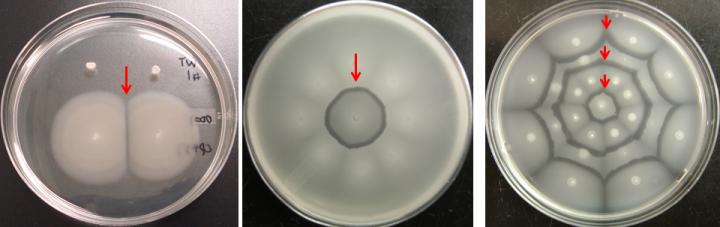
Credit: WANG Xiaoxue

Cells are social, and self-recognition is a critical aspect of group behavior as cells assist kin and antagonize non-kin in foraging for food and forming biofilms.

Recently, scientists discovered that cells can distinguish themselves from closely related competitors through the use of a virus, and the harboring of phage in bacterial genomes benefits host cells when facing competitors in the environment. These findings were published in Cell Reports on April 16.

The study was conducted by a group led by Prof. WANG Xiaoxue at the South China Sea Institute of Oceanology (SCSIO) of the Chinese Academy of Sciences and Prof. Thomas Wood at Pennsylvania State University in the United States.

Researchers found that a boundary (demarcation line) was formed due to phage lysis between different swimming Escherichia coli strains but not between identical clones; hence, motile bacterial cells discriminated between self and non-self.

The basis for this self-recognition is a novel, 49 kb, T1-type, lytic phage of the family Siphoviridae (named SW1) that controls formation of the demarcation line by utilizing one of the host’s cryptic prophage proteins, YfdM of CPS-53, to propagate.

SW1 provides a conditional benefit to E. coli K-12 compared to the identical strain that lacks the phage. A demarcation line also forms when strains harbor either the lysogenic phage φ80 or lambda and encounter siblings that lack the lysogen.

Thus, the relationship between a virus and its cellular host should be re-evaluated since a viral infection is sometimes beneficial.

A bacterial cell infected by a lytic phage may have conditional benefits absent in siblings that lack the phage. In addition, these benefits rely on the infected strain utilizing the tools it obtained from a very ancient enemy, a cryptic prophage.

###

Media Contact
WANG Xiaoxue
[email protected]

Related Journal Article

http://dx.doi.org/10.1016/j.celrep.2019.03.070

Tags: BacteriologyBiologyCell BiologyVirology
Share12Tweet8Share2ShareShareShare2

Related Posts

Florida Cane Toad: Complex Spread and Selective Evolution

Florida Cane Toad: Complex Spread and Selective Evolution

February 7, 2026
New Study Uncovers Mechanism Behind Burn Pit Particulate Matter–Induced Lung Inflammation

New Study Uncovers Mechanism Behind Burn Pit Particulate Matter–Induced Lung Inflammation

February 6, 2026

DeepBlastoid: Advancing Automated and Efficient Evaluation of Human Blastoids with Deep Learning

February 6, 2026

Navigating the Gut: The Role of Formic Acid in the Microbiome

February 6, 2026
Please login to join discussion

POPULAR NEWS

  • Robotic Ureteral Reconstruction: A Novel Approach

    Robotic Ureteral Reconstruction: A Novel Approach

    82 shares
    Share 33 Tweet 21
  • Digital Privacy: Health Data Control in Incarceration

    63 shares
    Share 25 Tweet 16
  • Study Reveals Lipid Accumulation in ME/CFS Cells

    57 shares
    Share 23 Tweet 14
  • Breakthrough in RNA Research Accelerates Medical Innovations Timeline

    53 shares
    Share 21 Tweet 13

About

We bring you the latest biotechnology news from best research centers and universities around the world. Check our website.

Follow us

Recent News

Evaluating Pediatric Emergency Care Quality in Ethiopia

TPMT Expression Predictions Linked to Azathioprine Side Effects

Improving Dementia Care with Enhanced Activity Kits

Subscribe to Blog via Email

Success! An email was just sent to confirm your subscription. Please find the email now and click 'Confirm' to start subscribing.

Join 73 other subscribers
  • Contact Us

Bioengineer.org © Copyright 2023 All Rights Reserved.

Welcome Back!

Login to your account below

Forgotten Password?

Retrieve your password

Please enter your username or email address to reset your password.

Log In
No Result
View All Result
  • Homepages
    • Home Page 1
    • Home Page 2
  • News
  • National
  • Business
  • Health
  • Lifestyle
  • Science

Bioengineer.org © Copyright 2023 All Rights Reserved.

