SEKO project tests strategies and technologies for climate-friendly interconnection of energy systems on the real-world lab scale — BMBF funding of EUR 6.5 million
Credit: Sebastian Mang, KIT
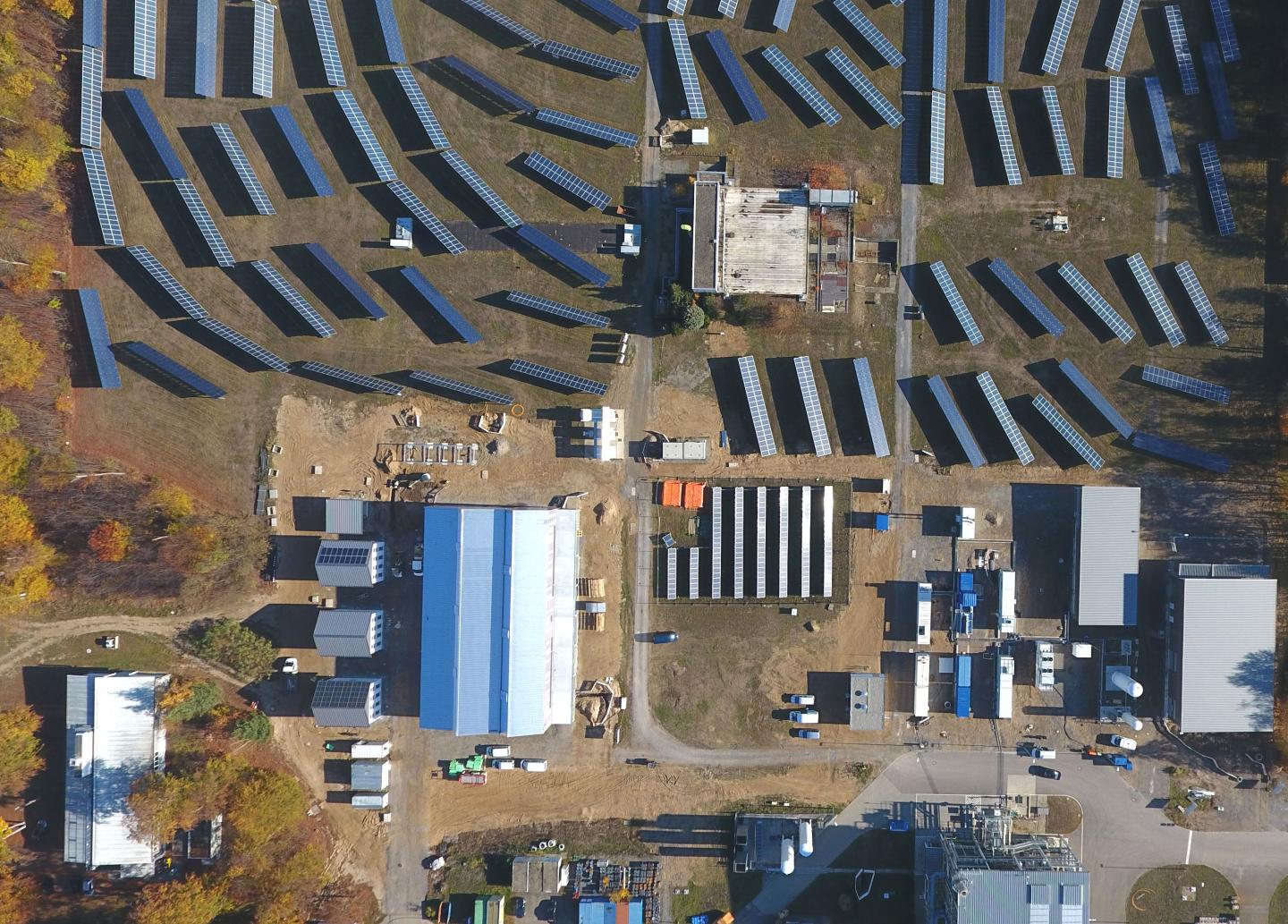
Flexible interconnection of power, heat, and gas promises to make the future energy system more sustainable. This so-called sector coupling will now be tested under close-to-practice conditions at Karlsruhe Institute of Technology (KIT). Within the SEKO research project, a large-scale real-world laboratory including the corresponding properties and energy grids of KIT will be established. The new research infrastructure for sector coupling will be funded by the Federal Ministry of Education and Research (BMBF) with more than EUR 6.5 million.
Climate-friendly transformation of the energy system is one of the big technological challenges of our time: fluctuating energy supply from decentralized wind or solar facilities will have to be managed, as will the consumption peaks to be expected when e.g. millions of electric vehicles are charged simultaneously. Smart interconnection of the different sectors, such as electric power, heat, mobility, or energy carrier materials may help solve this problem. Excessive heat from industrial processes may be converted into power for electric mobility, excessive wind energy may be used for the production of synthetic natural gas (SNG) that is then fed into the natural gas grid for later consumption. “The aim of sector coupling is to shift energy as efficiently as possible between the different sectors, depending on demand and supply, while reducing greenhouse gas emissions and costs.,” explains Professor Joachim Knebel, who coordinates the new sector coupling research project (SEKO). “In the past years, we developed a number of technologies for energy storage and energy conversion as well as strategies for the control of such processes at KIT. Within the SEKO research project, we now plan to test them in a large-scale real-world lab under close-to-practice conditions.”
Seven institutes of KIT are involved in SEKO. Within the project, these institutes cooperate across disciplines in various constellations. Research is funded by the BMBF with more than EUR 6.5 million for four years. “Some parts of the infrastructure of the SEKO real-world lab at KIT already exist,” project manager Dr. Isabelle Südmeyer says. With funding by the Helmholtz Association, a suited technology platform is being built on KIT’s Campus North at the moment. It consists of the Energy Lab 2.0 and Living Lab Energy Campus and will enable sector coupling both physically as well as with the help of information and communication technologies. By late 2019, construction of major components is planned to be completed. “Then, it will be possible to study system integration of various technologies and to develop and validate methods for dynamic coupling of the sectors,” Südmeyer continues.
The SEKO research project consists of four subprojects. The Power subproject headed by Professor Mathias Noe of the Institute for Technical Physics (ITEP) focuses on coupling of heat pumps and electric vehicles with photovoltaic facilities and power stores. The Gas subproject headed by Professor Thomas Kolb of the Institute for Technical Chemistry (ITC) studies the interaction of gas and heat grids taking into consideration an energy-intensive industrial process and the dynamics of power-to-gas processes. The Heat/Cold subproject headed by Professor Veit Hagenmeyer of the Institute for Automation and Applied Informatics (IAI) will cover the development of methods to automatically generate heat load curves for buildings and experimental studies of efficient power-to-heat conversion for domestic application. Within the framework of an overarching sector coupling subproject also headed by Hagenmeyer, interconnection of the different facilities by information and communication technologies for flexible management is studied. Particular attention will be paid to IT security to prevent interference, attacks, and manipulation.
Within the SEKO research project, scientists plan to test the sector coupling concept and the interaction of various energy technologies on the megawatt scale. In the opinion of project coordinator Knebel, this will not only strengthen Germany as a location of research. Against the background of the debate on climate goals, this also is of global signal character: “We demonstrate our ability to act. And as we directly apply research results in a real-world lab, we will be able to accelerate practical implementation.”
###
Click here for the project website: http://www.
More about the KIT Energy Center: http://www.
Press contact:
Dr. Martin Heidelberger
Press Officer
Tel.: +49 721 608-21169
Email: [email protected]
Being “The Research University in the Helmholtz Association,” KIT creates and imparts knowledge for the society and the environment. It is the objective to make significant contributions to the global challenges in the fields of energy, mobility and information. For this, about 9,300 employees cooperate in a broad range of disciplines in natural sciences, engineering sciences, economics, and the humanities and social sciences. KIT prepares its 25,100 students for responsible tasks in society, industry, and science by offering research-based study programs. Innovation efforts at KIT build a bridge between important scientific findings and their application for the benefit of society, economic prosperity, and the preservation of our natural basis of life.
This press release is available on the internet at http://www.
Media Contact
Monika Landgraf
[email protected]
Original Source
https:/