• HOME
  • NEWS
  • EXPLORE
    • CAREER
      • Companies
      • Jobs
    • EVENTS
    • iGEM
      • News
      • Team
    • PHOTOS
    • VIDEO
    • WIKI
  • BLOG
  • COMMUNITY
    • FACEBOOK
    • INSTAGRAM
    • TWITTER
Saturday, February 7, 2026
BIOENGINEER.ORG
No Result
View All Result
  • Login
  • HOME
  • NEWS
  • EXPLORE
    • CAREER
      • Companies
      • Jobs
        • Lecturer
        • PhD Studentship
        • Postdoc
        • Research Assistant
    • EVENTS
    • iGEM
      • News
      • Team
    • PHOTOS
    • VIDEO
    • WIKI
  • BLOG
  • COMMUNITY
    • FACEBOOK
    • INSTAGRAM
    • TWITTER
  • HOME
  • NEWS
  • EXPLORE
    • CAREER
      • Companies
      • Jobs
        • Lecturer
        • PhD Studentship
        • Postdoc
        • Research Assistant
    • EVENTS
    • iGEM
      • News
      • Team
    • PHOTOS
    • VIDEO
    • WIKI
  • BLOG
  • COMMUNITY
    • FACEBOOK
    • INSTAGRAM
    • TWITTER
No Result
View All Result
Bioengineer.org
No Result
View All Result
Home NEWS Science News Biology

Synergy of anthropogenic emissions and atmospheric processes may cause severe haze in northern China

Bioengineer by Bioengineer
April 17, 2019
in Biology
Reading Time: 2 mins read
0
IMAGE
Share on FacebookShare on TwitterShare on LinkedinShare on RedditShare on Telegram

IMAGE

Credit: IEE

Regional severe haze in northern China is characterized by exceedingly high concentrations of fine particulate matter and exhibits extensive temporal and spatial coverage, thus influencing air quality, human health, and ecosystems. The causes of these severe haze events, however, are very complex and still debated.

A study led by AN Zhisheng from the Institute of Earth Environment (IEE), Chinese Academy of Sciences, published online in PNAS on April 15, reviews and synthesizes recent advances in the causes and formation mechanisms of severe haze pollution in northern China.

“The severe haze events in northern China can be regarded as synergetic effects from the interactions between anthropogenic emissions and atmospheric processes,” said AN.

Researchers found that the seasonally enhanced emissions of pollutants from residential heating and efficient secondary aerosol formation and transformation could cause severe haze.

Unfavorable meteorological conditions, for example, enhanced air static stability and shallow planetary boundary layer due to aerosol-radiation and aerosol-cloud interactions could also exacerbate the formation of severe haze, according to AN.

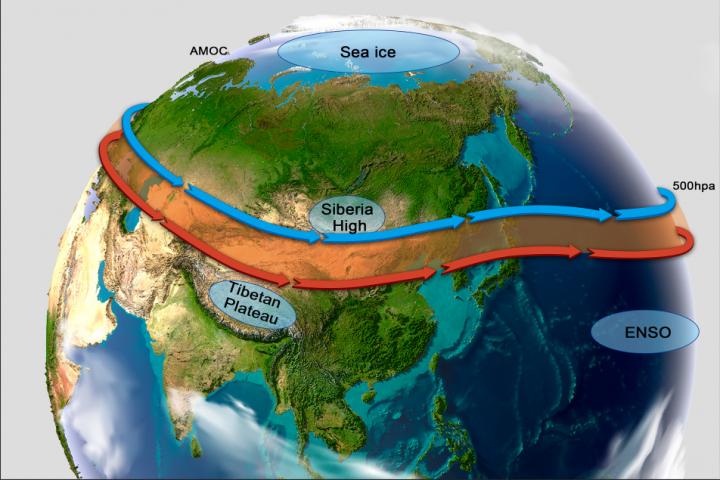
“In addition, the regional East Asian winter monsoon and westerly circulation, which are influenced by various factors, including variations of Arctic sea ice and the Siberian High, the topography of the Tibetan Plateau, and El NiƱo – Southern Oscillation, may also have significant influence on the formation of severe haze in northern China,” AN said.

Severe haze pollution in northern China provides a unique scientific platform for gaining insights into many aspects of the relevant atmospheric chemistry and physics.

The scientists call for additional research, including on the mechanisms leading to secondary aerosol formation and the chemical/physical transformation of primary and secondary aerosols during haze development as well as the interactions and feedback cycles between haze and meteorological/climatic conditions.

###

This work was supported by the National Research Program for Key Issues in Air Pollution Control, the National Natural Science Foundation of China, the State Key Laboratory of Loess and Quaternary Geology, and the Robert A. Welch Foundation.

Media Contact
AN Zhisheng
[email protected]

Related Journal Article

http://dx.doi.org/10.1073/pnas.1900125116

Tags: Atmospheric ScienceClimate SciencePollution/Remediation
Share13Tweet8Share2ShareShareShare2

Related Posts

Florida Cane Toad: Complex Spread and Selective Evolution

Florida Cane Toad: Complex Spread and Selective Evolution

February 7, 2026
New Study Uncovers Mechanism Behind Burn Pit Particulate Matter–Induced Lung Inflammation

New Study Uncovers Mechanism Behind Burn Pit Particulate Matter–Induced Lung Inflammation

February 6, 2026

DeepBlastoid: Advancing Automated and Efficient Evaluation of Human Blastoids with Deep Learning

February 6, 2026

Navigating the Gut: The Role of Formic Acid in the Microbiome

February 6, 2026
Please login to join discussion

POPULAR NEWS

  • Robotic Ureteral Reconstruction: A Novel Approach

    Robotic Ureteral Reconstruction: A Novel Approach

    82 shares
    Share 33 Tweet 21
  • Digital Privacy: Health Data Control in Incarceration

    63 shares
    Share 25 Tweet 16
  • Study Reveals Lipid Accumulation in ME/CFS Cells

    57 shares
    Share 23 Tweet 14
  • Breakthrough in RNA Research Accelerates Medical Innovations Timeline

    53 shares
    Share 21 Tweet 13

About

We bring you the latest biotechnology news from best research centers and universities around the world. Check our website.

Follow us

Recent News

Inflammasome Protein ASC Drives Pancreatic Cancer Metabolism

Phage-Antibiotic Combo Beats Resistant Peritoneal Infection

Boosting Remote Healthcare: Stepped-Wedge Trial Insights

Subscribe to Blog via Email

Enter your email address to subscribe to this blog and receive notifications of new posts by email.

Join 73 other subscribers
  • Contact Us

Bioengineer.org Ā© Copyright 2023 All Rights Reserved.

Welcome Back!

Login to your account below

Forgotten Password?

Retrieve your password

Please enter your username or email address to reset your password.

Log In
No Result
View All Result
  • Homepages
    • Home Page 1
    • Home Page 2
  • News
  • National
  • Business
  • Health
  • Lifestyle
  • Science

Bioengineer.org Ā© Copyright 2023 All Rights Reserved.